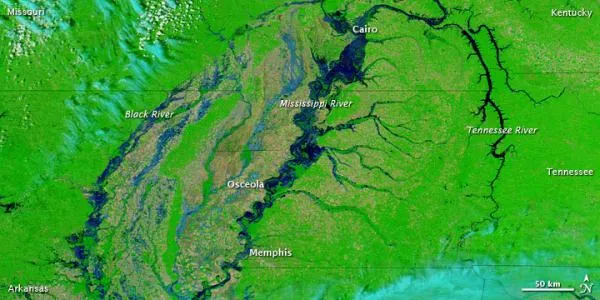
The deadly tornadoes and rainstorms that tore across the Midwest last month combined with melting snow have left the Mississippi River bursting at the seams. Amidst the evacuations and extensive flooding along the river, experts know records are being broken, but they say they won't know the full extent of the flood — such as how much water has actually breached the riverbanks — until things quiet down.
"We get rain across the [Mississippi River] basin all the time, and if it is spread out in time it will not cause a problem," said Tom Salem, science and operations officer at the National Weather Service in Memphis, Tenn. "It is when it comes at the same time and multiple rivers add to the total of the entire system that we have problems," Salem told Life's Little Mysteries.
Some areas along the Mississippi River have seen 10 to 20 inches (25.4 to 50.8 centimeters) of rain during April, said Royce Fontenot, a hydrologist at the National Weather Service.
While the river levels are currently reaching record levels, the extent of the damage won't be known until after the flooding stops, which could be well into June, Fontenot said. [Before and After: Images of the Mississippi River Floods]
"We don't know how much water has overflowed onto land from the Mississippi River," Fontenot told Life's Little Mysteries. "This is not something we can get in real time; we'll need to survey the area after the fact."
What we know
Although the size of the flooding is unknown, there are several indications of its severity. The Mississippi River is currently flowing at 2 million cubic feet per second (609,600 cubic meters per second) in Memphis, which is comparable to a football field of water at a height of 44 ft (13.4 m) per second. Another way to look at it: If you were to stand at one point in the river, it would be as though 2 million basketballs of water were moving past you every second. [What Is to Blame for Mississippi River Floods?]
Sign up for the Live Science daily newsletter now
Get the world’s most fascinating discoveries delivered straight to your inbox.
Before discharging into the Gulf of Mexico, the Mississippi River joins with the Atchafalaya River in south central Louisiana. On an average day in May, these two rivers collectively flow into the Gulf at a rate of 750,000 cubic feet per second (228,600 cubic meters per second).
Right now, flow rates of the Mississippi River in New Orleans (before joining the Atchafalaya River) are about 1.1 million cubic feet per second (335,280 cubic meters per second).
Water levels are also indicative of the severity of the flooding. For example, in Memphis, the average height of the river is 25.9 ft (7.90 m), according to data from the National Oceanic and Atmospheric Administration (NOAA) for the month of May. Today, this height has increased to 47.69 ft (14.23 m) and is expected to rise to about 48 feet (14.6 m).
About 2,350 miles (3,782 kilometers) long, the Mississippi river flows south from Lake Itasca in Minnesota and empties into the Gulf of Mexico. The river passes along the eastern border of Iowa, Missouri, Arkansas and Louisiana, and the western borders of Wisconsin, Illinois, Kentucky, Tennessee and Mississippi.
The entire Mississippi River basin drains 41 percent of the United States — parts of 30 states and also a small part of Canada. About 20 rivers feed into the Mississippi, including the Ohio, Illinois and Missouri rivers.
The Mississippi River is the fifth largest U.S. river by volume and on average holds 1.5 million to 5.2 million gallons of water. The water level of the river varies by location.
Follow Life's Little Mysteries on Twitter @LLMysteries.
Michelle writes about technology and chemistry for Live Science. She has a Bachelor of Science in Chemistry from the Salisbury University, a Bachelor of Chemical Engineering from the University of Delaware and a degree in Science Journalism from New York University. She is an active Muay Thai kickboxer at Five Points Academy and loves exploring NYC with friends.