













Geologists Watch as African Continent is Torn Apart

Seismic activity is tearing Africa apart and scientists are geared up to watch the ripping landscape in an unprecedented set of observations.
It's liable to be a long, slow investigation.
The African and Arabian plates meet in the remote Afar desert of Northern Ethiopia and have been going through a rifting process—at a speed of less than 1 inch per year—for the past 30 million years. This rifting formed the 186-mile Afar depression [image] and the Red Sea.
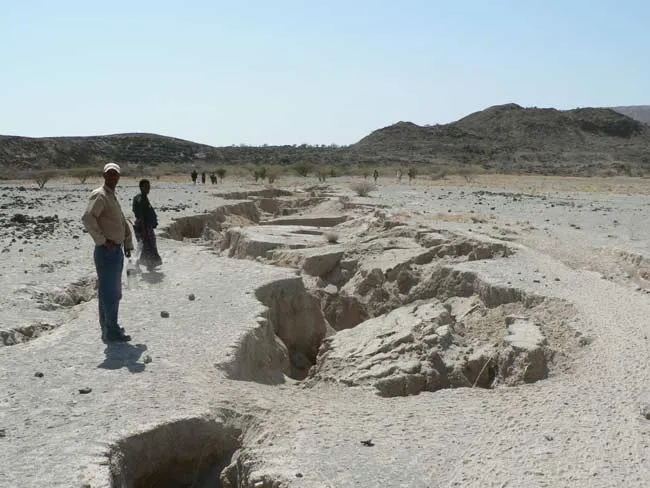
Occasionally, the buildup of pressure can lead to bursts of cataclysmic activity. In September 2005, a chain of earthquakes caused hundreds of deep fractures, as reported that year [image]. In some spots the ground shifted some 26 feet [image], and magma, enough to fill a football stadium more than 2000 times, was injected into a crack between the two plates.
More recent analysis showed that the Red Sea is parting as part of the phenomenon.
"Much of the activity between the continental shelves takes place deep underwater at the mid-ocean ridges,” said Tim Wright, a geophysicist with the University of Leeds, UK. “Ethiopia is the only place on the planet where we can see a continent splitting apart on dry land [image]."
Wright and his team plan to monitor the movement of these plates—one of the fundamental processes taking place on Earth—and determine the properties of rock and magma below the surface. This data will allow them to create a computer model that will simulate how magma moves through the Earth’s crust to make and break continents.
Get the world’s most fascinating discoveries delivered straight to your inbox.
“Afar is the only place on the planet where we can witness the final stages of continental breakup and the beginning of seafloor spreading,” Wright said in an email interview this week. “With this project, we'll be able to understand how this happens for the first time. It will be first time anyone has collected the integrated, multi-disciplinary observations needed to understand continental breakup.”
As the plates move away from each other, molten rock is seeping into the gaps. This filler cools down to form new land. A million years from now, the Red Sea could come pouring into the crevice.
"It's very exciting because we're witnessing the birth of a new ocean," Wright said. “The new ocean will connect to the Red Sea and the Gulf of Aden.” The Gulf of Aden is an arm of the Arabian Sea situated between Yemen on the Arabian Peninsula and Somalia in eastern Africa.
Should the processes occurring today continue, the map of Africa will be forever changed, the researchers say.
"In geological terms, a million years is the blink of an eye. We don't precisely know what is going to happen, but we believe that it may turn parts of Northern Ethiopia and Eritrea into an island, before a much larger land mass—the horn of Africa—breaks off from the continent."
- Top 10 Ways to Destroy Earth
- Natural Disasters: Top 10 U.S. Threats
- Images: Deadly Earthquakes
- The Red Sea Parts Again
- All About Earthquakes
