













Dante's New Look
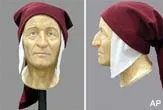
ROME (AP)—Dante Alighieri, traditionally portrayed as a stern figure with a large hooked nose, is now showing a softer side, thanks to a reconstruction of his face by Italian scientists.
In most artistic Renaissance renditions, the most distinguishing features of the author of "The Divine Comedy'' were a prominent nose and lower lip and a generally severe expression.
The new face—based on drawings, measures of Dante's skull by a professor in the 1920s, a plaster model and computer technology—shows softer traits: large eyes, a rounded jaw and a gentler expression, although the nose remains crooked.
"He looks like a man who lived in the world, who had his share of bad luck and sorrows,'' said Francesco Mallegni, an anthropologist and professor at Pisa University who reconstructed the Florentine poet's head with a team of experts.
| The New Look |
| The reconstructed face of Dante. Credit: AP via Pisa U. |
"His face looks worn-out, he is perplexed, less pointy,'' Mallegni said in a telephone interview Friday. "He's human.''
Dante lived a tough life, marked by exile, the death of his beloved Beatrice, who became his spiritual inspiration, and the intricacies of medieval Florentine politics.
The more severe renditions probably reflected, to some extent, what the artists believed Dante should look like, Mallegni said.
Get the world’s most fascinating discoveries delivered straight to your inbox.
"We know that Dante was someone who would call a spade a spade,'' he said. Artists "thought it'd be fair to portray him like that.''
Among the most commonly recognized portraits of the poet is a one by Italian Renaissance painter Sandro Botticelli. Dante, portrayed in profile more than 170 years after his death, looks gaunt and stern.
"He was a man with his own anxieties and fits of anger, but even the death masks made after he died, when the muscles are relaxed, show him as frowning,'' he said.
A councilman of Florence, Dante was opposed to the political power of Pope Boniface VIII and was dispossessed and banished in 1302.
He was buried in Ravenna, northern Italy, where he died in 1321. Mallegni said his team was denied access to Dante's bones, which were removed from the original tomb in Ravenna in the 17th century and hidden by local monks for centuries to thwart Florentine authorities who wanted to return them to the poet's hometown.
The multidisciplinary project to reconstruct Dante's face lasted about two months, using a plaster model of the skull and 3D computer technology and other techniques to simulate muscles and skin. Mallegni also reconstructed the face of Italian painter Giotto in recent years.
"I find it interesting. From the bones, you realize what kind of people they were and what they did in life,'' he said.