














What's the Biggest Volcanic Eruption Ever?
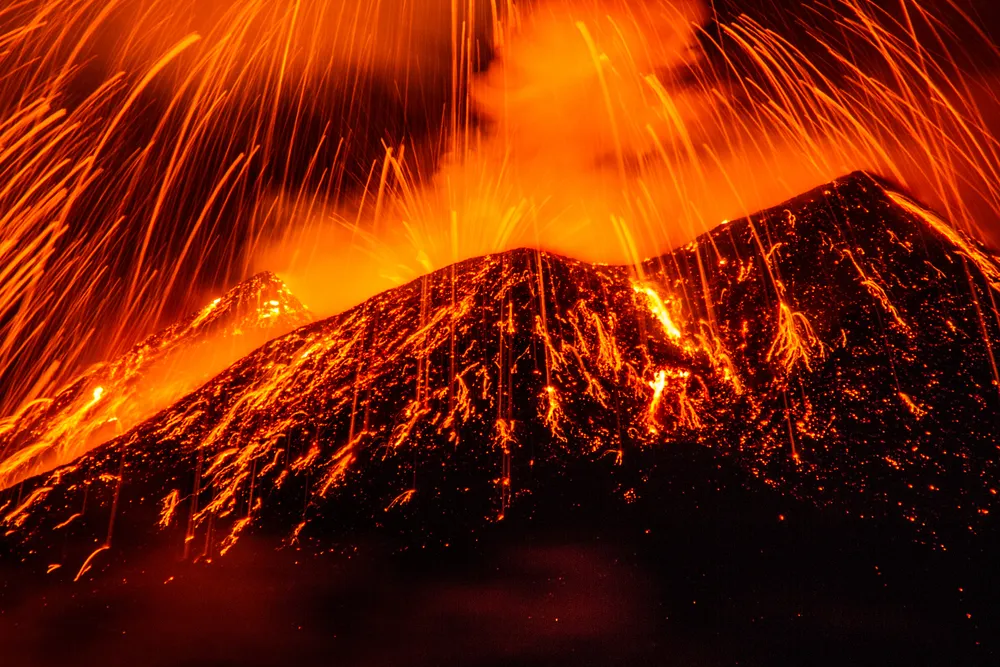
Volcanoes have been erupting for billions of years, but humans have been around to record them with varying degrees of accuracy for only tens of thousands of years, and with precise, scientific rigor only since the early 20th century. Still, even though many of the planet's most catastrophic eruptions occurred long ago, modern-day scientists have developed means for rating them.
Scientists with the U.S. Geological Survey use the Volcano Explosivity Index (VEI) to measure the magnitude of volcanic blasts. It's a logarithmic scale that runs from 1 to 8. A magnitude 1 eruption spews less than 350,000 cubic feet (10,000 cubic meters) of volcanic tephra, which consists of ash and rocks; a magnitude 8 eruption puts out more than 240 cubic miles (1,000 cubic kilometers) of the stuff. To help grasp that scale, the recent eruptions at Mount Merapi and Eyjafjallajokull in Iceland were both 4s. The 1980 eruption of Mount St. Helens was a magnitude 5.
By studying rock samples, geographical features, and layers of ash in ice core samples, scientists can reconstruct some — though certainly not all — of the most epic volcanic eruptions, including ones hundreds of millions of years ago.
The most energetic of those occurred in the San Juan Mountains in southwestern Colorado around 27 million years ago. That explosion formed what is known as the La Garita Caldera and spewed more than 3,107 cubic miles (5,000 cubic km) of lava — enough to put down a 40-foot layer on all of California. La Garita Caldera's ignimbrite, or volcanic deposit, is known as the Fish Canyon tuff and consists of dacite, an igneous rock formed by lava.
According to the USGS, it is the largest known eruption since the Ordovician era, between 504 and 438 million years ago. It was so large, in fact, that in a 2004 report in the Bulletin of Volcanology, scientists recommended adding a ninth level to the VEI scale, and declared the La Garita eruption a magnitude 9.2. Although this ranking is of some debate – the scale of any ancient volcanic activity is partly based on estimates, after all – La Garita is the only known magnitude 9 eruption.
Currently, the massive, circum-Pacific “Ring of Fire” seismic belt is home to more than half of the world's active volcanoes above sea level. This is because the Ring of Fire is a belt of convergent plate margins, or subduction zones, that surround the Pacific plate. Areas of tectonic plate subduction, where one plate is forced under another, produce powerful earthquakes and volcanic activity.
Original article on Live Science.
Get the world’s most fascinating discoveries delivered straight to your inbox.