Get the world’s most fascinating discoveries delivered straight to your inbox.
You are now subscribed
Your newsletter sign-up was successful
Want to add more newsletters?
Delivered Daily
Daily Newsletter
Sign up for the latest discoveries, groundbreaking research and fascinating breakthroughs that impact you and the wider world direct to your inbox.
Once a week
Life's Little Mysteries
Feed your curiosity with an exclusive mystery every week, solved with science and delivered direct to your inbox before it's seen anywhere else.
Once a week
How It Works
Sign up to our free science & technology newsletter for your weekly fix of fascinating articles, quick quizzes, amazing images, and more
Delivered daily
Space.com Newsletter
Breaking space news, the latest updates on rocket launches, skywatching events and more!
Once a month
Watch This Space
Sign up to our monthly entertainment newsletter to keep up with all our coverage of the latest sci-fi and space movies, tv shows, games and books.
Once a week
Night Sky This Week
Discover this week's must-see night sky events, moon phases, and stunning astrophotos. Sign up for our skywatching newsletter and explore the universe with us!
Join the club
Get full access to premium articles, exclusive features and a growing list of member rewards.
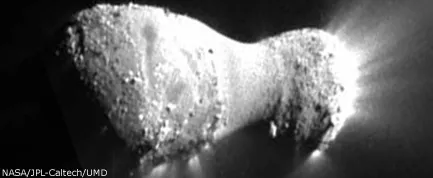
A NASA spacecraft has beamed back the first close-up photos from its rendezvous with a comet — and the images show an ice ball that looks like a giant chicken drumstick, or perhaps a peanut or bowling pin.
Deep Impact zoomed to within 435 miles (700 kilometers) of Comet Hartley 2 at 10:01 EDT (1401 GMT) this morning (Nov. 4), and the probe beamed down its first close-up shots an hour later.
Cheers erupted in the Mission Control room of NASA's Jet Propulsion Laboratory as five high-resolution images flashed up on a big screen. In the photos, the comet, which is about 1 mile (1.6 km) wide, looks like a big chicken drumstick, or a peanut.
The five photos bracket the time of closest approach. Deep Impact took thousands of images during the flyby, and these pictures will continue to flood researchers' computers in the hours and days to come, researchers have said.
This article was provided by SPACE.com, a sister site of LiveScience.com.
Get the world’s most fascinating discoveries delivered straight to your inbox.