Swarms of Small Creatures Stir the Sea

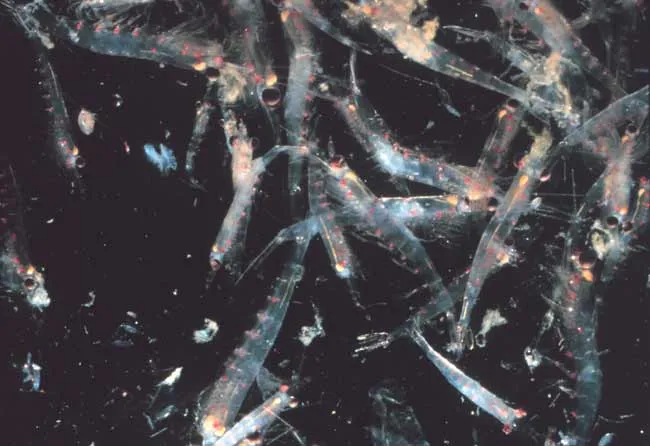
Swarms of tiny shrimp-like crustaceans known as krill could have a big impact on ocean life, by churning the waters and bringing nutrients from the depths up to the surface.
The discovery also suggest that sea life could contribute to mixing gases in the ocean. This might influence how gases such as carbon dioxide, linked to global warming, get trapped underwater.
The windswept surface layers of the open seas can teem with life, but scientists could not completely explain why, since predictions suggested not enough nutrients rise up from the abyss below to account for such abundance.
The researchers, from the University of Victoria in Canada, investigated swarms of krill in Saanich Inlet, a fjord on Vancouver Island. The crustaceans migrate to the surface daily as night approaches and retreat downward as day breaks.
Over the course of three dusks and two dawns, using data gathered in boat expeditions, the researchers discovered that in the roughly 10-minute bursts in which the krill migrated, they increased turbulence by up to thousands of times.
"I was initially skeptical that biologically linked turbulence could be significant. I was surprised at just how large it could be," researcher Eric Kunze, an ocean physicist, told LiveScience.
These findings suggest krill and other sea life could prove critical in bringing nourishment up from the ocean depths, which are loaded with nutrients released by surface organisms that died and sank.
Get the world’s most fascinating discoveries delivered straight to your inbox.
"The question now is how frequently and how significant any biologically linked turbulence really is," Kunze said. The most likely animals to generate large amounts of ocean turbulence are roughly inch-sized creatures that travel together in large schools or swarms, he speculated, such as anchovies, sardines, herring or squid.