













How Humans Shape Evolution of Fish Populations
This ScienceLives article was provided to LiveScience in partnership with the National Science Foundation.
Exploring the process of adaptive evolution in nature, and the relationship between evolution and the environment, has taken David Reznick to the tropics of Trinidad where he studies populations of guppies. After earning his Ph.D. from the University of Pennsylvania and pursuing various research paths (some more successful than others), fatherhood encouraged Reznick to seek more secure employment as an assistant professor at the University of California at Riverside. He began his guppy research with his dissertation and then used the results as preliminary data for his first NSF grant. He has continued to work on guppies ever since, because they have proven to be so well-suited for studies of adaptation – and also because they have been his continuing ticket to the tropics. Lately, he has also been studying the evolution of mammal-like placentas in the Poeciliidae, the family of live-bearing fish that includes guppies. Reznick was awarded the E. O. Wilson Naturalist Award from the American Society of Naturalists in recognition of that work. One of his academic hobbies has been to understand the development of the major concepts and research programs in evolution. An outgrowth of this pastime is his recently published book entitled "The Origin Then and Now: An Interpretive Guide to the Origin of Species" (Princeton, 2010). Read more about his work in a recent press release and see videos from his work in the field, and below read his responses to the ScienceLives 10 Questions.
Name: David Reznick Institution: University of California at Riverside Field of Study: Biology
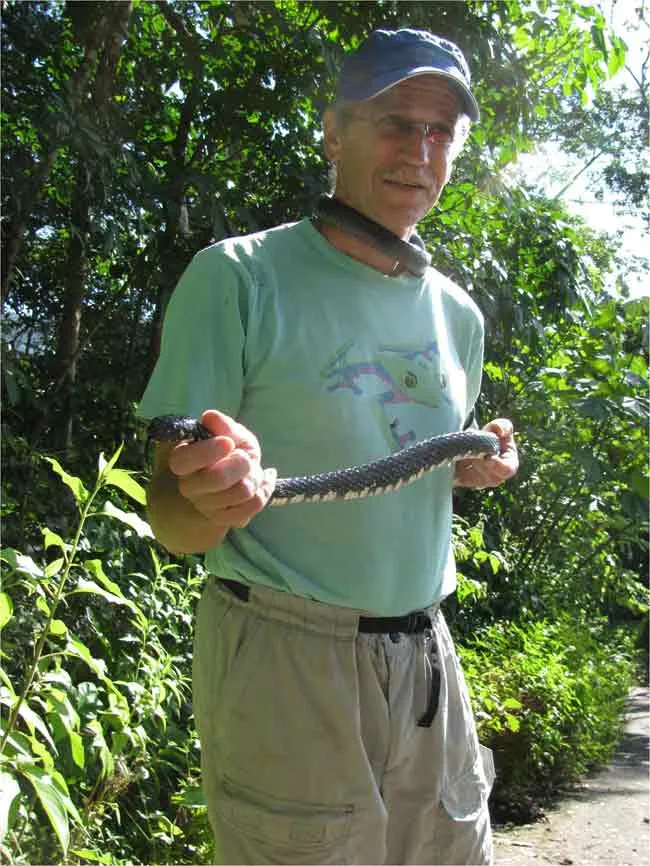
What inspired you to choose this field of study? I have been fascinated by animals at least since I was old enough to walk, which is the earliest that I could have shown interest. I collected tide pool animals from the Long Island Sound when I was as young as 3. I can remember seeing and catching my first grasshopper while waiting for the carpool to kindergarten. I was always told to beware of snakes because they will bite you. I saw my first snake in the wild when I was 7. I chased it and picked it up. It bit me. My career of research is very much like an extension of my earliest hobbies.
What is the best piece of advice you ever received? Don't be in too much of a hurry to finish college. I recall telling my uncle Bob Marks about my plan to go to veterinary school after my junior year in college. He replied that the year that I could save may seem like a lot at my age, but by the time I was his age it would be trivial. He advised that college may be the last time that I could do whatever I wanted and have a chance to explore alternative ways of spending my future, so take that fourth year. I withdrew my vet school applications and pursued my extended interests in natural history, first as a summer field assistant to Jay Cole, then via a research honors project with Owen Sexton. I reapplied to veterinary school and got in, but I also applied to graduate school and went there instead. I never regretted turning my back on becoming a veterinarian.
What was your first scientific experiment as a child? When I was 14, I crossed different colored Siamese fighting fish to study Mendelian inheritance. Blue was dominant to "Cambodia," or pink.
What is your favorite thing about being a researcher? Chris Kristopherson once said "I may not be Bobbie Dylan, but I don't have to get up for work in the morning if I don't want to either." I always want to get up for work in the morning, but being a scientist gives me similar freedom to decide how I want to spend my time.
Get the world’s most fascinating discoveries delivered straight to your inbox.
What is the most important characteristic a researcher must demonstrate in order to be an effective researcher? For my kind of work, it is to be a good observer of nature, to wonder why things are the way they are, then to be able to convert ideas about how the world works into experiments that test those ideas.
What are the societal benefits of your research? Most generally, my work shows how quickly organisms can evolve in response to changes in their environment, but also how some changes exceed an organism's ability to adapt, causing local extinction. Guppies have served as a model for understanding how humans are shaping the evolution of commercially exploited fish populations. My work has applications in conservation biology, since human activities have often caused the local extinction of predators, but now we are trying to reintroduce them. I have shown how prey evolve in response to such changes. I have found predictable genetic variation among populations of guppies that includes the rate of development, rate of aging and longevity, behavior, morphology and performance. Anyone who chooses could use guppies to study the genetic basis of these traits.
Who has had the most influence on your thinking as a researcher? All of my academic advisers have influenced me in different ways. They include Charles J. Cole (American Museum of Natural History), Owen Sexton (Washington University), Robert Ricklefs (then U. Pennsylvania, now U. of Missouri, St. Louis) and John Endler (then Princeton U., now Deacon University, Australia).
What about your field or being a researcher do you think would surprise people the most? I can perform experimental studies of evolution on natural populations, see evolution happen in short time frames and quantify the strength of selection and rate of evolution in real time. I suspect that most people think of evolution as being too slow to be amenable to direct study.
If you could only rescue one thing from your burning office or lab, what would it be? It may sound unromantic, but from my office it would be my computer. That is where all my personal effects that I care most about are concentrated – photos, correspondences, unfinished papers and data. I have off-site backup now, so all this is safely stored elsewhere, but I think that I have not yet internalized that fact. From my lab, I would save my bicycle.
What music do you play most often in your lab or car? I listen to a diverse range of choral and instrumental music that dates from the 15th through the 19th centuries, with more and more emphasis on earlier music and smaller ensembles.
Editor's Note: This research was supported by the National Science Foundation (NSF), the federal agency charged with funding basic research and education across all fields of science and engineering. Any opinions, findings, and conclusions or recommendations expressed in this material are those of the author and do not necessarily reflect the views of the National Science Foundation. See the ScienceLives archive.