













Creatures Build Thicker Shells as Ocean Chemistry Changes

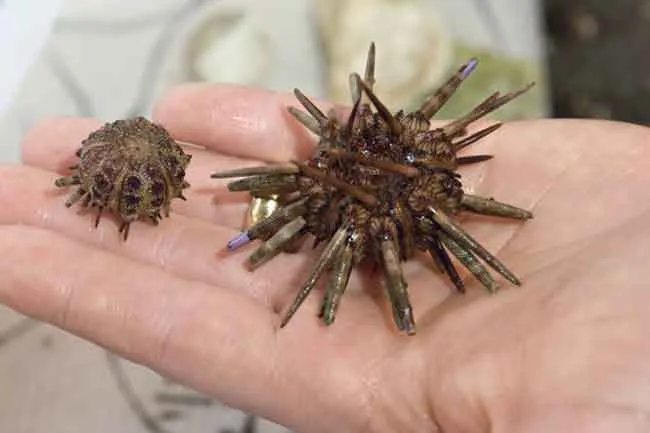
Scientists have worried in recent years that rising levels of carbon dioxide in the atmosphere, which is increasing acidification of the ocean, will cause shells of sea creatures to be thin and brittle, potentially threatening the entire ocean ecosystem.
So a new finding has surprised the heck out of them.
Some shell builders, such as crabs, shrimp and lobsters, unexpectedly build more shell when exposed to ocean acidification.
Carbon dioxide (CO2) — the notorious byproduct of fossil fuel burning — dissolves in the ocean. That makes the ocean more acidic. It also reduces the number of so-called carbonate ions in seawater, and these ions are among the primary materials that sea creatures use to build their calcium carbonate shells and skeletons.
Previous studies have found the changing chemistry is thinning the shells of some microscopic sea creature that are key to the food chain. Other larger creatures are known to suffer this problem, too.
Yet seven of 18 creatures in the new study built more shell when exposed to increased acidification. Could be that the total amount of dissolved inorganic carbon available to them is actually increased when the ocean becomes more acidic, even though the concentration of carbonate ions is decreased, the researchers figure.
"Most likely the organisms that responded positively were somehow able to manipulate ... dissolved inorganic carbon in the fluid from which they precipitated their skeleton in a way that was beneficial to them," said Justin B. Ries, formerly of the Woods Hole Oceanographic Institution (WHOI) and now an assistant professor in marine sciences at the University of North Carolina. "They were somehow able to manipulate CO2 ... to build their skeletons."
Get the world’s most fascinating discoveries delivered straight to your inbox.
The results are detailed in the Dec. 1 issue of the journal Geology.
Organisms displaying such improvement also included calcifying red and green algae, limpets and temperate urchins. Mussels showed no effect.
"We were surprised that some organisms didn't behave in the way we expected under elevated CO2," said Anne L. Cohen, a research specialist at WHOI and one of the study's co-authors. "What was really interesting was that some of the creatures, the coral, the hard clam and the lobster, for example, didn't seem to care about CO2 until it was higher than about 1,000 parts per million [ppm]." Current atmospheric CO2 levels are about 380 ppm, she said.
The researchers say more study is needed, however, to determine overall effects of increased acidification. For one thing, increased ocean acidification has been fingered as a culprit in killing corals.
"I wouldn't make any predictions based on these results," Cohen said. "What these results indicate to us is that the organism response to elevated CO2 levels is complex and we now need to go back and study each organism in detail."
- Gallery: Small Sea Monsters
- Dangers in the Deep: 10 Scariest Sea Creatures
- 101 Amazing Earth Facts
