













Secret to Sea Urchin's Sharp Teeth Found

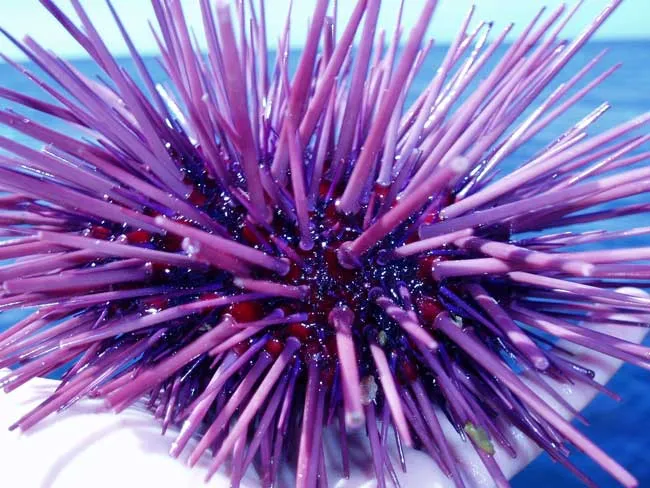
The spines of sea urchins make them look like pin cushions, but these marine invertebrates also have very sharp teeth that can dig into rock. Now researchers have discovered what makes the teeth so strong — a smart structural design. Sea urchins use their five tough teeth to hollow out holes for themselves in limestone rock. Scientists were puzzled as to how these sea creatures cut into the rock, since both their teeth and the rock are made of calcite, a relatively soft mineral made of calcium carbonate. Researchers at the Weizmann Institute of Science have been investigating this mystery for more than a decade, and recently made some new findings. Sea urchin teeth also contain crystals of magnesium calcite, which are harder than pure calcite. The concentration of magnesium in the crystals increases towards the tooth's tip, which is used for grinding, the scientists found. Also, the crystalline elements that make up the tooth are aligned, forming a block. The tooth is made up of two of these blocks. At the tooth's tip, these blocks are interwoven. These "interdigitated" blocks may form a corrugated ridge, like a carpenter's file. This ridge would be able to sharpen itself — when the tooth is ground down, the crystalline layers break off in such a way that the tooth stays sharp. Several high-resolution imaging techniques were used to view the tooth's structure at different scales. Learning more about how sea urchin teeth work may help inventors create better grinding and cutting tools, the scientist said. The work was published April 14 in the journal Proceedings of the National Academy of Sciences and was supported by the Clore Center for Biological Physics, the Kekst Family Center for Medical Genetics and others.
- All About the Sea
- Image Gallery: Rich Live Under the Sea
- Imagining Teeth
Get the world’s most fascinating discoveries delivered straight to your inbox.
