


Intact Spine of Hominin Toddler Revealed for 1st Time

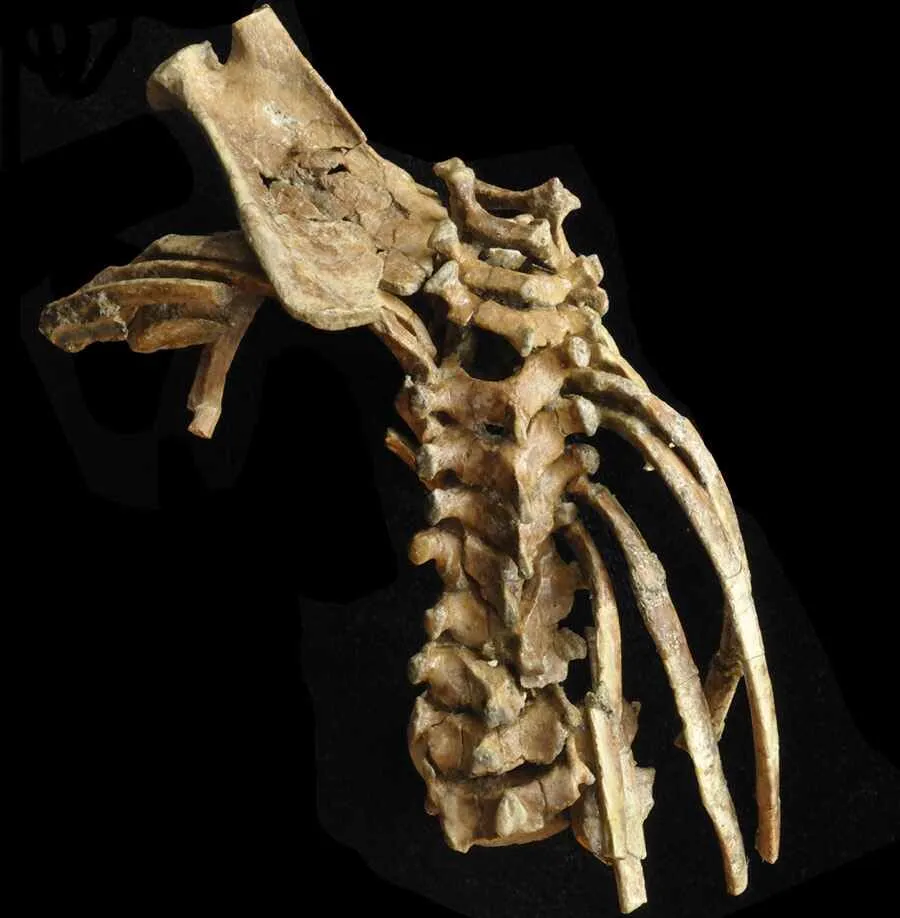
The lonely fossil of a 2.5-year-old early human ancestor has revealed for the first time that the spines of ancient hominins were a lot like ours — and a lot not.
New research, published today (May 22) in the journal Proceedings of the National Academy of Sciences, reveals that Australopithecus afarensis, a human ancestor that lived 3 million years ago, had the same number of lumbar and thoracic vertebrae as humans. But the young hominin, nicknamed "Selam," for the Amharic word for "peace," showed a markedly different transition between her upper and lower back, one that may have given her a boost for bipedal walking.
"We have never known before whether our earliest ancestors have the same pattern and the same numbers of vertebrae," study author Carol Ward, a biological anthropologist at the University of Missouri, told Live Science. [See Images of Selam, Our Toddler Human Ancestor]

The transition to walking

Finding out is important, Ward said, because the structure of the back is key to walking upright on two feet. Modern apes, chimpanzees and gorillas have 13 pairs of ribs compared with modern humans' 12. Modern humans also have lower backs that are longer than those of other great apes.
"Apes are really stiff," Ward said. That's fine if you want a strong platform for swinging around trees using your upper limbs, but humanity's more flexible lower backs are more suitable for upright walking.
Early hominins, or human ancestors, more or less personified the transition from scuttling about on all-fours to bipedalism. But their spines have remained a mystery. Vertebrae and ribs are small, delicate bones that don't preserve well in the fossil record, Ward said. A few partial skeletons ofAustralopithecus aferensis, Australopithecus africanus, Australopithecus sediba and Homo erectus have provided some hints as to what hominin backbones looked like, but were so fragmentary that researchers haven't been sure how many vertebrae made up their upper back, for example. "Lucy," the famous A. aferensis discovered in Ethiopia in 1974, had only nine vertebrae in her fossil, one of which was later found to belong to a baboon.
Selam has changed all that. The skeleton of this small female A. aferensis was discovered in Dikika, Ethiopia, in 2000. Since then, researchers have been painstakingly chipping her bones out of hard sandstone, trying not to damage them. They've already learned that this 3.3-million-year-old human ancestor was bipedal but also climbed trees.
Get the world’s most fascinating discoveries delivered straight to your inbox.
"This is an absolutely beautiful specimen that was prepped very carefully and meticulously," said Scott Williams, an anthropologist at New York University who wasn't involved in the original study but who has been shown the fossil in person by its discoverer, Ethiopian paleoanthropologist Zeresenay Alemseged. "It's very fragile, and it's very complete."
Selam's spine
Now, the research team has finally revealed Selam's backbone for the first time. Her vertebrae are each only about half an inch (1.2 centimeters) across, Ward said, so tiny that they couldn't be fully removed from the surrounding rock. Once the preparation team had chipped away enough sandstone, they took the fossil to the European Synchrotron Radiation Facility in France, which can take X-rays on the scale of a thousandth of a millimeter in resolution.
The researchers then transformed the X-rays into 3D digital models, a process that took another year and a half, Ward said.
What those images revealed was a spine with 12 ribs and 12 thoracic vertebrae, just like the spine of modern humans. (The spine is divided into three sections: the cervical spine, or neck; the thoracic spine, or upper back; and the lumbar spine, or lower back.)
But in another very important way, Selam's spine was not very human-like. The difference is in the thoracolumbar transition, or the anatomical changes in the vertebrae from the upper to lower back. These changes occur at the facet joints, where ligaments that allow for flexion and rotation attach the bones together. In modern humans, these facet joints subtly change shape and orientation at the 12th thoracic vertebrae, the lowest one that links up with a rib. They go from a flat shape and a front-to-back orientation to a more curved shape with a more side-to-side orientation.
In A. afarensis, Selam's skeleton reveals, this anatomical change happened at the 11th thoracic vertebrae, the one above the last rib-bearing bone. This is the exact same pattern seen in the few other early hominin partial backbones that have been preserved, including A. africanus, A. sediba and Homo erectus. [Australopithecus Sediba Photos: Anatomy of Humans' Closest Relative]
"We had maybe three specimens, now we have at least four that show that exact same unusual pattern," Ward said. "You almost never see it in humans, you don't see it in apes."
There is some variation in the transition in human spines, such that about a quarter of modern Homo sapiens also have the thoracolumbar transition at the 11th thoracic vertebra rather than the 12th. But, Ward said, if early hominin spines showed this same distribution, the chance of coincidentally finding the same variation in the thoracolumbar transition in all early hominin fossils so far would be less than 1 in 10,000. Thus, it's far more likely that early hominins really did have different spinal transitions than today's humans.
Structure and function
The higher transition may have enabled early hominins like Selam more mobility in an era when the pelvis hadn't evolved as much flexibility in its connection with the spine as in modern humans, Ward said.
That's a hard theory to prove, though. No one has found any evidence that modern humans with the thoracolumbar transition at the 11th thoracic vertebra are functionally any different than those with the transition at the 12th, Williams said. But Australopiths also had differences in their lower back shape, as far as the scant fossil record shows, so the interaction of the thoracolumbar transition and the rest of the spine might have been different than it is in today's humans.
"We will need more fossils to test it," Williams said.
Selam's spine is the only one that preserves all the neck- and rib-bearing vertebrae in the fossil record until the Neanderthals, 60,000 years ago. Neanderthals, as it happens, have the same thoracolumbar transition as modern Homo sapiens. Next, Ward said, the researchers plan to try to extrapolate more about Selam's body shape from the shape of her spinal column.
"How many vertebrae they had is the starting point for a lot of our other questions, speculations, hypotheses and models," she said.
Original article on Live Science.

Stephanie Pappas is a contributing writer for Live Science, covering topics ranging from geoscience to archaeology to the human brain and behavior. She was previously a senior writer for Live Science but is now a freelancer based in Denver, Colorado, and regularly contributes to Scientific American and The Monitor, the monthly magazine of the American Psychological Association. Stephanie received a bachelor's degree in psychology from the University of South Carolina and a graduate certificate in science communication from the University of California, Santa Cruz.