













British Skeleton Suggests Ancient Murder Mystery

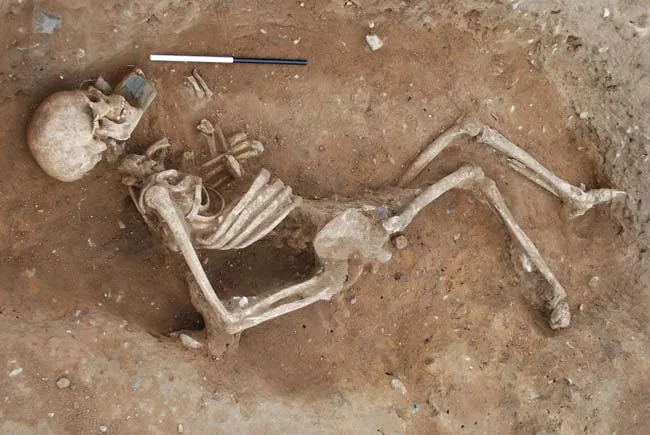
A skeleton found at an ancient Roman site in Britain has researchers wondering if they've stumbled on a murder mystery.
Excavations at the buried town of Venta Icenorum at Caistor St. Edmund in Norfolk, England, found what, for now, archaeologists are terming a "highly unusual" setup.
"This is an abnormal burial," said archaeologist Will Bowden of the University of Nottingham. "The body, which is probably male, was placed in a shallow pit on its side, as opposed to being laid out properly. This is not the care Romans normally accorded to their dead. It could be that the person was murdered or executed, although this is still a matter of speculation."
The skeleton has been removed for further investigation.
"It is an exciting find, and once we have cleaned the bones they will undergo a full examination and a range of scientific tests to try and find out how this individual died," Bowden said in a statement today.
The Caistor excavations — the digging began in 1929 — have also revealed evidence of Iron Age as well as early prehistoric occupation around 10,000 B.C.
"These excavations have added an enormous amount to what we knew before," Bowden said. "There are flints so sharp you could still shave with them — they are so fresh they have barely moved in all that time."
Get the world’s most fascinating discoveries delivered straight to your inbox.
Recent surveys have produced a street plan and shown the town's water supply system and the series of public buildings, including baths, temples and forum, known from earlier excavations.
Caistor lies in the territory of the Iceni, the tribe of Boudica who famously rebelled against Roman rule in A.D. 60/61. The survey revealed numerous circular features that apparently predate the Roman town, suggesting Caistor was the site of a large settlement before the Roman town was built.
