It's quick and easy to access Live Science Plus, simply enter your email below. We'll send you a confirmation and sign you up for our daily newsletter, keeping you up to date with the latest science news.
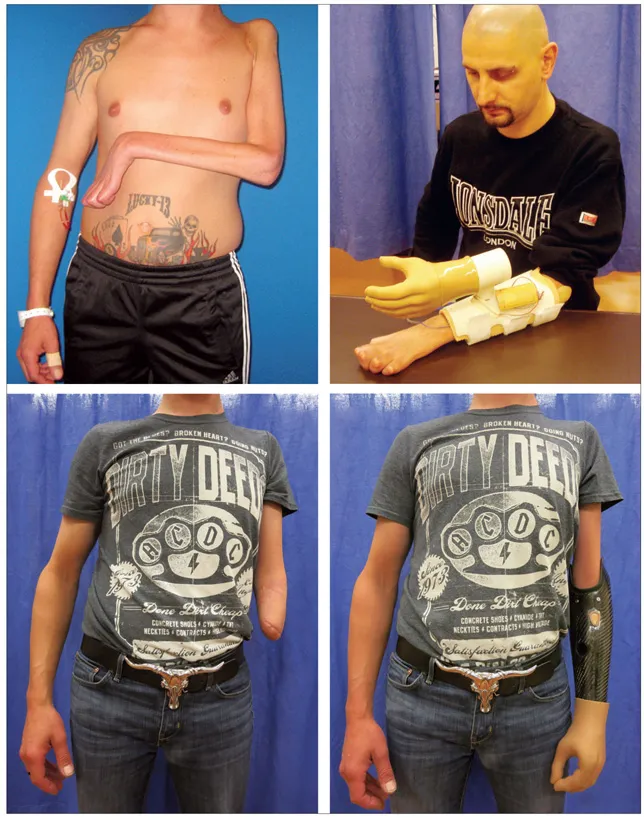
Three patients who suffered injuries to the nerves that control their arms received a modified Michelangelo prosthetic arm similar to the one shown here.
Three men who had lost the use of their hands in accidents are now the first people with this type of injury to receive bionic hands controlled by transplanted nerve tissue, a new study reports.
During the procedure, known as "bionic reconstruction," doctors amputated the useless hand, transplanted nerve and muscle tissue from another part of the body to boost nerve signals in the arm, and then used these nerve signals to control a robotic limb.
After the surgery, the men in the study regained the ability to perform everyday tasks such as pouring water from a jug or undoing buttons with two hands, the researchers said. [Bionic Humans: Top 10 Technologies]
"There's nothing new in the prosthetic device or the surgical techniques," said Dr. Oskar Aszmann, a professor of plastic and reconstructive surgery at the Medical University of Vienna, in Austria, and co-author of the study published today (Feb. 24) in the journal The Lancet. "But the concept of combining these methods … with improvement of the biotechnical interface, is what makes it so amazing."
The patients all had injuries to their brachial plexus, which means there was damage to a network of nerves that originates in the neck and controls movement and sensation in the shoulder, arm, forearm and hand.
The injuries amounted to an "inner amputation" — although the men did not lose their hands, the connections between their nervous systems and the hands were severed, Aszmann said. "For these patients, there's really no hope of regaining [hand] function," Aszmann told Live Science.
In the study, Aszmann and his colleagues pioneered a new technique that involves amplifying the remaining nerve signals in the arm and using them to control a prosthetic hand. To boost the existing signals, the researchers transplanted nerve and muscle tissue from each man's leg into his injured arm.
Sign up for the Live Science daily newsletter now
Get the world’s most fascinating discoveries delivered straight to your inbox.
The patients spent about nine months doing cognitive training, so they could learn to reactivate the muscles in their injured arm, which were weak from disuse. They also practiced by controlling a virtual hand on a computer or a prosthetic hand attached to their injured limb.
Then, once the researchers were sure that the nerve signals could be used to control a virtual or prosthetic hand, they amputated the injured hand, and replaced it with a bionic hand controlled by the nerves in the upper arm.
All three patients were able to control their bionic hands successfully. Three months after receiving the prosthetic limbs, the men scored better on multiple tests of hand function, and had lower scores on a test of disability, the researchers reported.
It's possible that this technique could be used to replace other limbs, too, Aszmann said. For example, a team of researchers in Chicago has used a similar technique to make bionic legs for patients with leg injuries.
Aszmann's lab has received a lot of inquiries from people who would like to have their limbs replaced with bionic ones, including some healthy people, he said. "But we're not trying to improve humans — just restore them," he said.
Tanya was a staff writer for Live Science from 2013 to 2015, covering a wide array of topics, ranging from neuroscience to robotics to strange/cute animals. She received a graduate certificate in science communication from the University of California, Santa Cruz, and a bachelor of science in biomedical engineering from Brown University. She has previously written for Science News, Wired, The Santa Cruz Sentinel, the radio show Big Picture Science and other places. Tanya has lived on a tropical island, witnessed volcanic eruptions and flown in zero gravity (without losing her lunch!). To find out what her latest project is, you can visit her website.