 Live Science Plus


You are now subscribed
Your newsletter sign-up was successful
Want to add more newsletters?

Delivered Daily
Daily Newsletter
Sign up for the latest discoveries, groundbreaking research and fascinating breakthroughs that impact you and the wider world direct to your inbox.

Once a week
Life's Little Mysteries
Feed your curiosity with an exclusive mystery every week, solved with science and delivered direct to your inbox before it's seen anywhere else.

Once a week
How It Works
Sign up to our free science & technology newsletter for your weekly fix of fascinating articles, quick quizzes, amazing images, and more
Delivered daily
Space.com Newsletter
Breaking space news, the latest updates on rocket launches, skywatching events and more!
Once a month
Watch This Space
Sign up to our monthly entertainment newsletter to keep up with all our coverage of the latest sci-fi and space movies, tv shows, games and books.

Once a week
Night Sky This Week
Discover this week's must-see night sky events, moon phases, and stunning astrophotos. Sign up for our skywatching newsletter and explore the universe with us!
Join the club
Get full access to premium articles, exclusive features and a growing list of member rewards.
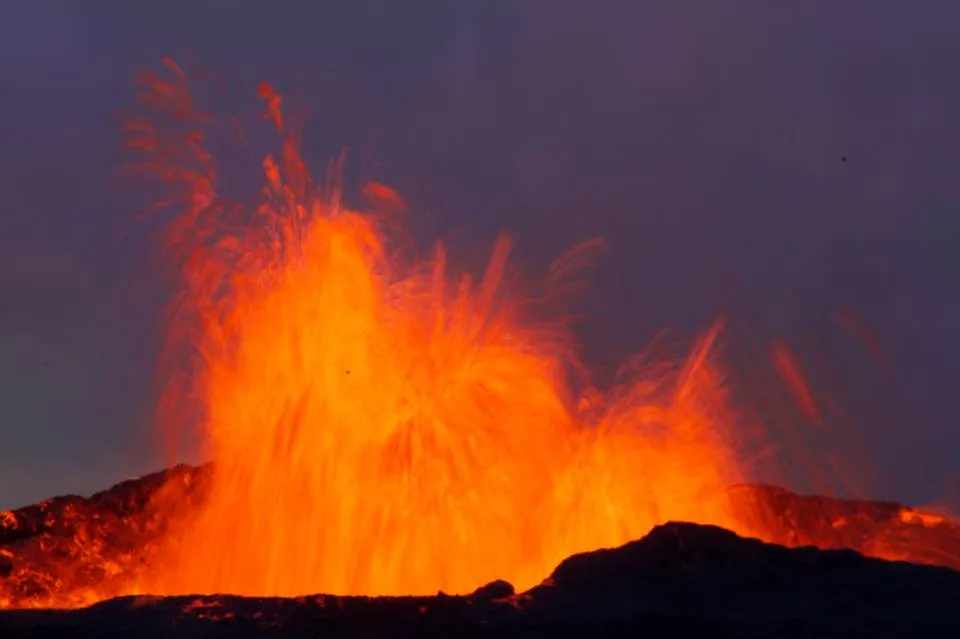
Iceland's fiery Holuhraun eruption may soon tunnel under a nearby glacier, triggering an explosive showdown between lava and ice, according to scientists monitoring the volcanic turmoil.
To make space for the fresh magma feeding the eruption, rock underneath nearby Dyngjujokull glacier has cracked, forming a long depression called a rift valley. The valley extends about a half-mile (1 kilometer) in front of the glacier and 1.2 miles (2 km) beneath the ice, the Icelandic Met Office said in a statement.
If the spouting lava migrates south into the rift valley, the melting could unleash a mighty flood called a jokulhlaup. The lava-ice interaction may also generate the eruption's first ash clouds. [Gallery: Beautiful Images of Bardarbunga's Volcanic Eruption]
Officials are also watching for new activity elsewhere in the lava field. GPS measurements suggest more magma is surging into the area than is being erupted. A flurry of small earthquakes sent scientists scurrying to safety today (Sept. 3), rather than risk being caught in a new eruption.
The surface eruption started Aug. 28, when lava spewed from a long fissure in the 200-year-old Holuhraun lava field between Bardarbunga volcano and Askja volcano.
The basalt lava now covers 2.8 square miles (7.2 square km) and is emerging at about 3,530 cubic feet per second (100 cubic meters per second), the Met Office said. The flow has a smooth, ropy surface, known as pahoehoe. A cloud of sulfuric gas is streaming from the fissure, forcing people nearby to wear gas masks for safety.
The volcanic activity kicked off Aug. 16, when thousands of small earthquakes underneath the Bardarbunga volcano warned Icelanders that an eruption was brewing. But the molten rock turned to the northeast, digging a long channel called a dike. This narrow magma intrusion surfaced near the toe of Dyngjujokull glacier, between Bardarbunga volcano and Askja volcano.
Email Becky Oskin or follow her @beckyoskin. Follow us @livescience, Facebook & Google+. Original article on Live Science.

