














Can Snakes Smell Anything?
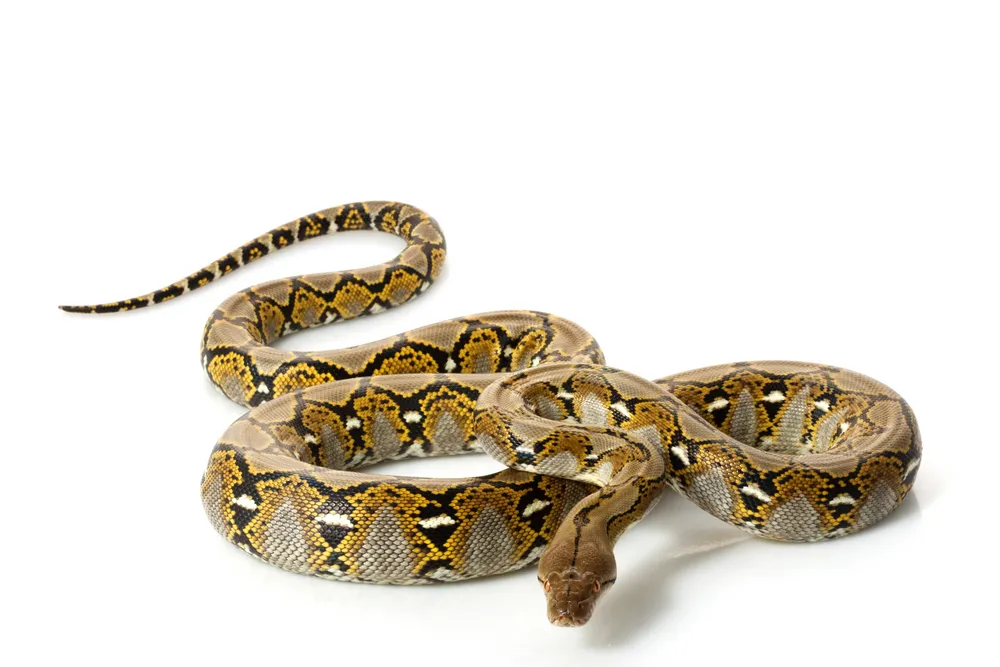
Most snakes have an excellent sense of smell, in part to make up for their poor eyesight and limited hearing.
Snakes do their best sniffing, not with their conventional nose (though they do smell through their nostrils, too), but with a pair of organs on the roof of their mouths called the Jacobson's or vomeronasal organ.
To smell through their mouths, snakes rely on tongue-flicking.
"They do have a regular nose," said Kurt Schwenk, a professor of ecology and evolutionary biology at the University of Connecticut. "The idea is that they smell something [with their nose], and if it's interesting to them that will trigger tongue-flicking behavior."
And their tongues are specially adapted to stay on the trail of that "interesting" odor. Snakes and lizards have forked tongues, some more extreme than others. And when they flick their tongues, each of the pair of tines on the "fork" picks up odor chemicals either from the air or the ground, said Schwenk, who has been studying snakes for decades.
When snakes retract the tongue back into their mouths, those odor molecules somehow make their way into the vomeronasal organs, or a "nose within a nose," according to Schwenk. The bulb-like vomeronasal organs are located above the roof of the mouth and open into the mouth through a pair of tiny holes in the palate. [Related: Guess How Many Scents a Human Can Smell]
In lizards and snakes, these organs open only into the mouth and are separated completely from the nasal cavity. "That means the only way the [odor] molecules can get to them is through the mouth," he said.
Get the world’s most fascinating discoveries delivered straight to your inbox.
In 1920, scientists proposed that snakes inserted each of the two "tines" of their forked tongue into each of the two holes at the roof of the mouth. Now scientists know that's not the case, Schwenk said; even so, the odor molecules somehow get transferred to those holes.
"If there's a way that those two tips [tines] don't get mixed and get delivered to separate holes and separate vomeronasal organs, then [the snake] can say the chemical is stronger on the right," for instance, sort of like a stereo smell that helps the predator stay on the trail of a prey, Schwenk told Live Science.
And the snake's brain must process that information rather quickly in order to stay hot on a prey's tail.
"When a snake is moving along, it will typically tongue-flick about once a second, if not faster in some cases," he said. "By the time it picks up the chemicals and transfers them, [the brain] has a fraction of a second to interpret them."
That doesn't give dinner much time to get away.
Jeanna Bryner is managing editor of Scientific American. Previously she was editor in chief of Live Science and, prior to that, an editor at Scholastic's Science World magazine. Bryner has an English degree from Salisbury University, a master's degree in biogeochemistry and environmental sciences from the University of Maryland and a graduate science journalism degree from New York University. She has worked as a biologist in Florida, where she monitored wetlands and did field surveys for endangered species, including the gorgeous Florida Scrub Jay. She also received an ocean sciences journalism fellowship from the Woods Hole Oceanographic Institution. She is a firm believer that science is for everyone and that just about everything can be viewed through the lens of science.