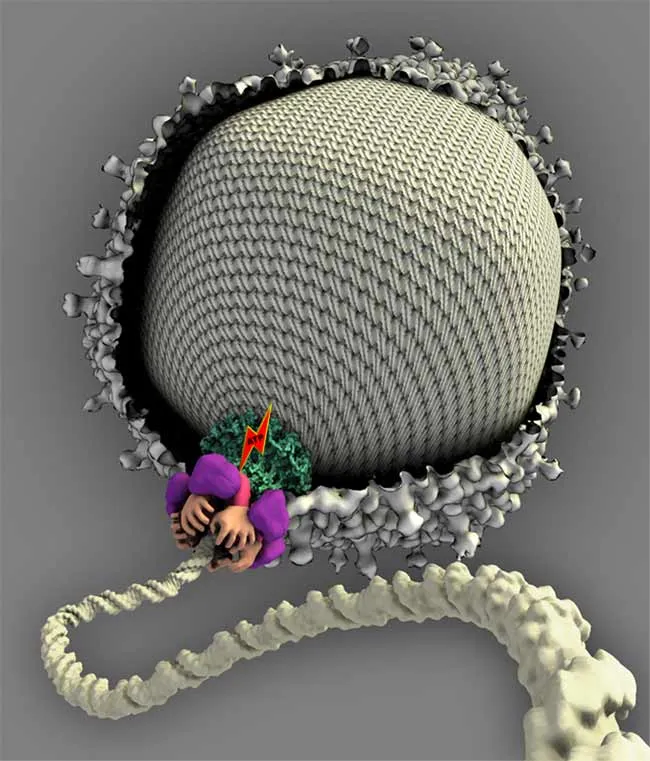
Like microscopic machine shops, some viruses assemble their parts with the help of tiny motors. Now, researchers have figured out the structure and workings of the natural molecular motors in one virus.
The discovery could lead to new pharmaceutical approaches to combat diseases, including herpes, which is caused by a virus that possesses a similar type of motor.
Unlike bacteria and other forms of life, viruses are unique in that they cannot reproduce or grow outside of a host cell. So figuring out precisely how they thrive inside us is a key to controlling or eradicating them.
Latest Videos From
The research team, including Purdue biologist Michael Rossmann, used two imaging techniques to look at the T4 virus, a type of virus called a bacteriophage that is capable of infecting bacteria. In the case of T4, the bacterial host is Escherichia coli, which in turn is common in the intestines of warm-blooded animals and usually harmless, but some strains can cause food poisoning.
The researchers focused on a small motor that many viruses use to package their DNA into their "heads," or capsids — sort of a protein coat for the virus. The images showed the motor is made up of a pair of conjoined protein rings, an upper ring and a lower ring.
Here's how the researchers think the tiny motor works: As a T4 virus assembles itself inside its host, the motor's lower ring attaches to a strand of viral DNA, while the upper ring holds onto the virus' head. The upper and lower rings contract and release, alternately tugging at the DNA like a ring of hands pulling on a rope.
DNA is made up of two strands held together by weak bonds between nitrogen-containing chemicals called bases on each strand, forming base pairs. In the case of T4, its motor packs about 171,000 base pairs into a head that's just 120 nanometers by 86 nanometers. For comparison, the width of a human hair is about 80,000 nanometers; and the human genome contains about 3 billion base pairs.
Once the DNA gets tugged inside the capsid, the motor falls off and a virus tail attaches to the capsid.
Now the virus can escape its host, killing it in the process, and seek out another E. coli cell. "The tail is another machine which is necessary for the virus to infect the next host," Rossmann told LiveScience. "The tail is used to puncture and to digest the cell wall of the next cell to be infected."
The finding, detailed in the Dec. 26 issue of the journal Cell, has practical implications for fighting off dangerous microbes.
"Bacteriophages like T4 are a completely alternative way of dealing with unwanted bacteria," Rossmann said. "The virus can kill bacteria in its process of reproduction, so use of such viruses as antibiotics has been a long looked-for alternative to overcome the problems which we now have with antibiotics."

 Live Science Plus