Get the world’s most fascinating discoveries delivered straight to your inbox.
You are now subscribed
Your newsletter sign-up was successful
Want to add more newsletters?
Join the club
Get full access to premium articles, exclusive features and a growing list of member rewards.
An account already exists for this email address, please log in.
Black hole 'traffic jams' are forcing cosmic monsters to collide, new study finds
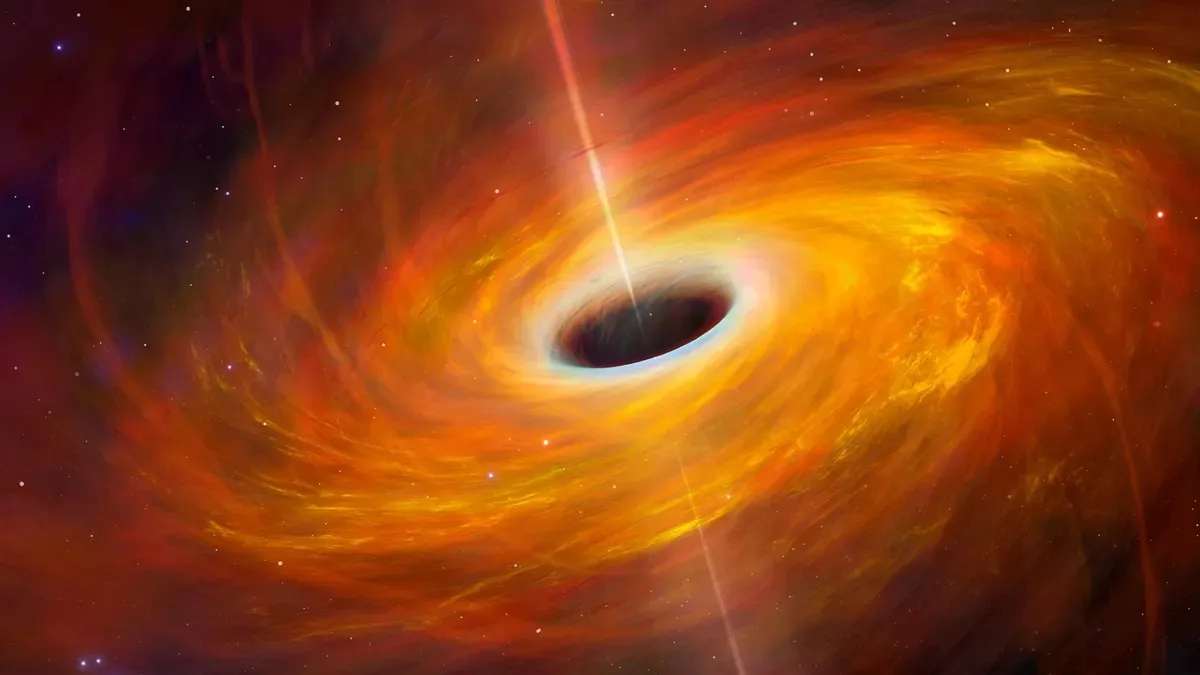
Supermassive black holes may create conditions akin to "cosmic intersections with failed traffic lights" that make collisions between smaller stellar-mass black holes inevitable.
And you thought rush hour was bad on Earth! New research suggests some "cosmic intersections" have failed "traffic lights" that deem black hole collisions almost inevitable.
At the hearts of all large galaxies lie cosmic monsters called supermassive black holes, enormous voids that swirl around everything in the galaxies themselves. This swirly behavior influences things like the disks of matter the galactic titan feasts on, stars and their systems — and, fascinatingly, even other black holes, albeit smaller, stellar mass ones.
It would also appear that such behavior around supermassive black holes can cause cosmic "traffic jams," and that these jams could actually be integral in slowing down the orbits of stellar-mass black holes. And, no longer zipping around, the affected black holes can be forced to collide, merge and create a larger daughter black hole.
Then, thanks to the immense gravitational influence of the traffic-jam-culprit supermassive black hole, a beast that can boast a mass millions (even billions) of times that of the sun, this process repeats. That results in even more black-hole collisions that create larger and larger stellar-mass black holes over time, with masses between three and a few hundred solar masses.
Zooming out, all of this means the environment around a supermassive black holes is perfect for facilitating the growth of other black holes.
Some supermassive black holes are surrounded by a disk of gas and dust called an accretion disk; it is this disk which gradually feeds the black hole. The gravity of supermassive black holes generates powerful tidal forces in those accretion disks that cause them to glow brightly, creating a region called an Active Galactic Nucleus (AGN).
Sign up for the Live Science daily newsletter now
Get the world’s most fascinating discoveries delivered straight to your inbox.
The new traffic-jam findings come courtesy of a team led by scientists from Monash University who looked at the dynamics found in accretion disks as well as the black holes that are embedded within them.
When stellar-mass black holes sit in these accretion disks, their interactions with the gas surrounding them can cause them to migrate through the disk. The team theorizes that this leads to stellar-mass black holes accumulating in regions they call "migration traps." This makes the possibility of two stellar mass black holes encountering each other, colliding and merging in these regions due to the traffic jam greater than anywhere else in the surrounding galaxy.
An illustration of two black holes colliding and merging, which could happen at busy cosmic intersections with no working traffic lights.
(Image credit: The SXS (Simulating eXtreme Spacetimes) Project)
Team leader and Monash University School of Physics and Astronomy researcher Evgeni Grishin took the traffic jam analogy a step further, in fact, comparing these migration traps for stellar-mass black holes around supermassive black holes to busy intersections without working traffic lights here on Earth.
"We looked at how many and where we’d have these busy intersections," Grishin said. "Thermal effects play a crucial role in this process, influencing the location and stability of migration traps. One implication is that we don’t see migration traps occurring in active galaxies with large luminosity."
Not only do the team's results have major implications for our understanding of how mergers between stellar-mass black holes proceed, but because these mergers create a burst of tiny ripples in spacetime called gravitational waves, the findings could help advance gravitational wave astronomy down the line, too.
"We’re thrilled with the results, and we now are one step closer to discovering where and how black holes merge in galactic nuclei," Grishin concluded. "The future of gravitational wave astronomy and active galactic nuclei research is exceptionally promising.
"Despite these significant findings, much about the physics of black holes and their surrounding environments remains unknown."
Robert Lea is a science journalist in the U.K. who specializes in science, space, physics, astronomy, astrophysics, cosmology, quantum mechanics and technology. Rob's articles have been published in Physics World, New Scientist, Astronomy Magazine, All About Space and ZME Science. He also writes about science communication for Elsevier and the European Journal of Physics. Rob holds a bachelor of science degree in physics and astronomy from the U.K.’s Open University