














Image Gallery: Saving the Rare Marbled Murrelet

Protecting the Marbled Murrelet

A rare bird called the marbled murrelet lives at sea but nests on tall, thick redwood branches. Attacks by Steller's jays, another type of bird, on murrelet eggs and chicks are one of the small bird's greatest modern threats. Biologists hope to train wild jays to avoid murrelets by setting out dummy eggs laced with a vomit-inducing chemical.
Marbled murrelet
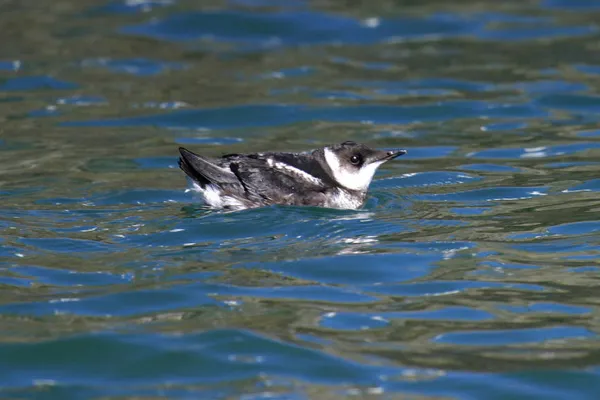
An adult marbled murrelet spends its life at sea, flying ashore once a year to nest in old-growth redwood trees.
World's tallest trees

Redwoods, where murrelets make there nests, are the world's tallest trees.
Murrelet nest

Marbled murrelets nest in old-growth redwoods because they have thick branches that are high above the forest floor. The "duff" on the branches makes a fine nest. Duff is tree needles and other debris that accumulates on the branches.
Old-growth redwoods

Fog drifts through a stand of old-growth trees in Redwoods National Park in California.
Murrelet chick

A marbled murrelet chick makes its first flight straight to the ocean, a trip as far as 50 miles (80 kilometers). No test flights for these birds, biologists say.
Murrelet egg
The speckled, blue-green marbled murrelet eggs are pointed on one end so they don't roll off the nest.
Get the world’s most fascinating discoveries delivered straight to your inbox.
Steller's jay

The Steller's jay likes campgrounds and picnic sites, and its population is booming in western forests. Though the jay doesn't rely on eggs for food, the dense population living near murrelet nesting sites means some birds find and eat murrelet eggs and chicks.
Fake eggs

A Steller's jay inspects a fake murrelet egg that contains a vomit-inducing ingredient called carbachol. The red egg is an experimental control. Tests in California's Redwood National and State Parks found jay predation dropped up to 80 percent after these dummy eggs were set out in the forests, indicating that the jays learned to avoid the murrelet eggs after the nasty effects of the fake eggs.
Crumb clean

Humans are a key link in helping keep Steller's jays from eating marbled murrelet eggs. The parks have a "crumb clean" program to reduce food available to jays, and lower the bird population.
