 Live Science Plus





You are now subscribed
Your newsletter sign-up was successful
Want to add more newsletters?

Delivered Daily
Daily Newsletter
Sign up for the latest discoveries, groundbreaking research and fascinating breakthroughs that impact you and the wider world direct to your inbox.

Once a week
Life's Little Mysteries
Feed your curiosity with an exclusive mystery every week, solved with science and delivered direct to your inbox before it's seen anywhere else.

Once a week
How It Works
Sign up to our free science & technology newsletter for your weekly fix of fascinating articles, quick quizzes, amazing images, and more

Delivered daily
Space.com Newsletter
Breaking space news, the latest updates on rocket launches, skywatching events and more!

Once a month
Watch This Space
Sign up to our monthly entertainment newsletter to keep up with all our coverage of the latest sci-fi and space movies, tv shows, games and books.

Once a week
Night Sky This Week
Discover this week's must-see night sky events, moon phases, and stunning astrophotos. Sign up for our skywatching newsletter and explore the universe with us!
Join the club
Get full access to premium articles, exclusive features and a growing list of member rewards.
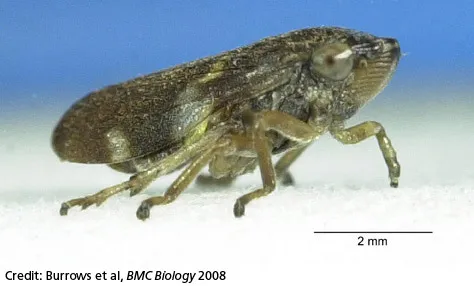
Lickety-split, insects called froghoppers can leap a distance of 100 times their body length. Now, scientists have found the bugs' secret: They sport bow-like structures that work like catapults.
Froghoppers are also called spittlebugs because the nymph stage of these insects produces a frothy sap for protection. The adults store energy in a pair of bow-shaped structures made of both a hard cuticle material and a rubbery protein called resilin, new research found. The structures are attached to the hind legs.
When the insect contracts its muscles to jump, these structures flex like an archery bow. Upon recoil, the "bow" sends the insect forward with a force that can reach more than 400 times its body mass.
Since the hopper's arching device is made of both hard and elastic materials, it can resist damage even if bent for a long time. In fact, froghoppers hold their bows in a ready position so they are prepared to leap at a moment's notice. They can also jump repeatedly without damaging the body, the researchers say.
As nymphs, froghoppers lack the elastic protein in their bow structures. And as expected, the little ones don't jump until they develop into adults.
The finding is published today in the journal BMC Biology.
- Video – See the Froghoppers Jump
- Top 10 Amazing Animal Abilities
- Image Gallery: Backyard Bugs

