














Study Reveals Earthquake Dangers in Spain

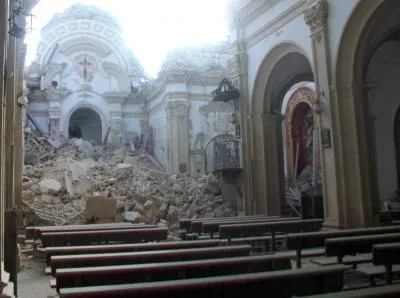
At least six earthquakes registering above a seven on the Richter scale struck a little-known Spanish fault in the recent past, according to new research. The finding suggests that the fault, in Southeast Spain, is more active than previously thought and could pose a potential hazard to people living in the region, according to the study, published in the Geological Society of America Bulletin in October.
The study also found that the fault has given rise to unusual earthquakes. "During earthquakes, the entire length of the fault does not break," said Jose J. Martínez Díaz, a study co-author and researcher at the Complutense University of Madrid, in a statement. "It does so in segments." These ruptures could give rise to larger earthquakes than previously thought.
"This fault has already produced an earthquake of magnitude 6.5 or 7, thousands of years ago, and could do so again tomorrow," Martínez Díaz said. "As a result, it is vital to bear in mind the earthquake-risk calculations and building codes on the area."
The seismic danger in the area has been underestimated because, until now, officials made estimates of earthquake likelihood based on records from only the last 2,000 years, according to the release.
The researchers found evidence for past faults by examining sediments in trenches they dug into the fault, some 100 feet long (30 meters) and 13 feet (4 meters) deep.
The study follows a 5.1 magnitude earthquake in Lorca, Spain, in 2011, which was twice as powerful as was thought possible in the region, according to the release. While some research suggests that groundwater removal caused the Lorca quake, Martínez Díaz is skeptical, pointing out that similar quakes took place in 1674 and 1818, when "aquifer exploitation was not practiced," according to the release.
Follow OurAmazingPlanet on Twitter @OAPlanet. We're also on Facebook and Google+.
Get the world’s most fascinating discoveries delivered straight to your inbox.
