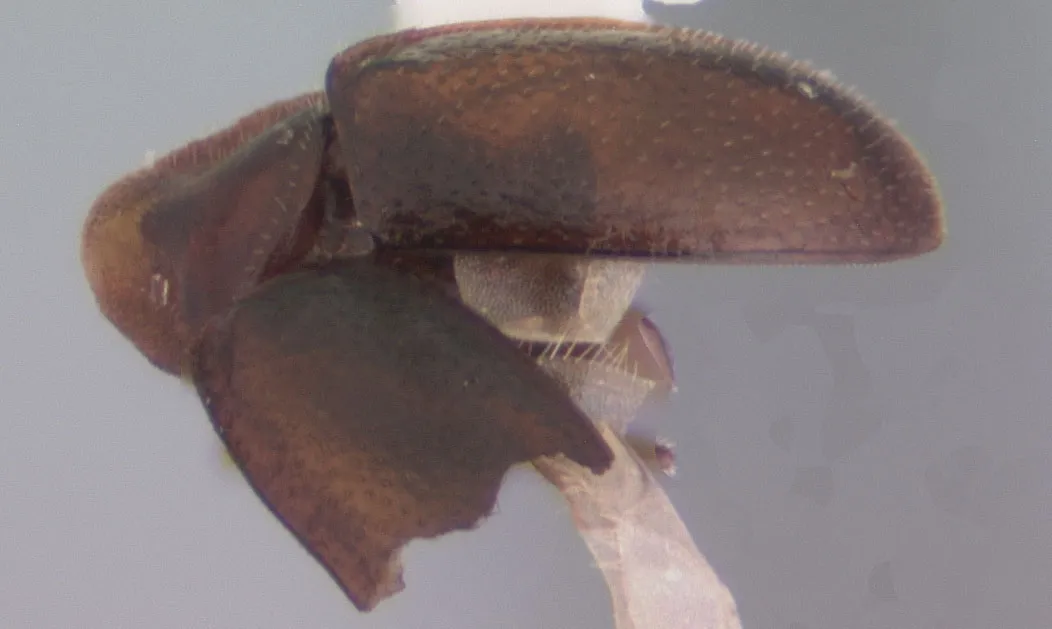
Scientists say they've discovered a new ladybug species that can tuck its head into its body like a turtle.
Ross Winton, a former entomology grad student at Montana State University (MSU), found the bug in a trap he set up in a sand dune in southwest Montana. He initially thought the tiny tan insect was just part of an ant or a bug with its head missing.
But upon further examination, Winton identified the one-millimeter-long insect as a male ladybird beetle, or ladybug, and found that it wasn't actually headless — its head was just hidden inside a tube in its thorax, much like a turtle that has its head tucked back into its shell.
Latest Videos From
A similar female bug previously was found about 90 miles (145 kilometers) away in Idaho. Winton's discovery allowed researchers to confirm that the two specimens belong to a new species, which they named Allenius iviei.
"The tiny species is known from only two individuals, one male and one female, making it qualify for the rarest species in the USA," Michael Ivie, an MSU entomologist and Winton's former adviser, said in a statement.
"The species is very unusual not only because of its small size, unique habitat and rarity, but the fact that its head is pulled back into a tube in its thorax makes its biology quite a mystery," Ivie added.
In fact, the bug is so distinct that it was placed in an entirely new genus of lady bug along with another new species known from Baja California, Allenius californianus.
"While discovery of a new species of beetle in the USA is not an everyday event, a completely new genus is quite rare," Ivie said.
Allenius iviei and Allenius californianus were both described earlier this year in the journal Systematic Entomology.
Follow LiveScience on Twitter @livescience. We're also on Facebook & Google+.

 Live Science Plus