













Photos: The World's Largest Atom Smasher (LHC)

LHC Students at CERN

Students working on the LHC sit outside of Geneva's CERN Physics Laboratory, home of the particle collider.
LHC Tunnel

This photo shows the tunnel of the Large Hadron Collider, where beams of particles pass through the central pipes before colliding with each other.
LHC Detector
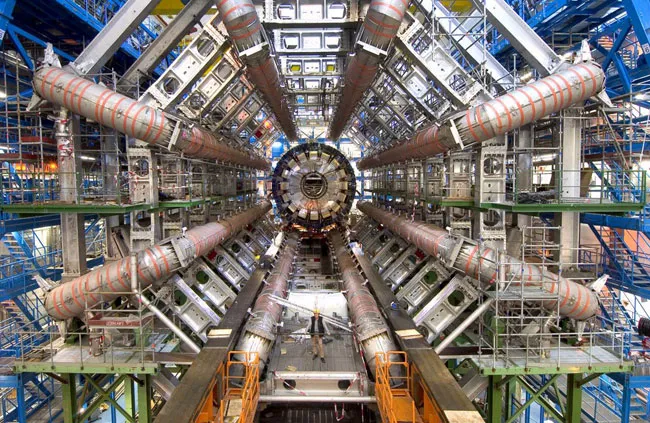
Detectors like this are placed at the spots where particles collide inside the LHC ring. They include sensitive equipment to detect the presence of exotic particles and their decay products that are created in the collisions.
LHC Control Room

Physicists watch particle collision data inside the LHC control room.
LHC Particle Tracks
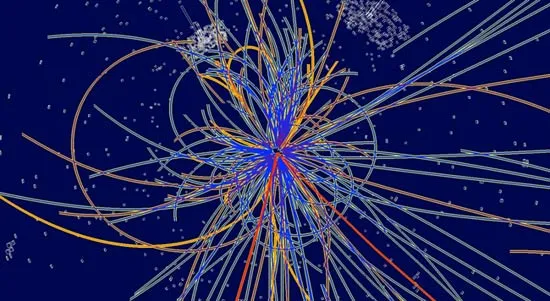
When particles collide inside the accelerator, they explode into energy that gives rise to new particles. These are often short-lived and decay into other particles. The particle products of collisions are shown as tracks in diagrams like this.
LHC's ATLAS

The ATLAS experiment at the Large Hadron Collider is one of the machine's two big all-purpose detectors.
ATLAS Tracker Barrel

Here, a technician works on the semiconductor tracker barrel of the ATLAS experiment.
Get the world’s most fascinating discoveries delivered straight to your inbox.
ATLAS' Cavern

Workers move an instrument called a calorimeter inside the ATLAS cavern.
ATLAS Mural

The building that houses the ATLAS experiment and its offices is painted with a mural showing two walls the detector with a collision event superimposed.
ATLAS in LEGOS

A model of the ATLAS detector made out of LEGO blocks by Sascha Mehlhase.
CMS Experiment
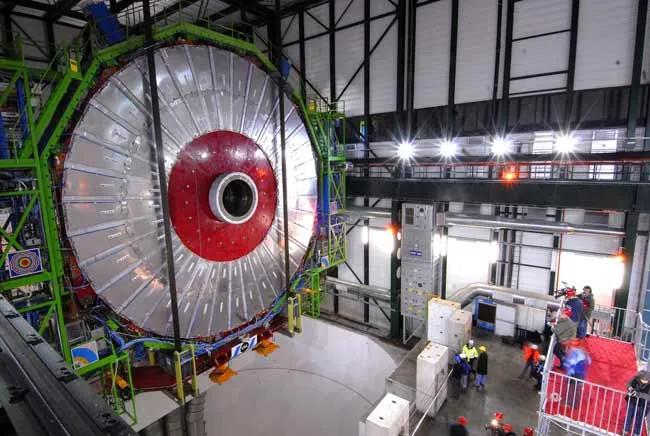
The Compact Muon Solenoid (CMS) experiment is LHC's second major all-purpose detector. Among other projects, it is searching for the elusive theoretical particle called the Higgs boson.
