
















Rise of the Drones: Photos of Unmanned Aircraft
Amazing Unmanned Aircraft
Drones are unmanned aerial vehicles (UAVs) that are used by the military in a number of ways, including missile testing, air strikes, aerial refueling, surveillance, transporting cargo, live-fire exercises and even long-range bombing. The U.S. military began experimenting with unmanned aircrafts as early as World War I, but they were called remotely piloted vehicles (RPVs) at the time. Today, UAVs are used by various organizations, including the U.S. Air Force, Navy and the U.S. Geological Survey.
The Reaper

The above unmanned aerial vehicle, which has the sinister name of the MQ-9 Reaper, is referred to as a Remotely Piloted Vehicles/Aircraft by the U.S. Air Force. It is operated by ground controllers, while other UAVs are flown autonomously thanks to pre-programmed flight plans.
Ready for Flight

The above photo of a QF-4 drone resting on an airfield was taken on July 30, 2010, at the Davis-Monthan Air Force Base in Tucson, Ariz. Drones such as the QF-4 are often implemented in missile system assessments and training, with the drones serving as moving targets in order to test weapons.
Takeoff

This coral-colored sub-scale drone, called the BQM-167 Air Force Subscale Aerial Target, was launched from the Tyndall Air Force Base in Tyndall, Fla. Used in the Air Force Weapon System Evaluation Program, the drone served as a shooting target during weapon-testing exercises.
Over Water

Members of the contracted Florida Offshore crew steady a BQM-167 sub-scale drone as it is lowered onto a cradle. The drone was fished out of the waters off of Tyndall Air Force Base, Fla., by one of the 120-foot recovery boats owned by the Air Force. These boats are used to help find and recover sub-scale drones after they are shot down during the Air Force's live-fire exercises.
In the Air

The unmanned aerial vehicle MQ-9 Reaper, originally named the Predator B, is not only used by the U. S. Air Force, but also by the Navy, the CIA and the U.S. Customs and Border Protection. Above, it is photographed after taking off from the Kandahar Air Base in Afghanistan as part of the 62nd Expeditionary Reconnaissance Squadron, where it was used in a mission as part of Operation Enduring Freedom.
Flying High

The above QF-4, a full-scale target drone, is show flying as it is tracked by a missile at the Tyndall Air Force Base in Tyndall, Fla. Acting as a realistic full-scale moving target, the QF-4 is mainly used for evaluating weapons systems.
Get the world’s most fascinating discoveries delivered straight to your inbox.
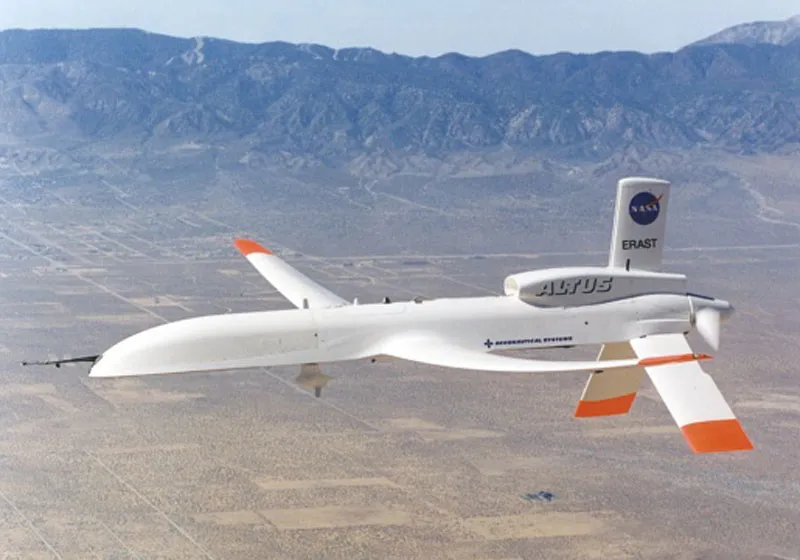
Droning On in the Name of Science

Soaring over southern California's San Gabriel range, the remotely-piloted Altus II is equipped with an air data system as well as a video camera in its nose. Flown from the Dryden Flight Research Center in Edwards, Calif., the Altus II is part of NASA's Environmental Research Aircraft and Sensor Technology (ERAST) program. Designed for high-altitude, long-duration scientific missions, the drone can reach and sustain an altitude of 55,000 feet for hours at a time as it collects air samples and data.
UAVs Big and Small

Unmanned aerial vehicles come in various shapes and sizes, from the Israeli Air Force's Heron TP, which is the world's largest UAV and is nearly as long as a 737 airliner, to the U.S. Army's "Switchblade," a new, sophisticated unmanned aerial vehicle small enough to be carried in a backpack.
Red Target

The above MQM-107E Streaker, a sub-scale aerial target drone, was photographed flying over the Tyndall Air Force Base in Tyndall, Fla. The MQM-107E Streaker was conducting a Weapons System Evaluation Program, also known as a Combat Archer exercise, during which the drone was used as a target.
In Formation

Also flying over the Tyndall Air Force Base in Tyndall, Fla., the above MQM-107E Streaker is flying in formation with an F-16C Fighting Falcon during a Combat Archer exercise.