













North vs. South Poles: 10 Wild Differences

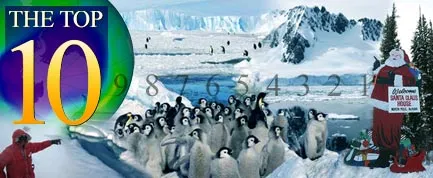
Meltdown

The Arctic has a normal melting cycle in which about half of the ice pack disappears in the summer, only to grow back to the size of the United States during the winter. Still, an alarming recent study determined that the 2-mile-thick ice sheet in Greenland is melting so rapidly that half of it could be gone by the end of the century. Other studies have found that the entire Arctic could be ice-free during summer in a few decades. Lately, research has also found that the Antarctic is also losing ice, which if all melted (no one expects this to happen anytime soon), would cause sea levels to rise roughly 200 feet.
Cracks in the Ice

Being primarily a thin layer of ice, the arctic is very sensitive to changing climate conditions. Warmer temperatures during the summer months cause the 12 to 15 feet thick ice sheet to melt and break apart. Last year, researchers reported for the first time that cracks in the ice had reached all the way to the North Pole.
The Ozone Hole
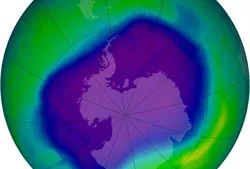
While the Antarctic has an ozone hole that has grown to about three times the size of the United States™ land mass, the Arctic is losing ozone coverage as well. In truth, there is no actual hole; the "hole" is a region of severely depleted ozone, a chemical that helps protect the planet from harmful solar radiation. Ozone losses in the Northern Hemisphere are lower than in the Southern because warmer Arctic temperatures limit the formation of polar stratospheric clouds that destroy ozone. But temperatures in the stratosphere, high above the Arctic, have gradually cooled over the last decade, resulting in increased ozone loss.
Battle of the Brrr

The Antarctic is so cold that the snow never melts in many areas of the continent. The region's average temperature is about -56 degrees Fahrenheit (-49 degrees Celsius), making it the coldest climate on earth. In contrast, the Arctic's average winter temperature is -29 degrees Fahrenheit (-34 degrees Celsius), but it gets warmer in the summer. The lowest temperature ever recorded on Earth was -128 degrees Fahrenheit (-89.6 degrees Celsius), recorded July 21, 1983, at the Vostok Station located near the South Geomagnetic Pole.
Santa Claus’ Address

Every Christmas, thousands of letters mailed to Santa Claus do make it to the North Pole... North Pole, Alaska that is. The small town of roughly 1,778 people advertises its ZIP code as the ZIP code of Santa. The Holiday spirit is felt year-round as candy-cane striped street lights keep things moving along festive places such as St. Nicholas Drive, Snowman Lane and Kris Kringle Drive.
Penguins and Polar Bears

Christmas cards and Coke commercials can be blamed for the misconception that polar bears and penguins live in the same frigid neighborhood. If penguins of the Antarctic and Artic-dwelling polar bears ever did cross the same frozen paths, the waddling birds would make for very easy prey for the giant bears. But since penguins needn’t worry about land predators, they have adapted their wings into paddle-like flippers to maneuver through the ocean.
Black Gold

Energy-hungry nations are forging northward as an estimated one quarter of all untapped oil reserves lie north of the Arctic circle, according to the U.S. Geological Survey. Russia has taken the bold step of laying claim to a large swath of the Arctic region in hopes of exploring gas deposits in the Lomonosov Ridge—a 1,200-mile underwater mountain range purported to hold up to 10 billion tons of the coveted resource. Even the U.S. is getting involved, sending an icebreaker ship to map out their Arctic territory off Alaska. While it is believed by some that deposits of petroleum exist in the southern continental shelf, such as the area under the Ross Sea, the Antarctic Treaty makes oil drilling momentarily off-limits.
Get the world’s most fascinating discoveries delivered straight to your inbox.
No-Man’s Land

Despite symbolic images of past explorers triumphantly planting flags at the South Pole, the continent remains the only place on Earth not owned by anyone. It has no history of native peoples and is governed by the Antarctic treaty, which maintains that the land and resources be used for peaceful and scientific purposes. This is in stark contrast to the more than 4 million people living within the Arctic circle in several small towns as well as major cities such as Barrow, Alaska; Tromso, Norway; and Muramansk and Salekhaard in Russia.
Most Ice

The southernmost continent has roughly 90 percent of the world’s ice, which amounts to nearly three quarters of the Earth’s fresh water being locked away there. This has led some to float the idea of towing icebergs to quench dry, drought-stricken areas. In fact, Prince Mohammed al Faisal of Saudi Arabia once considered a plan to find a 100 million-ton iceberg off Antarctica and tow it to the Arabian peninsula.
Polar Opposites

The Arctic region is essentially a frozen ocean surrounded by land. Conversely, Antarctica is a continent—with mountain ranges and lakes—surrounded by an ocean. Socially and politically, though, the Arctic region includes the northern territories of Canada, Greenland (a territory of Denmark), Russia, Iceland, Norway, Sweden, Finland and the United States.
