 Live Science Plus


You are now subscribed
Your newsletter sign-up was successful
Want to add more newsletters?

Delivered Daily
Daily Newsletter
Sign up for the latest discoveries, groundbreaking research and fascinating breakthroughs that impact you and the wider world direct to your inbox.

Once a week
Life's Little Mysteries
Feed your curiosity with an exclusive mystery every week, solved with science and delivered direct to your inbox before it's seen anywhere else.

Once a week
How It Works
Sign up to our free science & technology newsletter for your weekly fix of fascinating articles, quick quizzes, amazing images, and more

Delivered daily
Space.com Newsletter
Breaking space news, the latest updates on rocket launches, skywatching events and more!

Once a month
Watch This Space
Sign up to our monthly entertainment newsletter to keep up with all our coverage of the latest sci-fi and space movies, tv shows, games and books.

Once a week
Night Sky This Week
Discover this week's must-see night sky events, moon phases, and stunning astrophotos. Sign up for our skywatching newsletter and explore the universe with us!
Join the club
Get full access to premium articles, exclusive features and a growing list of member rewards.
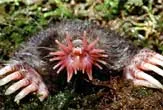
Moles do a lot of digging, as many gardeners know. But they don't use whiskers to find their way around in the dark. Instead, they simply follow their noses.
A new detailed study of tiny touch receptors, called "Eimer's organs," on the tip of a mole's nose reveals how the animals do it.
For moles, the Eimer's organs serve the function of whiskers found in most small mammals and fingers in humans. By touching their noses to the ground repeatedly, the animals explore their surroundings and discriminate between different objects.
Using fluorescent dyes, the researchers found that the Eimer's organs in the coast mole and the odd-looking star-nosed mole are composed of a column of skin cells, around which numerous nerve endings are arranged. An outer ring of nerves interlacing the column function as high-threshold pain receptors, while nerves within the cell column act as low-threshold touch receptors.
The researchers think that this organization allows the outer nerves to sense abrasive or potentially harmful areas before the more sensitive inner nerves come into contact with them.
The study, by Paul Marasco of Vanderbilt University in Tennessee and colleagues, is detailed in this week's issue of the journal for the Proceedings of the National Academy of Sciences.
