 Live Science Plus





You are now subscribed
Your newsletter sign-up was successful
Want to add more newsletters?

Delivered Daily
Daily Newsletter
Sign up for the latest discoveries, groundbreaking research and fascinating breakthroughs that impact you and the wider world direct to your inbox.

Once a week
Life's Little Mysteries
Feed your curiosity with an exclusive mystery every week, solved with science and delivered direct to your inbox before it's seen anywhere else.

Once a week
How It Works
Sign up to our free science & technology newsletter for your weekly fix of fascinating articles, quick quizzes, amazing images, and more

Delivered daily
Space.com Newsletter
Breaking space news, the latest updates on rocket launches, skywatching events and more!

Once a month
Watch This Space
Sign up to our monthly entertainment newsletter to keep up with all our coverage of the latest sci-fi and space movies, tv shows, games and books.

Once a week
Night Sky This Week
Discover this week's must-see night sky events, moon phases, and stunning astrophotos. Sign up for our skywatching newsletter and explore the universe with us!
Join the club
Get full access to premium articles, exclusive features and a growing list of member rewards.
On Feb. 12, 1935, during severe weather off Point Sur, Calif., a U.S. Navy flying machine called the USS Macon fell from the sky, plunged into the Pacific Ocean, and sank.
It was the nation's largest rigid, lighter-than-air craft, and the last of its kind [photo].
The images
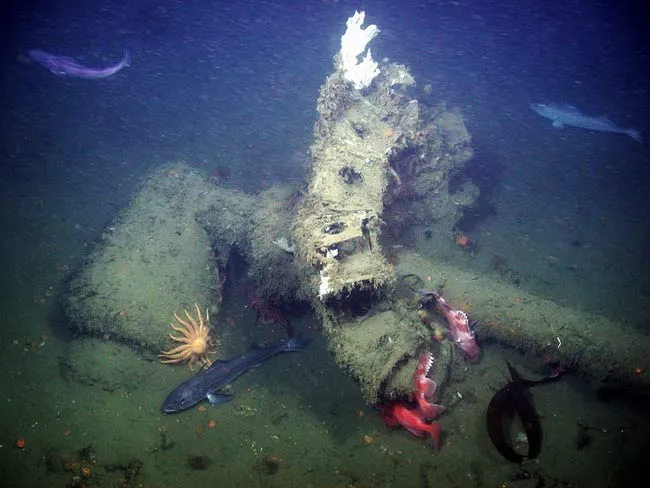
From a Monterey Bay Aquarium Research Institute’s (MBARI) research ship, scientists deployed a remotely operated vehicle to capture high-definition video and still images of wreckage.
Images show the airship's hangar bay, containing four Sparrowhawk biplanes, five of the eight 12-cylinder gasoline engines, and objects from the ship's galley, including two sections of the aluminum stove, propane tanks that supplied fuel for it and a dining table and bench.
A second debris field contained the Macon's bow section, including the mooring mast receptacle, plus aluminum chairs and desks that may have been in a port side officers' or meteorologist's office.
Decades of mystery
The exact location of the submerged wreckage remained a mystery for nearly 50 years until a commercial fisherman snagged a piece of the USS Macon’s girder in his net, and ended up displaying the artifact at a local seafood restaurant.
Meanwhile, researchers had attempted to locate the airship remains with no luck, because the objects weren’t at the recorded sinking location. In the early 1990s they finally spotted the wreckage at a depth of 1,000 feet.
The new survey included researchers from the NOAA National Marine Sanctuary program, MBARI, the University of New Hampshire and Stanford University. The researchers will now investigate the level of preservation of the artifacts and whether further research at the site is feasible.

