













World's oldest runestone may contain the earliest example of writing in Scandinavia
Archaeologists unearth "world’s oldest runestone" in Norway
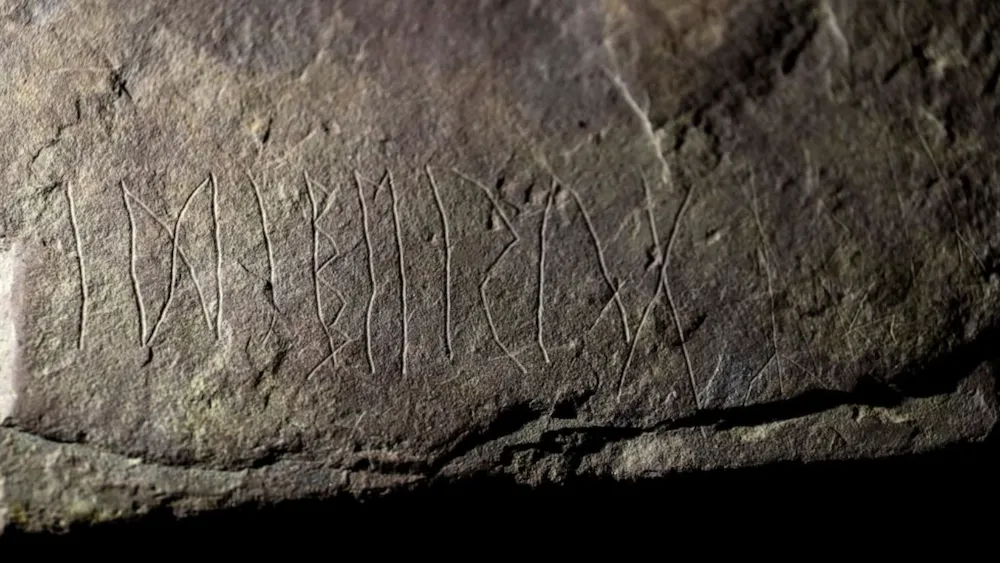
Archaeologists have unearthed the "world's oldest runestone," a squat block of sandstone with etchings scribbled across its flat surface.
The ancient stone, which archaeologists unearthed in Norway, could contain the earliest example of "words recorded in writing in Scandinavia." They made the find in late 2021 while excavating a gravesite in Tyrifjorden, a town west of Oslo. Radiocarbon dating of items collected at the site, including charred bones and charcoal, determined that the runestone was likely carved sometime between A.D. 1 and 250, according to a statement.
Measuring 12.2 by 12.6 inches (31 by 32 centimeters), the runestone has multiple inscriptions containing runes, letters related to the Germanic alphabet. Eight runes on the front of the stone read "idiberug," which researchers think could refer to a specific person or family. However, experts are still deciphering many of the etchings, since some don't appear to "make linguistic sense," according to The Associated Press.
Related: Meet a medieval woman named 'Tora' who lived 800 years ago in Norway
"Without a doubt, we will obtain valuable knowledge about the early history of runic writing," Kristel Zilmer, a runologist and professor at the Museum of Cultural History, which is part of the University of Oslo, told The Associated Press.
The stone has been dubbed Svingerudsteinen (or the "Svingerud Stone") after the gravesite where it was unearthed.
RELATED STORIES
"This find will give us a lot of knowledge about the use of runes in the early Iron Age," Zilmer told The Associated Press. "This may be one of the first attempts to use runes in Norway and Scandinavia on stone."
Get the world’s most fascinating discoveries delivered straight to your inbox.
The Svingerud Stone will be on display for a month beginning Jan. 21 at the Museum of Cultural History in Oslo.
Jennifer Nalewicki is former Live Science staff writer and Salt Lake City-based journalist whose work has been featured in The New York Times, Smithsonian Magazine, Scientific American, Popular Mechanics and more. She covers several science topics from planet Earth to paleontology and archaeology to health and culture. Prior to freelancing, Jennifer held an Editor role at Time Inc. Jennifer has a bachelor's degree in Journalism from The University of Texas at Austin.