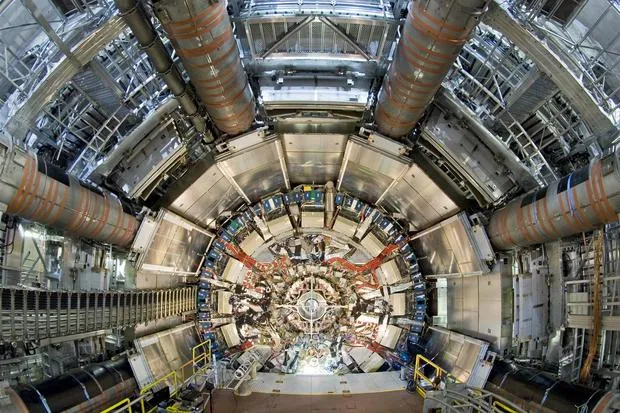
The particle physics lab CERN, home to the ATLAS experiment at the Large Hadron Collider shown here, celebrated its 60th anniversary on Sept. 29, 2014.
A never-before-seen particle has revealed itself in the hot guts of two particle colliders, confirming a half-century-old theory.
Scientists predicted the existence of the particle, known as the odderon, in 1973, describing it as a rare, short-lived conjointment of three smaller particles known as gluons. Since then, researchers have suspected that the odderon might appear when protons slammed together at extreme speeds, but the precise conditions that would make it spring into existence remained a mystery. Now, after comparing data from the Large Hadron Collider (LHC), the 17-mile-long (27 kilometers) ring-shaped atom smasher near Geneva that's famous for discovering the Higgs boson, and the Tevatron, a now-defunct 3.9-mile-long (6.3 km) American collider that slammed protons and their antimatter twins (antiprotons) together in Illinois until 2011, researchers report conclusive evidence of the odderon's existence.
Finding the odderon
Here's how they found it: After those particle collisions, the scientists watched to see what happened. They theorized that odderons would appear at slightly different rates in proton-proton collisions and proton-antiproton collisions. This difference would reveal itself in a slight mismatch between the frequencies of protons bouncing off other protons and the frequencies of protons bouncing off antiprotons.
The LHC and Tevatron collisions happened at different energy levels. But the researchers behind this new paper developed a mathematical approach to compare their data. And it produced this graph, which they called the "money plot":
A graph shows two similar lines that don't follow the exact same path. The difference between these two lines is due to the existence of the odderon.
(Image credit: Courtesy of The University of Kansas)
The blue line, representing proton-antiproton collisions, doesn't line up perfectly with the red line, which represents proton-proton collisions. That difference is the telltale sign of the odderon — demonstrated with 5 sigma statistical significance, meaning that the odds of an effect like this randomly emerging without odderons involved would be 1 in 3.5 million.
Why proton collisions create odderons
So, what are odderons? Fundamentally, they're a rare combination of three "sticky" particles known as gluons.
Protons aren't fundamental, indivisible particles. Rather, they're constructed of three quarks and many gluons. Those quarks are the heavy hitters of the subatomic world, relatively bulky and responsible for make up the mass of protons and neutrons (and, in turn, most of the mass of atoms) and electromagnetic charge. But the gluons play just as important a role: They carry the strong force, one of the four fundamental forces of the universe, responsible for "gluing" quarks together into protons and neutrons, and then binding those protons and neutrons together inside atomic nuclei.
Sign up for the Live Science daily newsletter now
Get the world’s most fascinating discoveries delivered straight to your inbox.
When protons collide at super high energies inside particle colliders like the LHC, they shatter into pieces about 75% of the time. The remaining 25% of the time, they bounce off one another like pool balls on a billiards table. In this instance — a process called elastic scattering — the protons survive the encounter. And physicists think that is possible because the protons exchange either two or three gluons. At the brief point of contact, that set of gluons travels from the interior of one proton to the interior of the other.
"In high-energy physics, we always exchange some particles when two protons interact, or a proton and an antiproton" interact, study lead author Christophe Royon, a physicist at The University of Kansas, told Live Science. "In most cases, it will be one gluon."
It's important that both protons-proton collisions and proton-anti-proton collisions exchange particles, because it's in the subtle difference between those two types of exchanges that the odderon was revealed.
Occasionally, a quasi state called a glueball — a pair or trio of gluons — emerges during a collision. Scientists had already confirmed the existence of the double glueball, but this is the first time they've observed with confidence the triple glueball called the odderon, the one that in 1973 was predicted to exist.
These glueballs keep protons intact because of a property called color. Colors (and anti-colors) are similar to positive and negative electromagnetic charges — they control how quarks and gluons attract or repel one another in a system much more intricate than electromagnetism known as quantum chromodynamics. Quarks and gluons can have one of three charges classified as red, green or blue. And a combination of red, green and blue is said to be "white" and, therefore, balanced.
Antiquarks, meanwhile, have anti-colors — anti-red, anti-green and anti-blue — which cancel out with their color counterparts to form stable, balanced white charge. And gluons have both colors and anti-colors.
But individual gluons are always an unstable mixture of color and anti-color: blue and anti-green, or red and anti-blue, etc. "Every gluon carries a color and an anti-color. And [these gluons] don't like to be alone," Royon said.
When a single gluon enters a new proton, it grabs onto the other particles — the quarks and gluons that make up the proton. The single gluon seeks to pair with particles that balance out its color and anti-color. But the colors inside the proton are already in balance, and the entrance of a foreign, unstable gluon disrupts the internal balance of the proton, triggering a cascade of events that rips the particle apart. That's what happens in 75% of the collisions, when protons shatter.
But in the quarter of cases where the protons bounce off each other instead of shattering, that's a sign that the gluon exchange involved a double or triple glueball (odderon) and so it didn't disrupt the protons' internal balance. Double glueballs have their own internal balance. Their color and anti-color charges are matched and slip easily from one proton to another without ripping them apart. In 1973, researchers showed that three gluons should, theoretically, be able to form a triple glueball in which red, green and blue colors balanced each other out. They called that particle the odderon.
Gluon and multi-gluon exchanges happen for the briefest of moments at the most extreme energies. Until now, no one had ever seen or directly detected an odderon (or the double glueball, for that matter, though its existence has been indirectly confirmed).
The detection of the Odderon won't change the face of physics, as SUNY Stony Brook astrophysicist Paul Sutter wrote in an article for Live Science in 2019, back when researchers first spotted possible evidence for the particle. Sutter and many other researchers argue that it's not a true particle at all but a quasiparticle, because it's nothing more than a temporary arrangement of smaller particles. (The same could be said of protons and neutrons, however.) Royon said the discovery is important because it confirms that the basic ideas about particle physics researchers used to predict the odderon's existence back in 1973 were correct.
Rafi joined Live Science in 2017. He has a bachelor's degree in journalism from Northwestern University’s Medill School of journalism. You can find his past science reporting at Inverse, Business Insider and Popular Science, and his past photojournalism on the Flash90 wire service and in the pages of The Courier Post of southern New Jersey.