















Was the 'Nazareth Inscription' a Roman response to Jesus' empty tomb? New evidence says it wasn't.

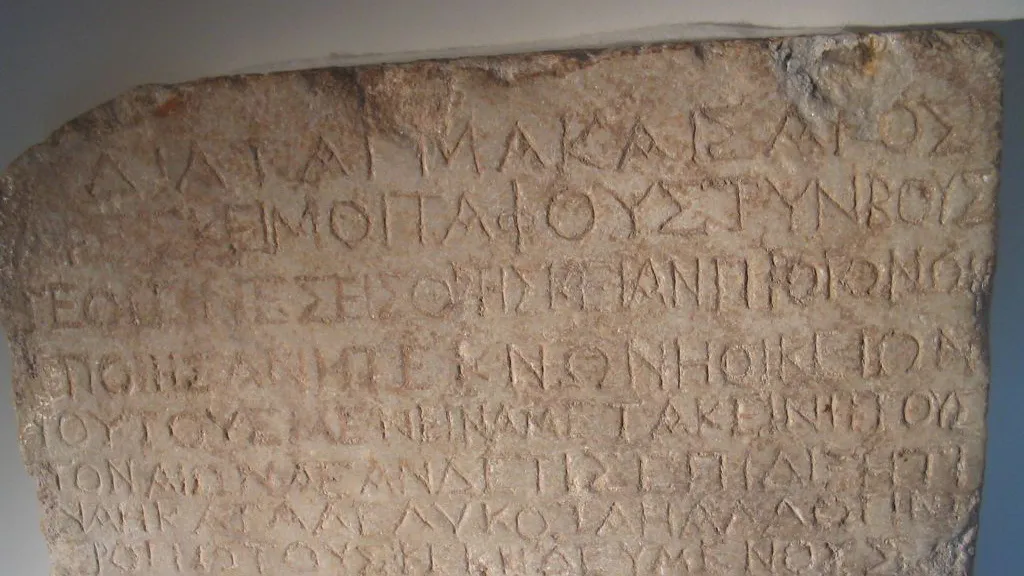
A stern warning carved in Greek on an ancient marble slab declared that a Roman emperor would pass harsh judgement on grave robbers, promising a severe punishment for their crimes. This artifact, known as the Nazareth Inscription, was long suspected to be an official Roman response to the disappearance of Jesus' body from its tomb.
However, new evidence suggests otherwise.
Scientists conducted the first isotope analysis of marble sampled from the slab, describing the results in a new study. Their findings offer fresh clues about where the carved edict came from and call into question its relationship to early Christianity.
Related: Proof of Jesus Christ? 7 pieces of evidence debated
Standing 24 inches high, 15 inches wide and 2 inches deep (60 by 15 by 6 centimeters), the slab was acquired in Paris in 1878 by the German collector Wilhelm Froehner. His notes on where it came from are vague, specifying only that it was "sent from Nazareth"; the site where the artifact was discovered, who found it and how it ended up in Paris are details that have been lost to history, the study authors reported.
Scholars published a translation of the inscription in 1930. Its 22 lines of text begin with "Edict of Caesar" and then proclaim that tombs and graves shall stay "forever unmolested." Should anyone remove human remains for illicit purposes, or disrespect or destroy remains in any way, "he shall suffer capital punishment on the charge of desecration of graves," the inscription went on, according to the new study.
The researchers further noted that the lettering style, along with the content, suggests that the warning was carved "sometime between the later first century B.C. and the first century C.E."
Get the world’s most fascinating discoveries delivered straight to your inbox.
Because of the slab's apparent age, its anti-grave-robbing message and its alleged origin in Nazareth — the town where Jesus was raised — some experts have argued that Roman authorities carved it after hearing that early Christians were heralding the disappearance of Jesus' body as proof of his divine resurrection.
"'Sent from Nazareth in 1878' is a clue that stirs the imagination but proves little," said lead study author Kyle Harper, a professor of classics and letters and Senior Vice President and Provost at The University of Oklahoma.
"And, it turns out, the note is very likely wrong," Harper told Live Science in an email.
Chemical fingerprints
For the new study, researchers turned to geochemical analysis to investigate the slab, now in the collection of the Bibliothèque national de France. They carefully abraded a very small section on the back of the slab to expose the original marble underneath, and then collected samples of marble powder. The scientists analyzed that powder for stable carbon and oxygen isotopes (forms of an element with a different number of neutrons in the nucleus), to see if they could find a match to marble in a specific geographic location, resolving once and for all where the artifact came from.
"We believe that it is the first time stable isotope chemistry has ever been used to establish the provenance of an inscription, period," Harper said. "It has been used for big architectural elements, sarcophagi and statues, but not, so far as we are aware, an inscription."
Related: Photos: 1st-century house from Jesus' hometown
They discovered that the unique isotopic fingerprints of the marble were a close match for a signature found in white marble from the Greek island of Kos, near Turkey's southwestern coast. If the slab's marble came from Kos, which is far from Nazareth, that diminishes the likelihood that the message had anything to do with early Christianity, the study authors reported.
Rather, it places the anonymous Caesar's warning in a new context, recalling an incident that took place decades prior to Jesus' purported demise. One possibility is that the inscription was a stern response to an incident that took place on Kos in the 30s B.C. After an unpopular official named Nikias died, locals broke into his tomb and desecrated the body; Nikias had been a powerful figure, and it's likely that the Roman edict promising to punish grave desecration was a response to the fate suffered by Nikias' corpse, according to the study.
"We got lucky twice over," Harper explained. "First, it was a very direct match with a rather unexpected marble quarry, so we could really pinpoint its origins on Kos. Second, it happened that we know of an episode of tomb violation that was very famous in the exact right period. I would have never hoped for such a remarkable alignment."
This information provides a new twist — and a likely resolution — to an archaeological mystery spanning more than a century, the researchers concluded.
The findings were published online in the April 2020 issue of the Journal of Archaeological Science: Reports.
Originally published on Live Science.
- The Holy Land: 7 amazing archaeological finds
- 8 Alleged Relics of Jesus of Nazareth
- 8 archaeological sites that Jesus may have visited

OFFER: Save 45% on 'How It Works' 'All About Space' and 'All About History'!
For a limited time, you can take out a digital subscription to any of our best-selling science magazines for just $2.38 per month, or 45% off the standard price for the first three months.

Mindy Weisberger is a science journalist and author of "Rise of the Zombie Bugs: The Surprising Science of Parasitic Mind-Control" (Hopkins Press). She formerly edited for Scholastic and was a channel editor and senior writer for Live Science. She has reported on general science, covering climate change, paleontology, biology and space. Mindy studied film at Columbia University; prior to LS, she produced, wrote and directed media for the American Museum of Natural History in NYC. Her videos about dinosaurs, astrophysics, biodiversity and evolution appear in museums and science centers worldwide, earning awards such as the CINE Golden Eagle and the Communicator Award of Excellence. Her writing has also appeared in Scientific American, The Washington Post, How It Works Magazine and CNN.