













Nuclear fusion reactor 'breakthrough' is significant, but light-years away from being useful
Useful, cost-effective nuclear fusion remains a distant dream, despite a small step in the right direction from the government's NIF reactor.

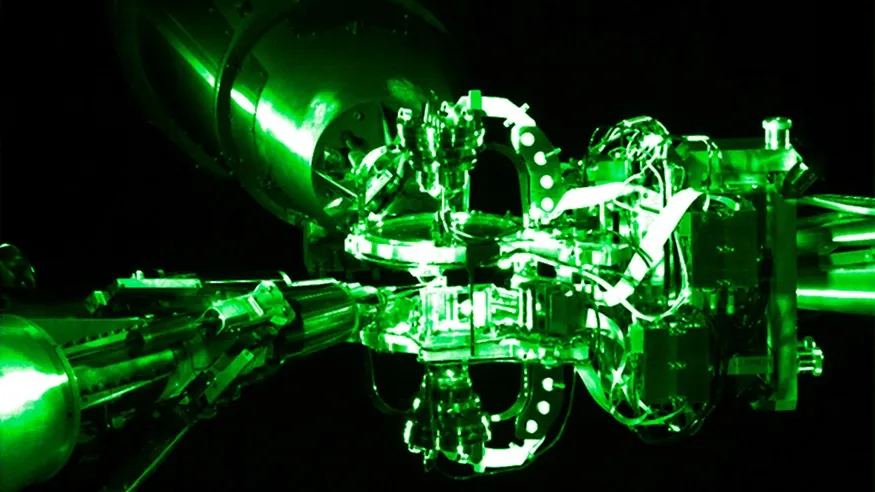
Scientists have just announced a breakthrough in nuclear fusion ignition: For the first time the heart of a powerful fusion reactor has briefly generated more energy than was put into it. But experts are urging caution, saying that the breakthrough, while hugely significant, is still a long way from safe, limitless nuclear energy.
On Tuesday (Dec. 13), physicists at the U.S. government-funded National Ignition Facility (NIF) at Lawrence Livermore National Laboratory in California announced that they were able to fire a laser carrying roughly 2 megajoules of energy into a tiny fuel pellet made up of two hydrogen isotopes, turning the atoms into plasma and producing 3 megajoules of energy — a 50% increase.
Scientists are very excited by the results, but wary of overhyping them. The reactor as a whole did not produce a net gain of energy. For a fusion reaction to be practically useful, the tens of megajoules drawn from the electrical grid, converted into the laser beams and fired into the reactor core would have to be significantly less than the energy released from the plasma.
Related: Nuclear fusion reactor core produces more energy than it consumes in world-first demonstration
But the new plasma ignition milestone only accounts for the laser energy in and the plasma energy out, not the sizable loss from converting electricity to light.
What's more, the reaction takes place in a tiny fuel pellet inside the world's biggest laser, lasts only a few billionths of a second, and can only be repeated every six hours. This makes the reaction far too inefficient for practical purposes.
"Net energy gain is a significant milestone, but to put it in perspective, it means fusion is now where Fermi put fission about eighty years ago," Ian Lowe, a physicist and emeritus professor at Griffith University in Australia, told Live Science. "The huge technical problem is maintaining a mass of plasma at a temperature of several million degrees to enable fusion, while extracting enough heat to provide useful energy. I still haven't seen a credible schematic diagram of a fusion reactor that achieves that goal."
Get the world’s most fascinating discoveries delivered straight to your inbox.

The National Ignition Facility's fusion reactor uses 192 laser beams to focus laser light into a hot-spot the diameter of a human hair.
How fusion reactors work
Existing fusion reactors can be split into two broad categories: inertial confinement reactors like the NIF's, which contain the hot plasma with lasers or particle beams, and magnetic confinement reactors, such as the U.K.-based Joint European Torus (JET), Europe's upcoming International Thermonuclear Experimental Reactor (ITER), and China's Experimental Advanced Superconducting Tokamak (EAST), which sculpt the plasma into various torus shapes with strong magnetic fields. At ITER, the field confining the burning plasma will be 280,000 times as strong as the one around Earth.
The varying reactor types reflect different strategies for overcoming fusion's intimidating technical barriers. Magnetic confinement reactors, known as tokamaks, aim to keep the plasma continuously burning for prolonged periods of time (ITER's goal is to do this for up to 400 seconds). But, despite edging ever closer, tokamaks have yet to create a net energy gain from their plasmas.
On the other hand, inertial confinement systems like the NIF reactor, which also operates to test thermonuclear explosions for military purposes, generate bursts of energy by quickly burning one tiny chunk of fuel after another. This fuel, however comes in the form of discrete pellets, and scientists have yet to figure out how to replace them quickly enough to maintain a reaction for longer than the tiniest fraction of a second.
"That is very, very tricky because it would mean that you need to position your next pellet during the time that the [plasma] cloud expands in the vessel," Yves Martin, the deputy director of the Swiss Plasma Center at the École polytechnique fédérale de Lausanne in Switzerland, told Live Science. "This pellet is typically one millimeter [0.04 inches] big in diameter and it has to be positioned in a room which is nine meters [30 feet] across. As far as I know, it still costs several tens of thousands of dollars [to get the reaction going]. To be interesting, it should go down to one dollar or even less."
A very expensive isotope
Another problem for fusion reactors is the dwindling supplies of tritium, a key isotope that is combined with deuterium as fuel for the reaction. Once a common and unwanted byproduct of open air nuclear weapons tests and nuclear fission — which splits atoms instead of combining them and produces far more radioactive waste — tritium's 12.3-year half-life means that much of its existing stock is already on the way to being unusable, making it one of the most expensive substances on Earth at $30,000 per gram.
Physicists have proposed other methods for making tritium, such as breeding it inside nuclear reactors that capture stray neutrons. But, besides some smaller scale experiments, rapidly ballooning costs meant plans to test tritium breeding at ITER had to be scrapped.
Fusion researchers believe that if the political will can be found and the engineering challenges solved, the first viable fusion reactors could come online as soon as 2040. But that's still ten years too late to keep global warming below the target of 1.5 degrees Celsius (2.7 degrees Fahrenheit), by 2030.
"Decision makers yearn for the holy grail of clean energy from an abundant resource," Lowe said. "Having spent squillions on fusion research, they are very reluctant to give up, just as they spent decades chasing the fantasy of the breeder reactor [a fission reactor which outputs more energy than it consumes]."
Nevertheless, recent years have seen improvements to fusion technology arriving in a steady stream. These include a successful trial of AI to control the plasma inside a tokamak; a slew of records in power generation, plasma burn time, and reactor temperatures across multiple experiments; and the rewriting of a foundational rule which could enable future reactors to generate twice as much power. In light of these advances, fusion scientists insist that multiple strategies for a long-term solution to the climate crisis are necessary, and that fusion will become a vital component of a future carbon-free energy system.
"If we wanted to rely on renewables only, we would need such an excess of installations to have the amount of energy you would typically need in winter, or in a period with no wind. We need something which will be the base level that will produce exactly what you want," Martin said. "It's not because I believe in fusion that I will not put some solar panels on my roof. In a sense, we really need to use everything that is better than fossil fuels."

Ben Turner is the features editor at Live Science. He covers physics and astronomy, among other topics such as tech and climate change. He graduated from University College London with a degree in particle physics before training as a journalist. When he's not writing, Ben enjoys reading literature, playing the guitar and losing at chess.