













Your doppelgänger doesn’t just look like you — they behave like you too
Human genetic variation is far from infinite

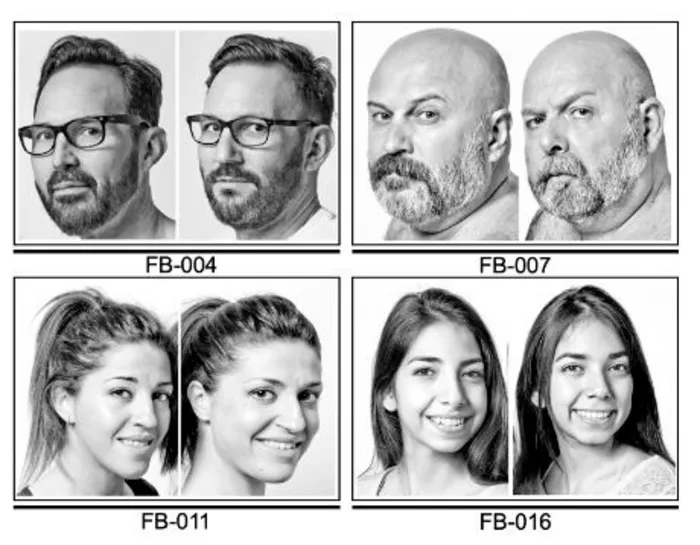
Somewhere out there, there's probably a person who has your face. And this unrelated look-alike may have more in common with you than appearances, a new study suggests.
The surprising research, based on 32 pairs of unrelated doppelgängers from around the world, shows that two people who have a strong facial similarity to each other are also likelier to share significantly more of their genes and be more likely to share similar behaviors; but the genes that get switched on or off, and the microbial ecosystems in the two people’s bodies, still differ.
These "virtual twins" had never met and were instead recruited thanks to the work of Canadian artist and photographer François Brunelle, who had been collecting pictures of look-alikes since 1999. The researchers published their findings Aug. 23 in the journal Cell Reports.
Related: Ticking time bombs of DNA mutation may dictate when animals die
"Our study provides a rare insight into human likeness by showing that people with extreme lookalike faces share common genotypes, whereas they are discordant at the epigenome [the genes which are switched on or off] and microbiome levels," senior author Manel Esteller, the director of the Josep Carreras Leukaemia Research Institute in Barcelona, Spain, said in a statement. "Genomics clusters them together, and the rest sets them apart."
For the study, the 32 look-alike pairs completed a lifestyle and biometric questionnaire in their native languages, and the researchers used three different facial recognition algorithms to score the pairs’ likenesses — of which half were considered doppelgängers by all three algorithms.
Taking these 16 highly similar pairs, the researchers then investigated their genomic structure using DNA analysis. The analysis revealed that nine of the 16 pairs were "ultra" look-alikes; they not only appeared closely related, they also shared 19,277 common genetic variations (called single nucleotide polymorphisms, or SNPs) in 3,730 genes. However, these extreme look-alikes were no more likely to share similar epigenetics or microbiomes than pairs that did not look alike.
Get the world’s most fascinating discoveries delivered straight to your inbox.
Many of the look-alikes didn't just share some of their genetics either, but also had similar smoking habits, education levels and weights — a reminder that behavior can be profoundly influenced by genes.
RELATED STORIES
"These findings do not only provide clues about the genetic setting associated with our facial aspect, and probably other traits of our body and personality, but also highlight how much of what we are, and what defines us, is really inherited or instead is acquired during our lifetime," the authors wrote in the study.
Perhaps most fascinating of all is that these genetic similarities between unrelated doppelgängers occurred by random chance, implying that the combinations the human genome can take are far from infinite, especially on a planet that is fast approaching a population of 8 billion people.
The researchers say that their findings could be used in fields such as evolution, biomedicine and forensics
"These results will have future implications in forensic medicine — reconstructing the criminal's face from DNA —and in genetic diagnosis — the photo of the patient's face will already give you clues as to which genome he or she has," Esteller said. "Through collaborative efforts, the ultimate challenge would be to predict the human face structure," based on genes and other factors.
Originally published on Live Science.

Ben Turner is a U.K. based writer and editor at Live Science. He covers physics and astronomy, tech and climate change. He graduated from University College London with a degree in particle physics before training as a journalist. When he's not writing, Ben enjoys reading literature, playing the guitar and embarrassing himself with chess.