













Children can be stealth superspreaders of malaria to mosquitoes

Children infected with malaria can become "superspreaders" and pass the parasite to droves of local mosquitoes, even if the kids never develop symptoms of the disease, a new study suggests.
Since this disease is passed from humans to mosquitoes and then back again, rather than from person to person, this finding is worrisome.
If malaria goes untreated in these asymptomatic children, the parasites will continue to circulate among mosquitoes, even in places that employ intensive malaria controls like insecticides, bednets, and free diagnostic tests and treatments. According to new research, presented Wednesday (Nov. 18) at the annual meeting of the American Society of Tropical Medicine and Hygiene (ASTMH), even a small number of infected children can transmit malaria parasites to a mob of mosquitoes, which can then go on to infect more humans.
From their new research in Uganda, the researchers concluded that asymptomatic children between ages 5 and 15 are the main source of infection for local mosquitoes in the region they studied. Some of these children were so-called superspreaders, meaning they infected a much larger number of mosquitoes than others; in experiments where mosquitoes were fed blood samples from infected people, more than 60% of the resulting mosquito infections could be traced back to just four asymptomatic children, two of whom were school-age. The other two superspreaders were ages 3 and 4.
Related: The 10 most diabolical and disgusting parasites
Despite some children becoming infected with multiple malaria clones during the study, these kids never fell ill and continued to lead a "normal life … somehow living with all these parasites," said lead author Chiara Andolina, a graduate student and malaria expert at Radboud University Medical Center in the Netherlands. Malaria is well controlled in the region the team studied, but should control efforts ever falter or cease, these children could potentially fuel a resurgence of disease in the area.
To prevent malaria cases from rebounding, control efforts could specifically target school-age children, senior author Teun Bousema, a malaria epidemiologist at Radboud, told Live Science. For example, regular malaria screenings and treatment campaigns in schools could have a "very meaningful impact" on depleting reservoirs of malaria, and ultimately, driving the case count down to zero, he said.
Get the world’s most fascinating discoveries delivered straight to your inbox.
Spotting superspreaders
Asymptomatic malaria infections make up 80% or more of the cases detected through comprehensive screenings in areas where the disease regularly circulates, Bousema said. Studies suggest that these asymptomatic infections crop up most often in school-age children.
While scientists agree that mosquitoes pick up malaria from both symptomatic and asymptomatic people, there's a question as to whether one kind of infection is more or less infectious than the other. In search of the answer, the study authors traveled to the Tororo district of Uganda.
Malaria was once incredibly common in Tororo; as recently as 2011, each resident was bitten about 310 times per year by malaria-infected mosquitoes, Andolina said in her ASTMH presentation. Now, after years of intensive malaria control, infection rates have plummeted. In 2018, exposure to infectious mosquitoes fell to only 0.43 bites per person, per year.
"It's sort of a blueprint for what you can expect — if you really invest very heavily in malaria control, you can bring malaria burden down," Bousema said. But to completely eliminate malaria, scientists have to find and purge any remaining hideouts of the parasite, he added.
Related: 11 (sometimes) deadly diseases that hopped across species
To do so in Tororo, the team recruited 531 adults and children from 80 households and monitored them for malaria for two years. Each month they conducted diagnostic tests and collected blood samples from the participants; the blood was screened for malaria parasites and then used in mosquito-feeding experiments.

After feeding mosquitoes the blood of infected people, the study authors dissected the insect to see if they showed signs of malaria infection.
To pass from humans to mosquitoes, malaria parasites must first mature into "gametocytes;" once being ingested by the blood-sucking insects, the gametocytes divide into sex cells, fertilize each other and multiply. With this in mind, the team also analyzed the density of gametocytes in the human blood samples, as the number can hint at how infectious that blood might be to mosquitoes.
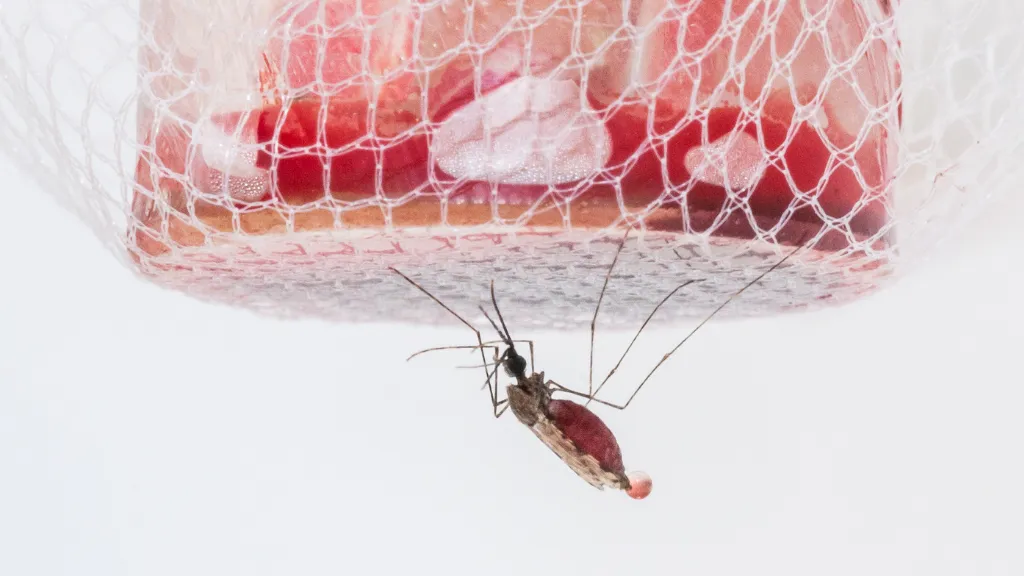
Over the course of the study, the team detected 148 episodes of malaria — 38 symptomatic and 110 asymptomatic. They conducted nearly 540 mosquito-feeding experiments with blood from 107 of the infected people, using an apparatus that keeps the blood warm with circulating water. In each experiment, dozens of mosquitoes got released into a container with the apparatus, where they could access the blood through a membrane that mimicked human skin.
The team later dissected the fed mosquitos to see how many became infected, and the vast majority of infections were linked to blood from asymptomatic people.
In all, blood from symptomatic people only infected 0.6% of the total infected mosquitoes.
Targeting hidden reservoirs
This trend is likely due, in part, to symptomatic people having easy access to malaria treatment, the authors said.
"In our study, children and adults if they fell sick … often they went to the clinic before they developed these transmissible gametocytes," Bousema said. Gametocytes take nine to 12 days to reach maturity, during which time most symptomatic people had already gotten treatment. "It actually demonstrates that if your access to care is very good, you can prevent symptomatic individuals from transmitting."
The challenge then becomes identifying infected people without symptoms, so that their chains of transmission can also be broken, he said. Notably, some asymptomatic people in the study remained infectious for months, though their gametocyte levels fluctuated over time. For example, two children remained infectious for six months without ever developing symptoms of malaria.
Related: 20 of the worst epidemics and pandemics in history
Related Content
"Asymptomatic infections really dominated in children … and schoolchildren somehow have longer duration infections, higher gametocyte densities, and thus were really the important source for mosquitoes to become infected," Bousema said.
Overall, the researchers estimated that children ages 5 to 15 represent nearly 57% of the infectious reservoir, meaning they carry most of the parasites that could infect mosquitoes with malaria. Following school-age children, children younger than 5 represent 27.5% of the reservoir, while those age 16 and older represent the remaining 15.7%.
Malaria control measures, such as insecticide-treated nets to cover people's beds, are often prioritized for young children under age 5 and pregnant women, but school-age children might get overlooked, the authors noted. Beyond nets, test-and-treat campaigns at schools could help snuff out new cases of malaria before they get passed to local mosquitoes, they said, and preventative medications, many of which can also be used to treat malaria, could help kids avoid picking up the parasites in the first place.
Originally published on Live Science.

Nicoletta Lanese is the health channel editor at Live Science and was previously a news editor and staff writer at the site. She is a recipient of the 2026 AHCJ International Health Study Fellowship, with a project focused on antibiotic stewardship practices in Japan and the U.S. They hold a graduate certificate in science communication from UC Santa Cruz and degrees in neuroscience and dance from the University of Florida. Beyond Live Science, Lanese's work has appeared in The Scientist, Science News, the Mercury News, Mongabay and Stanford Medicine Magazine, among other outlets. Based in NYC, she also remains involved in dance and performs in local choreographers' work.