
















Giant 'potentially hazardous' asteroid will fly safely by Earth in April
Don't worry. It won't even come close to hitting us.

A large and "potentially hazardous" asteroid is poised to fly by Earth next month, but don't worry — it poses no threat to Earth.
Asteroid (52768) 1998 OR2 will make a close approach to Earth on April 29. The hefty space rock has an estimated diameter of 1.1 to 2.5 miles (1.8 to 4.1 kilometers), or about the width of the isle of Manhattan.
While an asteroid that size could wreak havoc if it crashed into Earth — prompting some alarmist and misinformed media reports — this asteroid poses no threat.
Video: Big asteroid 1998 OR2 will safely fly by (imagery + orbit animation)
Related: Potentially dangerous asteroids (images)
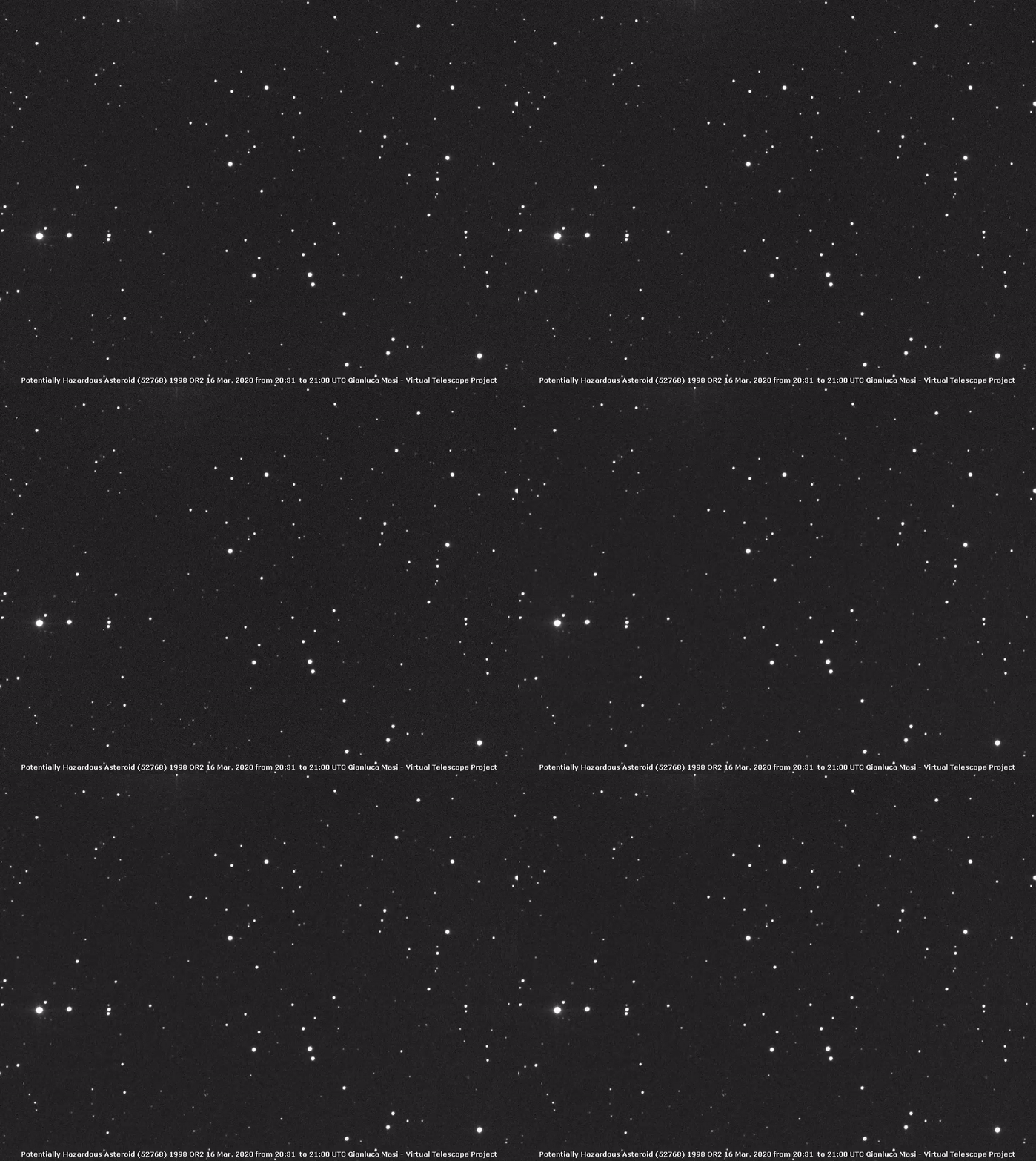
This animation by Gianluca Masi at the Virtual Telescope Project shows the movement of the potentially hazardous asteroid 1998 OR2 in the night sky on March 16, 2020, between 4:31 p.m. EDT and 5 p.m. EDT (2031-2100 GMT).
At its closest approach, which will happen at about 5:56 a.m. EDT (0956 GMT), asteroid 1998 OR2 will be 3.9 million miles (6.3 million km) from Earth. That's more than 16 times the average distance between Earth and the moon.
NASA has classified asteroid 1998 OR2 as "potentially hazardous" not because it puts Earth in danger, but because it fulfills certain criteria in the agency's classification scheme. According to NASA, an asteroid qualifies as "potentially hazardous" if its orbit ever intersects Earth's orbit at a distance less than 4.6 million miles (7.5 million km), or 0.05 astronomical units, the average distance between Earth and the sun.

Two images from the Virtual Telescope Project's "Elana" astrograph telescope show the potentially hazardous asteroid 1998 OR2 in the night sky on March 16, 2020, at approximately 4:45 p.m. EDT (2045 GMT). Each image is the average of 10 separate 180-second exposures. In the top image, the telescope tracked the asteroid's motion, so the asteroid appears as a white dot among a sea of small star trails. For the second image, the telescope remained fixed on the stars, so the asteroid has a small trail.
Asteroid 1998 OR2, which orbits the sun in between the orbits of Earth and Mars, won't fly by Earth again until May 18, 2031, and it will be farther away, passing about 12 million miles (19 million km) from our planet, according to NASA.
Get the world’s most fascinating discoveries delivered straight to your inbox.
Its next two flybys, in 2048 and 2062, will be even farther away. The closest flyby of asteroid 1998 OR2 for the foreseeable future will be on April 16, 2079, when it will be only 1.1 million miles (1.8 million km) away.
NASA and its international partners are actively scanning the skies for potentially hazardous asteroids and studying ways to deflect an Earth-bound asteroid before it strikes. So far, about one-third of the 25,000 large asteroids thought to be zooming around in Earth's cosmic neighborhood have been discovered.
- The Hunt for Dangerous Asteroids: Here's How Scientists Do It
- NASA wants a new space telescope to hunt asteroids that may threaten Earth
- Planetary defense joins NASA's menu for next decadal survey focus
Email Hanneke Weitering at [email protected] or follow her @hannekescience. Follow us on Twitter @Spacedotcom and on Facebook.

OFFER: Save at least 56% with our latest magazine deal!
All About Space magazine takes you on an awe-inspiring journey through our solar system and beyond, from the amazing technology and spacecraft that enables humanity to venture into orbit, to the complexities of space science.

Hanneke Weitering is an editor at Liv Science's sister site Space.com with 10 years of experience in science journalism. She has previously written for Scholastic Classroom Magazines, MedPage Today and The Joint Institute for Computational Sciences at Oak Ridge National Laboratory. After studying physics at the University of Tennessee in her hometown of Knoxville, she earned her graduate degree in Science, Health and Environmental Reporting (SHERP) from New York University. Hanneke joined the Space.com team in 2016 as a staff writer and producer, covering topics including spaceflight and astronomy.