













Roman emperor Caligula's 2,000-year-old garden unearthed near the Vatican
The gardens overlooking the Tiber river in Italy once belonged to an infamous Roman emperor.
Construction workers in Italy have discovered a 2,000-year-old garden that once belonged to a Roman emperor.
The travertine walls of the garden overlook the banks of the Tiber, a river that cuts through Rome and sits east of Vatican City. The ruins were unearthed as workers constructed a new overpass at Piazza Pia, according to a translated statement from the Italian Ministry of Culture.
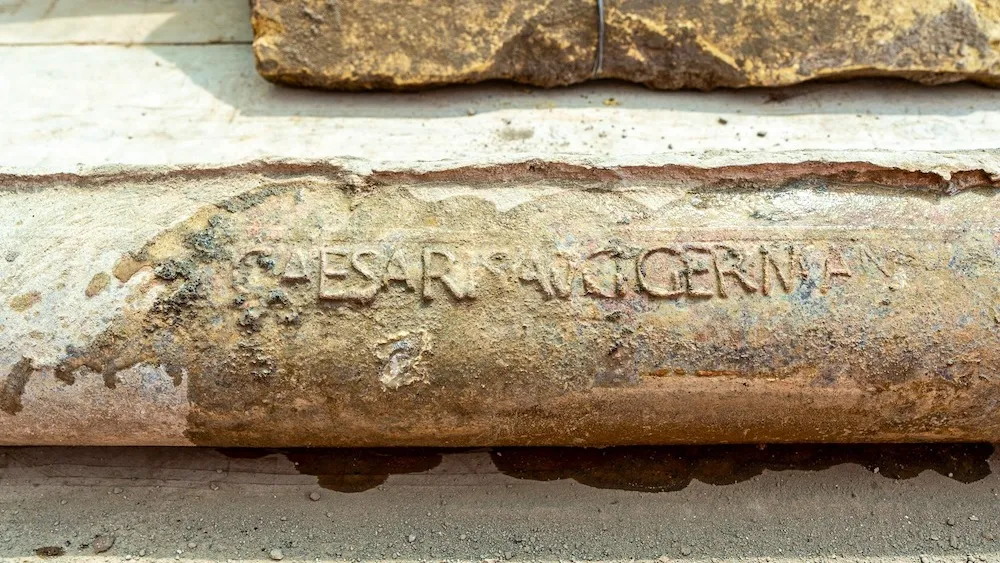
As archaeologists removed debris, they found a lead water pipe with the following inscription: "C(ai) Cæsaris Aug(usti) Germanici." Researchers determined that the engraving referred to Gaius Caesar Augustus Germanicus, better known as Caligula (aka "little boot," a childhood nickname given to him by his father's soldiers).
Based on the inscription, researchers think the garden likely belonged to the infamous Roman emperor. Not only was Caligula known for being a tyrannical and ruthless leader, he was also a sadist who humiliated his senate. Caligula assumed the throne in A.D. 37, and in A.D. 41 the Praetorian Guard — the officials who were supposed to protect him — assassinated the emperor.
Related: Villa near Mount Vesuvius may be where Augustus, Rome's 1st emperor, died
This conclusion is supported by a passage in the ancient text "On the Embassy to Gaius," penned by Egyptian philosopher Philo of Alexandria. It describes how Caligula had met with a representative of Jews living in Alexandria, Egypt, at a large garden along the Tiber, according to the statement.
At that time, Jewish Alexandrians and the Greek-Alexandrian population were in a "crisis that had manifested itself with violence, brawls and episodes of religious intolerance." However, Caligula rejected the Jews' requests for religious autonomy, instead siding with the Greeks.
Get the world’s most fascinating discoveries delivered straight to your inbox.
RELATED STORIES
Alessio De Cristofaro, an archaeologist at the Special Superintendency for Archaeology, Fine Art and Landscape, a government agency in Rome, said the find is significant because Piazza Pia is in the same area as the "Horti Agrippinae," the garden of Agrippina the Elder, who was Caligula's mother.
The pipe is also similar to another one, found in the early 1900s, that's inscribed with the name Iulia (Julia) Augusta, the second wife of Augustus and the grandmother of Germanicus. Researchers speculate that the property was inherited by Germanicus and later passed down to his wife, Agrippina the Elder, before going to Caligula.
In addition to the pipe, archaeologists found slabs of Roman-era pottery and terra-cotta figures of mythological scenes that would have decorated rooftops.
Jennifer Nalewicki is former Live Science staff writer and Salt Lake City-based journalist whose work has been featured in The New York Times, Smithsonian Magazine, Scientific American, Popular Mechanics and more. She covers several science topics from planet Earth to paleontology and archaeology to health and culture. Prior to freelancing, Jennifer held an Editor role at Time Inc. Jennifer has a bachelor's degree in Journalism from The University of Texas at Austin.