













2 rare Roman cavalry swords from 1,800 years ago discovered by UK metal detectorist
A metal detectorist unearthed a pair of swords once used by the Roman cavalry.
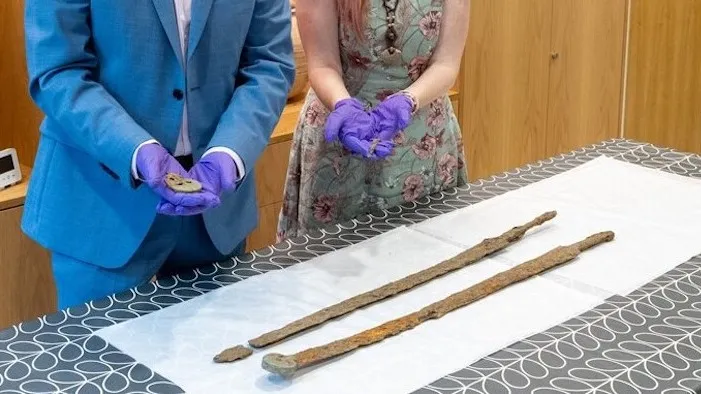
A metal detectorist discovered two 1,800-year-old Roman cavalry swords still protected in remnants of their wooden scabbards, or sheaths in the North Cotswolds, England.
Glenn Manning found the artifacts in March while participating in a metal detectorist rally, according to BBC News.
Archaeologists determined that due to their long, straight-edged blades that they were spatha swords, a type of weapon that was commonly issued to cavalry officers riding on horseback during the Roman Empire between the first century and third century A.D., according to a statement.
Based on the style of the newfound swords, they date to the late second century A.D. and were likely used by either calvary or civilians, Simon James, an archeology professor at the University of Leicester, said in the statement.
Related: 'It's a dream': 4 Roman swords likely stolen as war booty 1,900 years ago discovered in Israeli cave
"These two swords are testimony of the presence of the Roman military in the northern Cotswold District," Emma Stuart, the director of the Corinium Museum, said in a YouTube video describing the discovery. "It's an incredibly important find."
The swords are a rarity, being two of only four Roman swords found in this region, according to the statement.
Get the world’s most fascinating discoveries delivered straight to your inbox.
"In terms of parallels, I can't think of finds of more than one sword being deposited in any similar circumstance from Roman Britain," James, who analyzed the items, said. "The closest that springs to mind was a pair of similar swords found in Canterbury — with their owners, face down in a pit within the city walls, clearly a clandestine burial, almost certainly a double murder."
Manning also found a broken copper-alloy bowl near the weapons.

RELATED STORIES
However, much remains unknown about the swords.
"The question is and the mystery is, why were those swords buried in the north of the Cotswolds? What were they doing there?" Stuart said in the YouTube video. To investigate, archaeologists may revisit the site to carry out further excavations later this year, she said.
A different group of archaeologists found a 1,300-year-old spatha sword buried with a Frankish warrior earlier this summer in Germany. Spatha swords gave horse-mounted troops a blade that was longer than the Roman gladius, which was often used by Roman foot soldiers.
The newfound swords will soon undergo X-ray analysis. The Corinium Museum plans to put the swords on display next year, according to BBC News.
Jennifer Nalewicki is former Live Science staff writer and Salt Lake City-based journalist whose work has been featured in The New York Times, Smithsonian Magazine, Scientific American, Popular Mechanics and more. She covers several science topics from planet Earth to paleontology and archaeology to health and culture. Prior to freelancing, Jennifer held an Editor role at Time Inc. Jennifer has a bachelor's degree in Journalism from The University of Texas at Austin.