Five millennia ago, Bronze Age people in Mesopotamia built elaborate stone tombs full of spectacular grave goods and human sacrifices. Researchers are unsure of the meaning of this ritual, but a new study of the skeletons points to a clue: the age at which people were sacrificed and their biological sex.
"The fact that they are mostly adolescents is fascinating and surprising," David Wengrow, a professor of comparative archaeology at University College London, told Live Science. "It highlights how little thought scientists and historians have really given to the importance of adolescence as a crucial stage in the human life cycle."
The finding may also upend assumptions about the type of government this culture practiced. Previously, it was thought to be a king-led hierarchical society, but these burials hint at a more egalitarian organization.
Ancient burials in Turkey
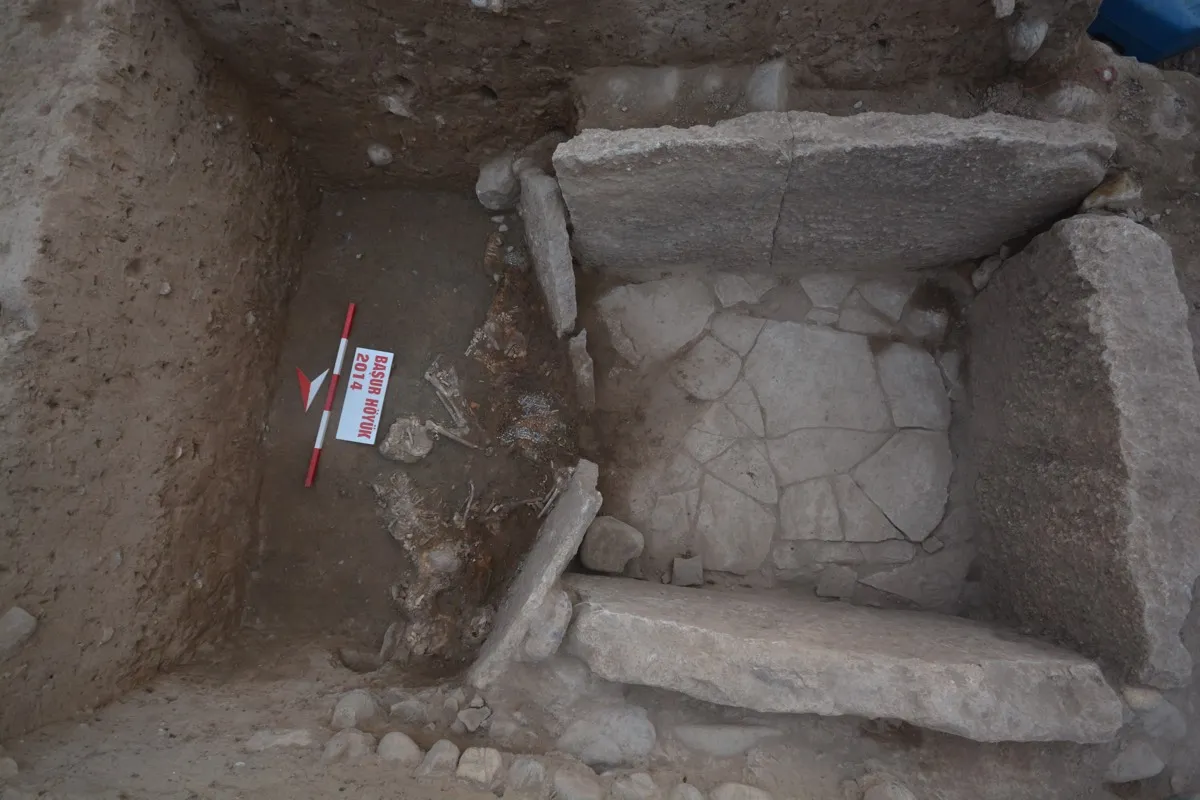
Wengrow and colleagues have studied a series of skeletons found at the archaeological site of Başur Höyük on the Upper Tigris River in southeastern Turkey. Once part of ancient Mesopotamia, Başur Höyük is dated to between 3100 and 2800 B.C. Several stone tombs were discovered there a decade ago, full of hundreds of copper artifacts, textiles and beads.
In a previous study, researchers identified a burial of two 12-year-old children flanked by eight violently killed people and suggested the funeral ritual indicated the rise of an early state that included "royal" tombs with "retainer sacrifice."
But in a new study, published March 17 in the Cambridge Archaeological Journal, the researchers conducted ancient DNA analysis on a separate set of skeletons and presented a more nuanced view of the cemetery, focusing on the idea of adolescence as an important life stage in this society.
Get the world’s most fascinating discoveries delivered straight to your inbox.
Assemblages of beads discovered inside one of the graves at Başur Höyük.
(Image credit: Photograph by permission of the Başur Höyük Research Project; Cambridge Archaeological Journal 2025)
Ancient DNA analysis of nine skeletons from Başur Höyük showed that the people were not biologically related to one another. The DNA also showed that most of the people the researchers tested were female.
"So we are dealing with adolescents brought together, or coming together voluntarily, from biologically unrelated groups to carry out a very extreme form of ritual," Wengrow said. The meaning of the ritual, however, is still unclear.
Previously, researchers thought that the main burials represented young royals with their sacrificed attendants. But this interpretation was based on the idea that early Bronze Age societies had evolved into large-scale states with a king at the top of the social hierarchy.
There is now more archaeological evidence that Bronze Age political systems were more flexible. Societies in Mesopotamia could have regularly switched between hierarchical, king-based rule and a more egalitarian social organization where people collectively make decisions.
"The idea that humans evolved to live in just one form of society almost all the time is almost certainly wrong," Wengrow said. If Başur Höyük was one of these more fluid societies, the "royal" burial may be better explained as a complex and potentially age-related funeral tradition.
"Much more likely, what we see in the cemetery is a subset of a larger group, other members of which survived the ritual process and went on to full adulthood," Wengrow said. This larger group can be called an "age set," according to the study.
In general, in egalitarian societies, leadership is earned instead of inherited, but "age sets" and gender can also come into play. For instance, elders may be valued for their wisdom and experience, while adolescents may be valued for their hunting skills. In the case of the Bronze Age burials in Turkey, this "age set" of adolescents could represent initiates into an ancient cult or victims of inter-group competition or violence, the researchers note in their study.
Few researchers focus on adolescence in ancient societies, the researchers noted in their study, so the Başur Höyük burials suggest that it is important to investigate age sets in early Bronze Age states rather than assuming the society was led by kings and other royals at the top of a political hierarchy.
Further research on the skeletons is forthcoming, Wengrow said, in terms of stable isotope analysis to figure out the origins of the people buried at Başur Höyük.
"For now, all we can say is that many of the teenagers buried in the tombs were not local to the area of the cemetery," he said.
Kristina Killgrove is a staff writer at Live Science with a focus on archaeology and paleoanthropology news. Her articles have also appeared in venues such as Forbes, Smithsonian, and Mental Floss. Kristina holds a Ph.D. in biological anthropology and an M.A. in classical archaeology from the University of North Carolina, as well as a B.A. in Latin from the University of Virginia, and she was formerly a university professor and researcher. She has received awards from the Society for American Archaeology and the American Anthropological Association for her science writing.
You must confirm your public display name before commenting
Please logout and then login again, you will then be prompted to enter your display name.