Get the world’s most fascinating discoveries delivered straight to your inbox.
You are now subscribed
Your newsletter sign-up was successful
Want to add more newsletters?
Delivered Daily
Daily Newsletter
Sign up for the latest discoveries, groundbreaking research and fascinating breakthroughs that impact you and the wider world direct to your inbox.
Once a week
Life's Little Mysteries
Feed your curiosity with an exclusive mystery every week, solved with science and delivered direct to your inbox before it's seen anywhere else.
Once a week
How It Works
Sign up to our free science & technology newsletter for your weekly fix of fascinating articles, quick quizzes, amazing images, and more
Delivered daily
Space.com Newsletter
Breaking space news, the latest updates on rocket launches, skywatching events and more!
Once a month
Watch This Space
Sign up to our monthly entertainment newsletter to keep up with all our coverage of the latest sci-fi and space movies, tv shows, games and books.
Once a week
Night Sky This Week
Discover this week's must-see night sky events, moon phases, and stunning astrophotos. Sign up for our skywatching newsletter and explore the universe with us!
Join the club
Get full access to premium articles, exclusive features and a growing list of member rewards.
Egyptian evisceration
A systematic analysis of ancient Egyptian mummy evisceration has found that historical descriptions of the techniques may have been off-base
Trade secret
In ancient Egypt, embalmers had guild-like organizations and their tricks of the trade were closely guarded secrets.
Father of history
But in the fifth century B.C., ancient Greek historian Herodotus managed to get an inside peek at the industry and described the techniques used to eviscerate the dead.
Organ removal
In his histories, he says that the highest classes were the only ones eviscerated with a trans-abdominal slit, and that the brain was always removed. Other accounts suggested the heart was always removed.
Cedar oil enema?
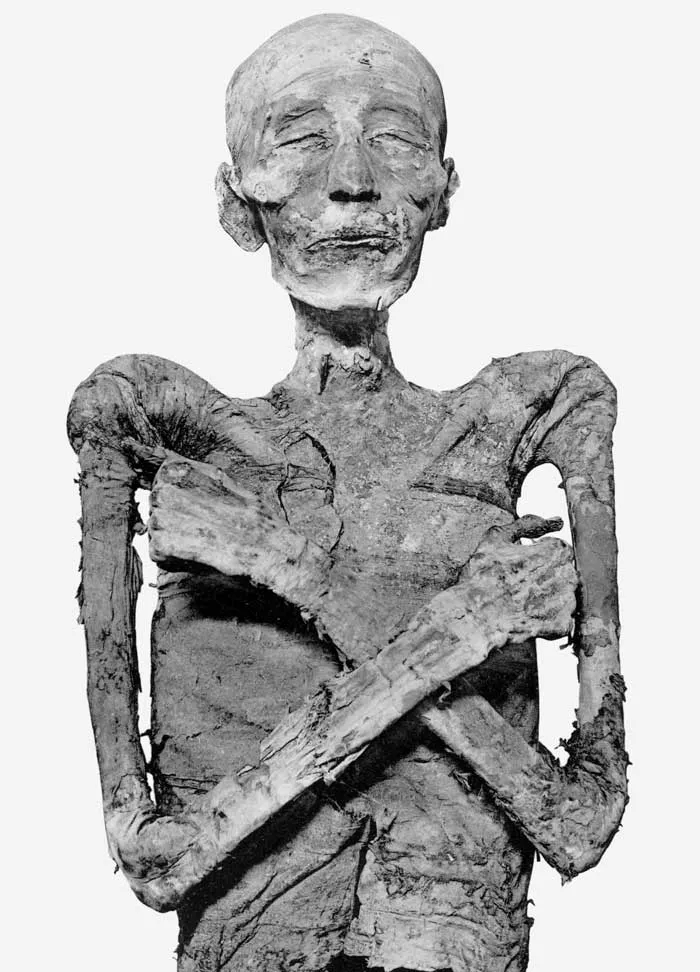
The lower classes, he said, received a cedar oil enema to eat away their internal organs.
Thorough analysis
But researchers Andrew Wade and Andrew Nelson wanted to see whether Herodotus accounts matched practices we actually see in mummies. They analyzed mummies described in the literature, and performed CT scanning on several others. Here, a Theban male mummy from the Redpath museum gets scanned.
Varied techniques
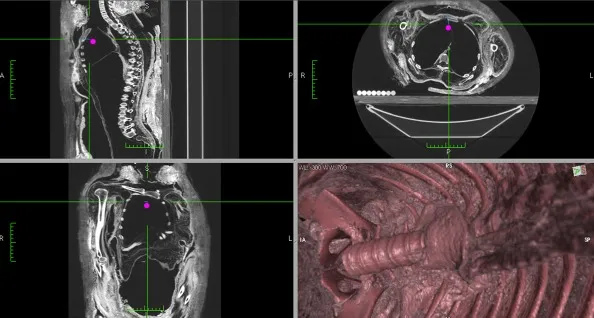
They found that contrary to Herodotus' accounts, the upper and lower classes alike tended to get the trans-abdominal slit, with a cut through the anus restricted to elites.
Get the world’s most fascinating discoveries delivered straight to your inbox.
Mummy skeleton
Mummies didn't show evidence of cedar oil enemas. In addition, the mummies didn't always have their hearts left in place and their brains removed. Here, a 3D reconstruction of a mummy, with an oval indicating the incision site.

Tia is the editor-in-chief (premium) and was formerly managing editor and senior writer for Live Science. Her work has appeared in Scientific American, Wired.com, Science News and other outlets. She holds a master's degree in bioengineering from the University of Washington, a graduate certificate in science writing from UC Santa Cruz and a bachelor's degree in mechanical engineering from the University of Texas at Austin. Tia was part of a team at the Milwaukee Journal Sentinel that published the Empty Cradles series on preterm births, which won multiple awards, including the 2012 Casey Medal for Meritorious Journalism.
