













Impending Galactic Crash Could Rip Open the Black Hole at the Milky Way’s Center

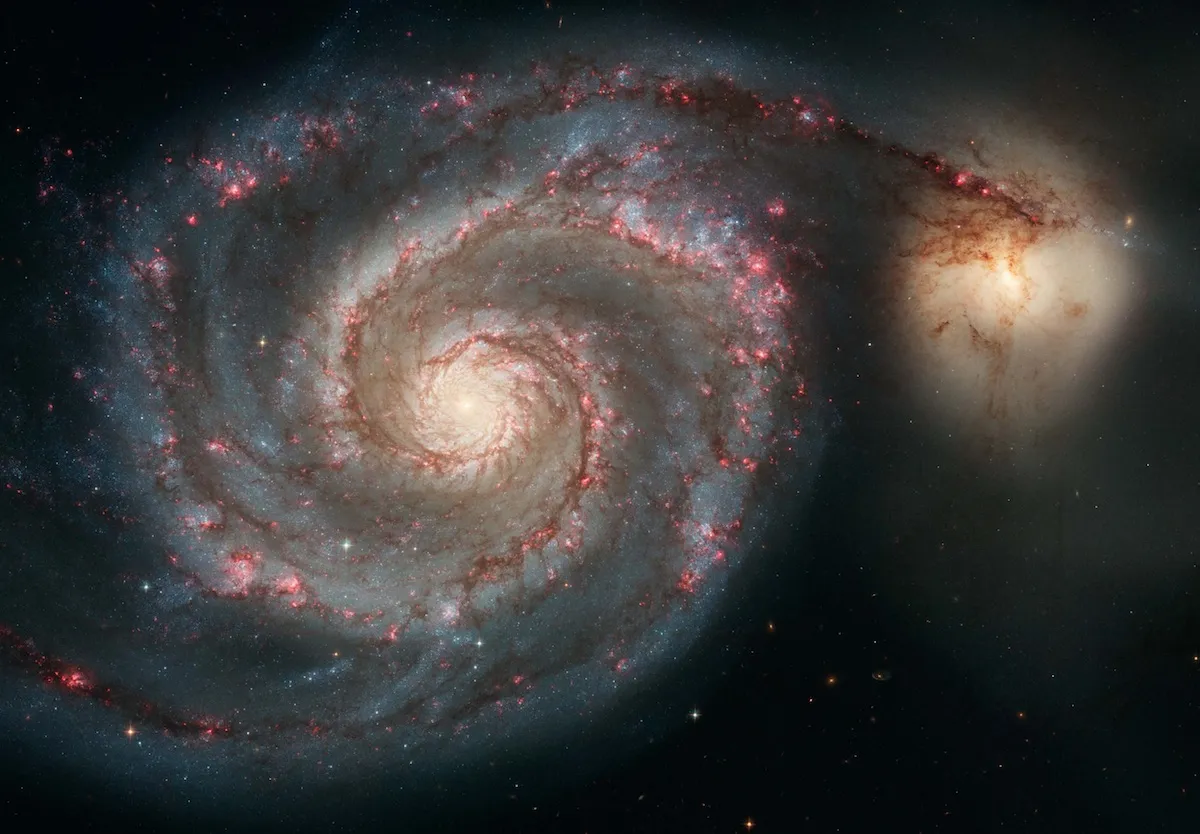
The end of the Milky Way as we know it may come a few billion years ahead of schedule.
According to a new paper published Jan. 4 in the journal Monthly Notices of the Royal Astronomical Society, our home galaxy appears to be on a crash course with one of its nearest satellites, the spiral of stars known as the Large Magellanic Cloud (LMC).
This cosmic crash, modeled in lovely and terrifying detail by a team of astrophysicists at Durham University in the U.K., could begin as soon as 2 billion years from now — roughly 2 billion to 3 billion years sooner than the long-anticipated collision between the Milky Way and its nearest cosmic neighbor, the Andromeda Galaxy. (Adjust your doomsday clocks accordingly.)
While the LMC boasts only about one-twentieth the solar mass of the Milky Way, the collision would nevertheless leave permanent scars on both galaxies, igniting once-dormant black holes, flinging stars quadrillions of miles out of orbit and staining the sky with crackling cosmic radiation.
"The destruction of the Large Magellanic Cloud, as it is devoured by the Milky Way, will wreak havoc with our galaxy," Marius Cautun, lead study author and postdoctoral fellow in Durham University's Institute for Computational Cosmology, said in a statement.
When galaxies collide
Galactic collisions are a common occurrence in the surprisingly-crowded infinity of space, and scientists are getting pretty good at modeling how fresh mergers might play out. Using a supercomputer collision simulator called EAGLE, the Durham team modeled several possible scenarios for the impending Milky Way/LMC merger.
What will change for our galaxy? For starters, the colliding LMC would likely pour loads of fresh gas and stars into the black hole at the center of the Milky Way, breathing fresh life into the once-sleeping giant. According to Cautun and colleagues, such a collision could bulk up the black hole to about 8 times its current size, possibly even turning it into a quasar — one of the brightest objects in the universe, which occurs when a supermassive black hole sucks in and spits out blazing celestial matter at near-light-speed.
Get the world’s most fascinating discoveries delivered straight to your inbox.
Should this happen, the stars that currently call the Milky Way's galactic center home will, sadly, have to yield the neighborhood they know and love to a new population of cosmic emigrants from the LCM. According to the researchers, many stars will be sucked into the growing black hole at the galactic center; other stars, reacting to all the extra mass pouring into their neighborhood, could be flung headlong into interstellar space, quadrillions of miles away.
Fortunately for any descendants you might leave 2 billion years from now, only a few stars inhabiting the general region of Earth's sun will be affected by the merger, the authors wrote. The researchers predicted that any risk to life on Earth is "very unlikely" — and, on the brighter side, the Milky Way's brand-new quasar could actually treat future Earthlings to "a spectacular display of cosmic fireworks," according to study coauthor Carlos Frenk, director of the Institute for Computational Cosmology at Durham.
- Stephen Hawking's Most Far-Out Ideas About Black Holes
- 11 Fascinating Facts About Our Milky Way Galaxy
- The 11 Biggest Unanswered Questions About Dark Matter
Originally published on Live Science.

Brandon is the space / physics editor at Live Science. With more than 20 years of editorial experience, his writing has appeared in The Washington Post, Reader's Digest, CBS.com, the Richard Dawkins Foundation website and other outlets. He holds a bachelor's degree in creative writing from the University of Arizona, with minors in journalism and media arts. His interests include black holes, asteroids and comets, and the search for extraterrestrial life.