













See the Apollo Moon Missions Like Astronauts Did — In 3D

Fifty years ago, NASA launched America into the space race with the birth of the Apollo program — an 11-year initiative that sent 33 spaceflights to the moon, six of which deployed landers that visited the lunar surface.
That incredible story comes to light in a new book, "Mission Moon 3D: A New Perspective on the Space Race" (The MIT Press, 2018), offering a fresh view of the decades-long challenge that galvanized space agencies in the U.S. and the former Soviet Union and brought the first people to the moon.
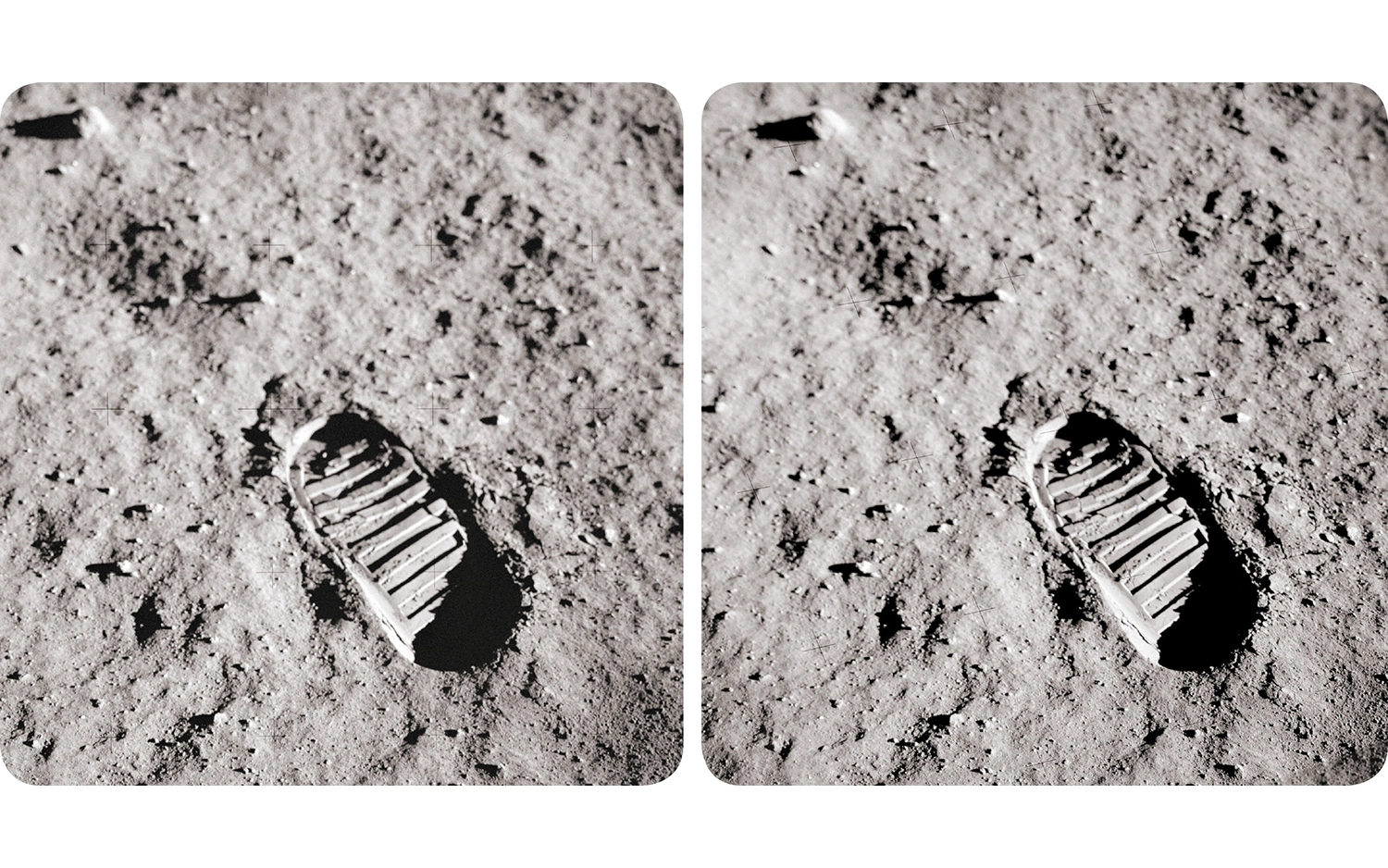
And it does so with a unique and extensive collection of archival photos featuring astronauts, cosmonauts, spacecraft and moon landscapes, presented in stereo pairs so the images can be viewed in 3D. [See Spectacular Lunar Mission Images in 3D (Photos)]
Written by David Eicher, editor of Astronomy Magazine, the book brings together numerous astronauts' recollections for the first time. And, intriguingly, the book includes tales from Soviet cosmonauts — many of which were not previously available for much of the past 50 years, Eicher told Live Science.
"The Soviets had an aggressive lunar landing program of their own that petered out because of some tragedies: an explosion on the launch pad, some key deaths of very important engineers," Eicher said. "By the time Apollo 8 was happening — our lunar fly-around — the momentum for the Soviet program had really stalled out. But we tried to tell the story from both sides," he said.

Alongside the descriptions of space travel, images in "Mission Moon 3D" offer an astronaut's-eye-view of 3D moonscapes. Many of the book's stereo photos are extremely well-known and iconic even in 2D, such as Buzz Aldrin's footprint pressed into lunar soil — an image that is often mistakenly thought to represent Neil Armstrong's footprint, Eicher said.
NASA astronauts were trained to take stereo photographs while in space, and the Apollo missions' photo archives were brimming with 3D photos, Eicher said. Image selection for the book was organized and overseen by astrophysicist and Queen guitarist Brian May, who has long been an aficionado of stereoscopy. For decades, May collected vintage stereoscopic cards and captured his own stereo photos, and since 2006 he has served as the director of the London Stereoscopic Co., which provides information and resources for fans of modern and historical stereo photography.
Get the world’s most fascinating discoveries delivered straight to your inbox.
"Moon Mission 3D" even includes a 3D stereoscopic viewer of May's own design, called the Lite Owl.
"My geekiness is bottomless when it comes to stereo," May told the Telegraph in 2014.
The 1969 Apollo 11 moon landing was arguably one of the most dramatic and memorable moments in the history of space exploration. And yet, it was the later trips to the moon that delivered the most interesting discoveries, Eicher said. Analysis of moon rocks collected in the final missions revealed similar isotopes to those in Earth rocks, suggesting that the moon originated from broken bits of debris floating around Earth after a massive impact, Eicher explained.
"That came out of the Apollo program. The analysis of the moon's history, its origin — all that stuff happened later in the program with the last mission," he said.

Fifty years have flown by since the start of the Apollo program, and recent NASA missions have seen uncrewed spacecraft rocketing far beyond the moon, with New Horizons rocketing all the way to Pluto and past the boundaries of our solar system. However, there is still much that can be learned about the future of space exploration by revisiting its history — especially when it comes to missions that will include human crews, Eicher told Live Science.
"We can learn a lot about what it's going to take to go onto the next step — a return to the moon or a mission to Mars, which is a quantum leap beyond the moon in terms of ambition, danger and expense," he said. "It's going to take international cooperation between nations — and between governments and private companies all together — to take the next step out into the solar system."
"Mission Moon 3D: A New Perspective on the Space Race" is available to buy on Amazon and at other booksellers.
- Apollo 8: NASA's First Crewed Trip Around the Moon in Pictures
- 20 Most Marvelous Moon Missions
- The Best Space Photos Ever: Astronauts & Scientists Weigh in
Originally published on Live Science.

Mindy Weisberger is a science journalist and author of "Rise of the Zombie Bugs: The Surprising Science of Parasitic Mind-Control" (Hopkins Press). She formerly edited for Scholastic and was a channel editor and senior writer for Live Science. She has reported on general science, covering climate change, paleontology, biology and space. Mindy studied film at Columbia University; prior to LS, she produced, wrote and directed media for the American Museum of Natural History in NYC. Her videos about dinosaurs, astrophysics, biodiversity and evolution appear in museums and science centers worldwide, earning awards such as the CINE Golden Eagle and the Communicator Award of Excellence. Her writing has also appeared in Scientific American, The Washington Post, How It Works Magazine and CNN.