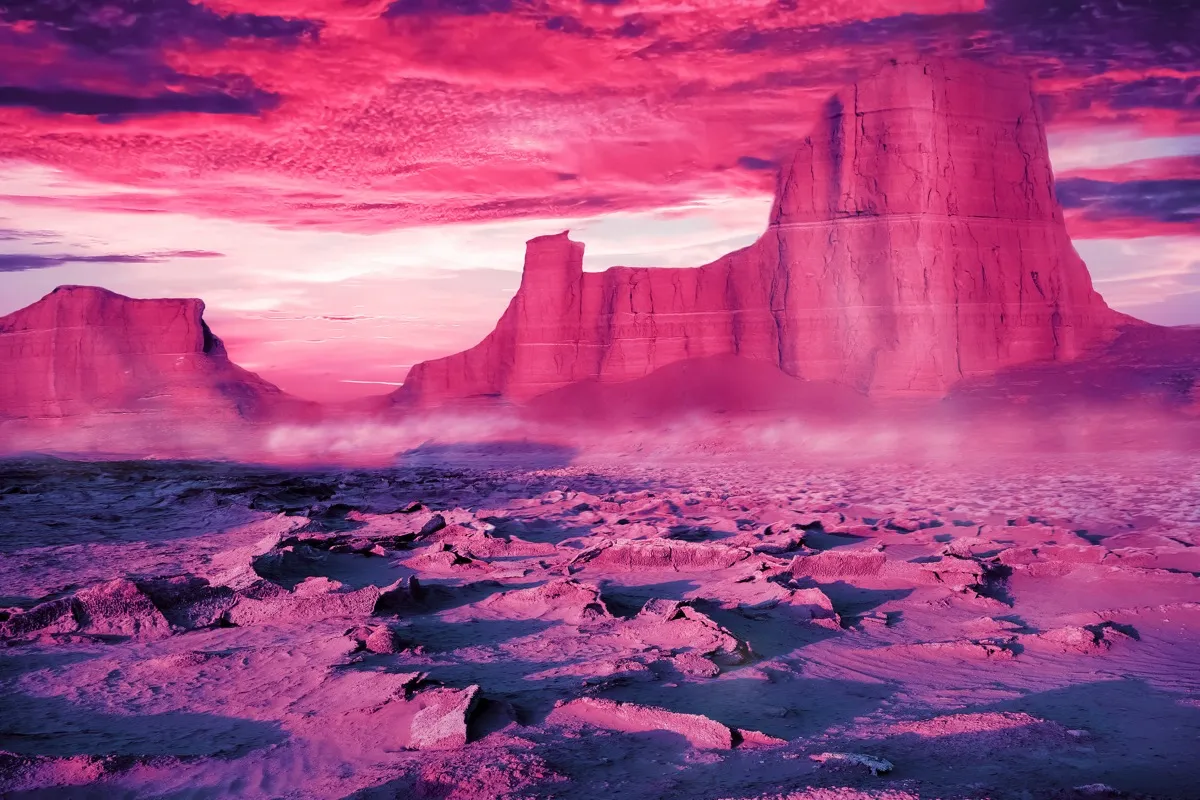
Is bright pink the new black? Well, not exactly, but it is the world's oldest-known color produced by a living organism, according to new research.
Researchers extracted the pigment from bacteria fossils preserved in rocks under the Sahara Desert in Mauritania, West Africa. Inside those teensy bacteria, the scientists found chlorophyll — a pigment used today by plants for photosynthesis — dating back to about 1.1 billion years ago. That's about 600 million years older than similar chlorophyll fossils found previously, scientists reported in the new study. [In Images: The Oldest Fossils on Earth]
Their findings hint that cyanobacteria, bacteria that survive on sunlight, appeared much earlier than algae, which have been traced to around 650 million years ago. And bacteria likely dominated Earth's ancient oceans for hundreds of millions of years, according to the study.
Chlorophyll is what gives modern plants their green color, though the fossilized chlorophyll in the cyanobacteria samples was dark red and deep purple in its concentrated form, the scientists reported.
When they pulverized the fossils to analyze the bacteria molecules, the researchers distilled the colors to find a brilliant pink. This colorful remnant suggests that ancient sunlight-eating organisms cast a pink tint to a long-gone ocean, lead study author Nur Gueneli, of the Research School of Earth Sciences at the Australian National University (ANU), said in a statement.
When you imagine Earth's oldest color, think pink.
(Image credit: The Australian National University)
Chlorophyll this ancient is preserved only under exceptional circumstances, study co-author Jochen Brocks, an associate professor with ANU's Research School of Earth Sciences, told Live Science in an email. First, dead organic matter — a bloom of cyanobacteria, for example — sinks quickly onto the seafloor. Once there, it must be isolated from any exposure to oxygen, which spurs decay, and then the rock that holds the material has to remain in one piece for a billion years, Brocks said.
Her reaction to seeing colors produced by organisms that lived more than a billion years ago? "Sheer amazement," Brocks said. Even algae, one of the most ancient forms of life, was absent or scarce at the time of these chlorophyll-swallowing bacteria, the researchers wrote in the study.
Sign up for the Live Science daily newsletter now
Get the world’s most fascinating discoveries delivered straight to your inbox.
It was a few hundred million years until algae would begin to multiply, ultimately forming the base of a food web that would eventually fuel the evolution of larger animals, Brocks told Live Science.
But until the rise of algae, and more-complex organisms, the planet belonged to the bacteria.
Mindy Weisberger is a science journalist and author of "Rise of the Zombie Bugs: The Surprising Science of Parasitic Mind-Control" (Hopkins Press). She formerly edited for Scholastic and was a channel editor and senior writer for Live Science. She has reported on general science, covering climate change, paleontology, biology and space. Mindy studied film at Columbia University; prior to LS, she produced, wrote and directed media for the American Museum of Natural History in NYC. Her videos about dinosaurs, astrophysics, biodiversity and evolution appear in museums and science centers worldwide, earning awards such as the CINE Golden Eagle and the Communicator Award of Excellence. Her writing has also appeared in Scientific American, The Washington Post, How It Works Magazine and CNN.