













Did These Children Have Their Hearts Ripped Out as a Sacrifice to an Ancient Rain God?

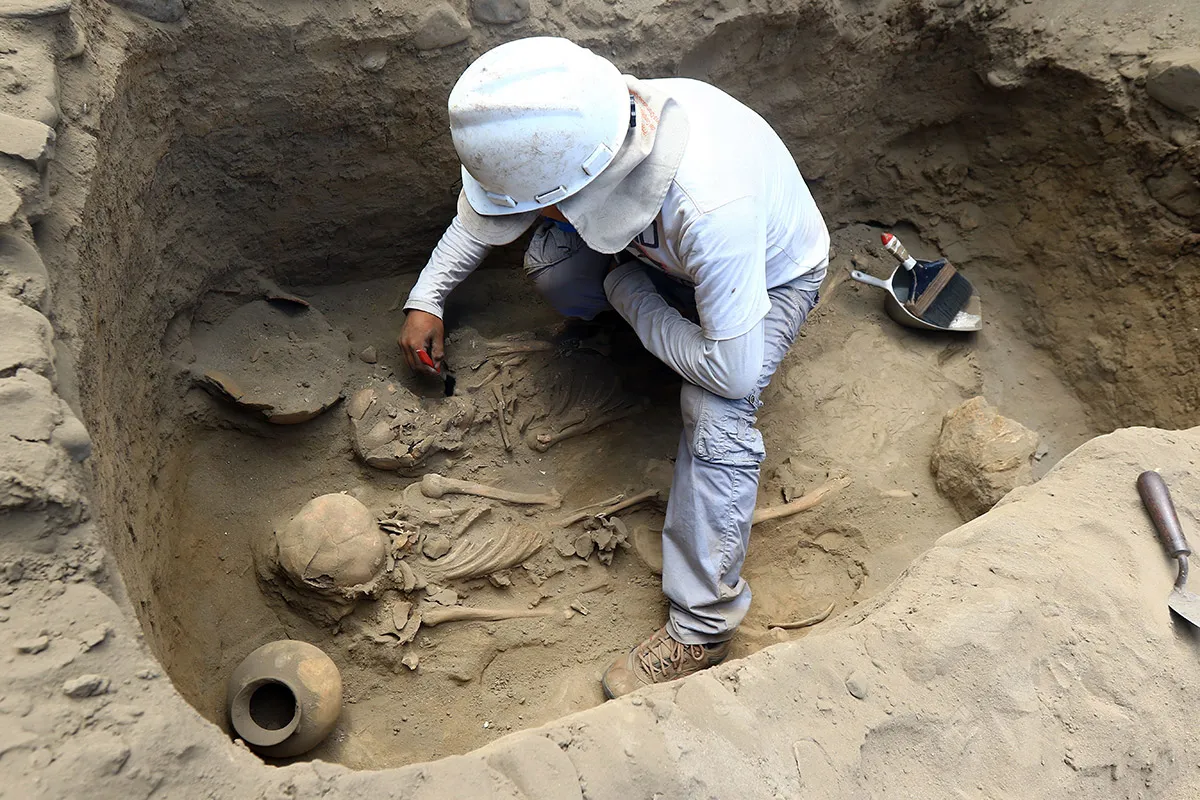
Construction workers in northern Peru recently uncovered a grisly discovery: The skeletal remains of 47 ancient people, including those of at least 12 children who were likely sacrificed by the ancient Chimú culture about 1,500 years ago.
The children's chest bones had cut marks on them, likely a sign of an attempt to break their ribs so that their hearts could be removed, archaeologist Víctor Campaña León, director of the Las Lomas Archaeological Rescue Project, told La República, a Peruvian newspaper.
After finding the bones, the workers — who were laying down drinking-water pipes in the beach town of Huanchaco — notified archaeologists. In the following excavation, the researchers unearthed 77 tombs and burials, as well as camelid bones (likely from vicuña or alpaca) and 115 vessels from the Chimú, Salinar and Virú cultures, La República reported. [25 Cultures That Practiced Human Sacrifice]
In addition to the 12 children, "We have also found a neonate, a newborn, who has also been sacrificed," Campaña León said in Spanish. The excavations began on Oct. 23, 2017, and are projected to end on June 23, 2018, according to Andina, a Peruvian news outlet.
This is hardly the first evidence of human sacrifice in pre-Columbian societies. Archaeologists have also uncovered the remains of sacrifice victims associated with the Inca, Maya and Aztec cultures. Meanwhile, human sacrifice was also practiced in ancient Rome, China and Japan, as well as at Cahokia, an early Native American city located by modern-day St. Louis, Live Science previously reported.
In the case of the Chimú discovery, it's possible these children were sacrificed with the hope of encouraging the gods to bring rain to the arid region, Campaña León said, according to Newsweek.
The Chimú civilization lasted from about A.D. 900 to 1470, when the Inca conquered them, according to the Encyclopedia Britannica. The Chimú people are known for their pottery, textiles, irrigation and metalwork with gold, silver and copper. In fact, the Chimú capital, called Chan Chan, is recognized by the United Nations Educational, Scientific and Cultural Organization(UNESCO) for its "absolute masterpiece of town planning."
Get the world’s most fascinating discoveries delivered straight to your inbox.
Original article on Live Science.

Laura is the managing editor at Live Science. She also runs the archaeology section and the Life's Little Mysteries series. Her work has appeared in The New York Times, Scholastic, Popular Science and Spectrum, a site on autism research. She has won multiple awards from the Society of Professional Journalists and the Washington Newspaper Publishers Association for her reporting at a weekly newspaper near Seattle. Laura holds a bachelor's degree in English literature and psychology from Washington University in St. Louis and a master's degree in science writing from NYU.