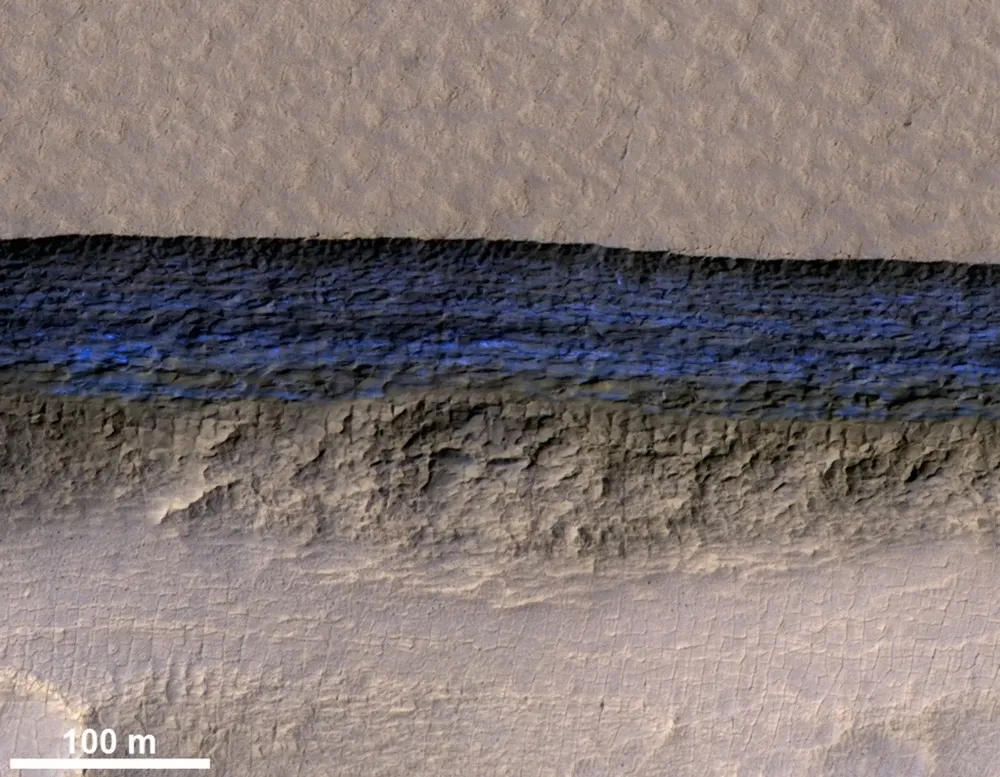
For the first time, high-resolution images show the three-dimensional structure of massive ice deposits on Mars. This photo by the HiRISE camera aboard NASA’s Mars Reconnaissance Orbiter shows a detailed subsection of an icy scarp on the Red Planet in enhanced color.
(Image credit: NASA/JPL/University of Arizona/USGS)
Sizable deposits of water ice lurk just beneath the surface in some regions of Mars, a new study reports.
The newfound sheets appear to contain distinct layers, suggesting that studying them could shed considerable light on the Red Planet's climate history, researchers said. And the ice is buried by just a few feet of Martian dirt in places, meaning it might be accessible to future crewed missions.
"I'm not familiar with resource-extraction technology, but this may be information that's useful to people who are," study lead author Colin Dundas, of the U.S. Geological Survey's Astrogeology Science Center in Flagstaff, Arizona, told Space.com. [Photos: The Search for Water on Mars]
Dundas and his colleagues analyzed photos captured over the years by the High Resolution Imaging Science Experiment (HiRISE) camera aboard NASA's Mars Reconnaissance Orbiter (MRO). They identified eight locations where erosion had exposed apparent glaciers, some of which extend 330 feet (100 meters) or more into the Red Planet's subsurface.
These sites are steep, pole-facing slopes in Mars' midlatitudes, between about 55 and 60 degrees both north and south of the equator. The ice-harboring areas sport few craters, suggesting they're quite young, geologically speaking, the researchers said.
Interestingly, scientists think that Mars' obliquity — the tilt of the planet's axis relative to the plane of its orbit — has shifted a fair bit over the past few million years, varying between about 15 and 35 degrees, Dundas said. (The Red Planet's obliquity is currently about 25 degrees; Earth's is 23.5 degrees.)
This high-resolution HiRISE image shows an icy scarp on Mars in the context of a broader area.
(Image credit: NASA/JPL/University of Arizona/USGS)
"There've been suggestions that, when there's high obliquity, the poles get heated a lot — they're tilted over and pointed more at the sun, and so that redistributes ice toward the midlatitudes," Dundas said. "So, what we may be seeing is evidence of that having happened in the past."
Sign up for the Live Science daily newsletter now
Get the world’s most fascinating discoveries delivered straight to your inbox.
Researchers already knew that Mars harbors subsurface water ice, and lots of it. For example, MRO's ground-penetrating Shallow Radar instrument recently found a buried ice layer that covers more ground than the state of New Mexico. (NASA's Phoenix lander also dug up some ice near the Martian north pole in 2008, but it's unclear if that stuff is part of a big sheet.)
But the newly analyzed HiRISE data give researchers more detailed looks at such deposits, Dundas said.
"The take-home message is, these are nice exposures that teach us about the 3D structure of the ice, including that the ice sheets begin shallowly, and also that there are fine layers," he said.
The new study was published online today (Jan. 11) in the journal Science.
Michael was a science writer for the Idaho National Laboratory and has been an intern at Wired.com, The Salinas Californian newspaper, and the SLAC National Accelerator Laboratory. He has also worked as a herpetologist and wildlife biologist. He has a Ph.D. in evolutionary biology from the University of Sydney, Australia, a bachelor's degree from the University of Arizona, and a graduate certificate in science writing from the University of California, Santa Cruz.