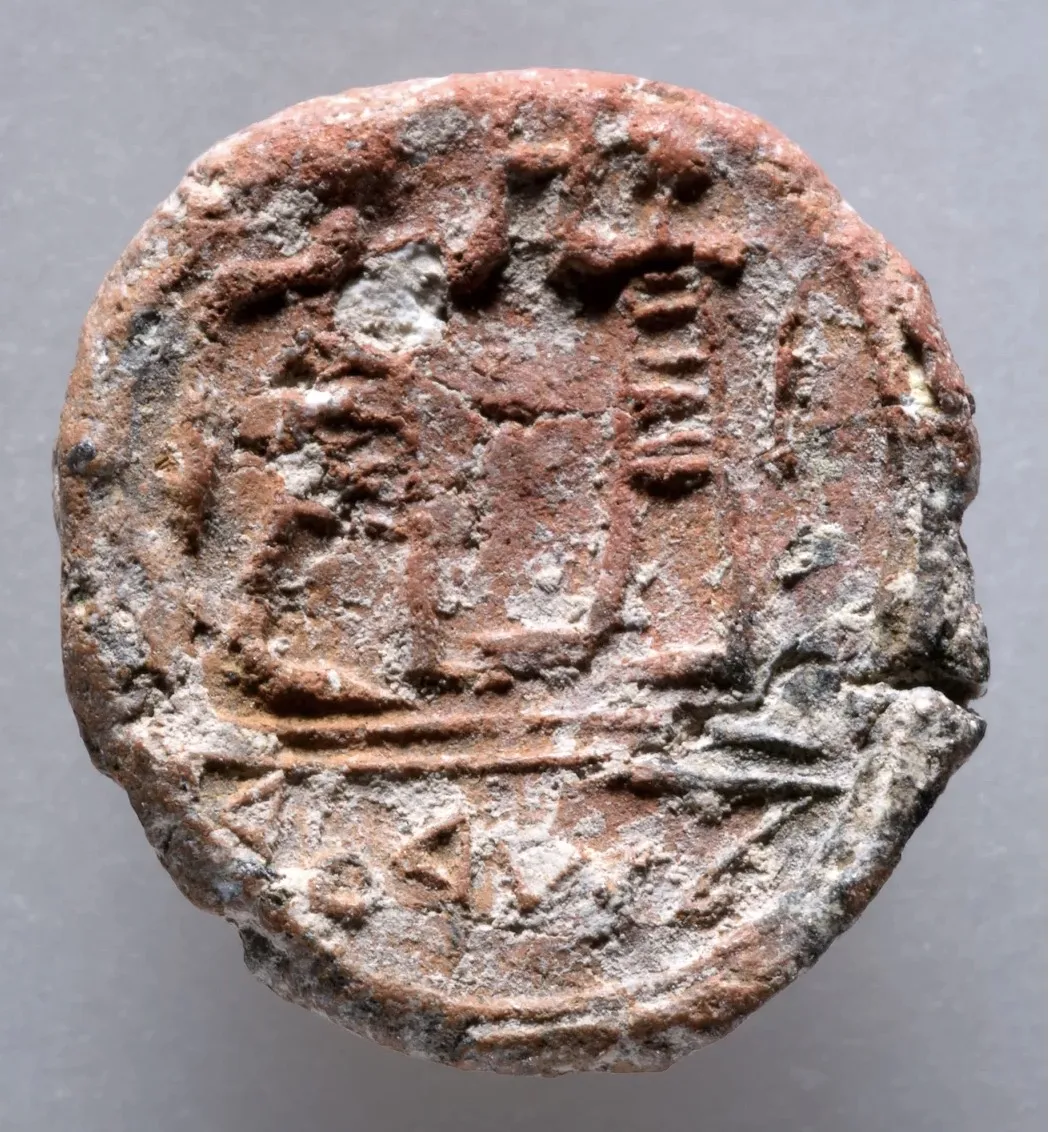
Archaeologists have discovered a 2,700-year-old clay stamp near Jerusalem's Western Wall that seems to shed some light on the political structure of the ancient society that inhabited the city.
The researchers who announced the discovery worked on behalf of the Israel Antiquities Authority (IAA), which funds archaeology and typically focuses on discoveries that the agency interprets to legitimize Israeli claims on the city of Jerusalem, as has been pointed out by Haaretz and the Jerusalem Post in past news reports.
The 0.5 by 0.6-inch (13 by 15 millimeters) clay stamp depicts two figures facing one another above archaic Hebrew script that reads "לשרער" (roughly: l'sar'ir). The researchers said that the word is a condensed version of the phrase "לשר העיר," (l'sar ha-ir) which means "belonging to the governor of the city."
Archaeologist Shimon Cohen, with the IAA, found the stamp while sifting through soil from a building that stood during the period of the first Temple of Solomon in Jerusalem — centuries before the construction of the wall around the Temple Mount, of which the Western Wall is a part. [The Holy Land: 7 Amazing Archaeological Finds]
It's not clear how the stamp was used in its time, but the researcher Shlomit Weksler-Bdolah offered a possible explanation in an IAA statement emailed to Live Science:
"The sealing had been attached to an important transport and served as some sort of logo, or as a tiny souvenir, which was sent on behalf of the governor of the city. It is likely that one of the buildings in our excavation was the destination of this transport sent by the city governor," she said.
The text on the stamp appears to offer the first direct archaeological evidence for the existence of governors of Jerusalem during that period, a position described twice in the Hebrew Bible — once in 2 Kings and once in 2 Chronicles.
Sign up for the Live Science daily newsletter now
Get the world’s most fascinating discoveries delivered straight to your inbox.
The IAA and mayor Nir Barkat claimed in the statement that the find strengthens the case that Jerusalem has been "continually populated by the Jewish people for more than 3,000 years."
For most of the last two millennia, Jews made up a very small, minority population in Jerusalem. That continuous presence is nonetheless a critical element of the Israeli case for its political and military dominance over the city, including land such as the site of this excavation, which the United Nations considers occupied territory.
The Western Wall Plaza, where the seal was found, was constructed shortly after Israeli forces conquered East Jerusalem in 1967. Israeli contractors demolished the existing Moroccan-Arab neighborhood that stood on the site.
A photo shows the site of the find at a dig at the rear of Jerusalem's Western Wall Plaza.
(Image credit: Courtesy of the Israeli Antiquities Authority)
After the completion of scientific study, the release stated, the seal will appear on temporary display in the mayor's office.
Rafi joined Live Science in 2017. He has a bachelor's degree in journalism from Northwestern University’s Medill School of journalism. You can find his past science reporting at Inverse, Business Insider and Popular Science, and his past photojournalism on the Flash90 wire service and in the pages of The Courier Post of southern New Jersey.