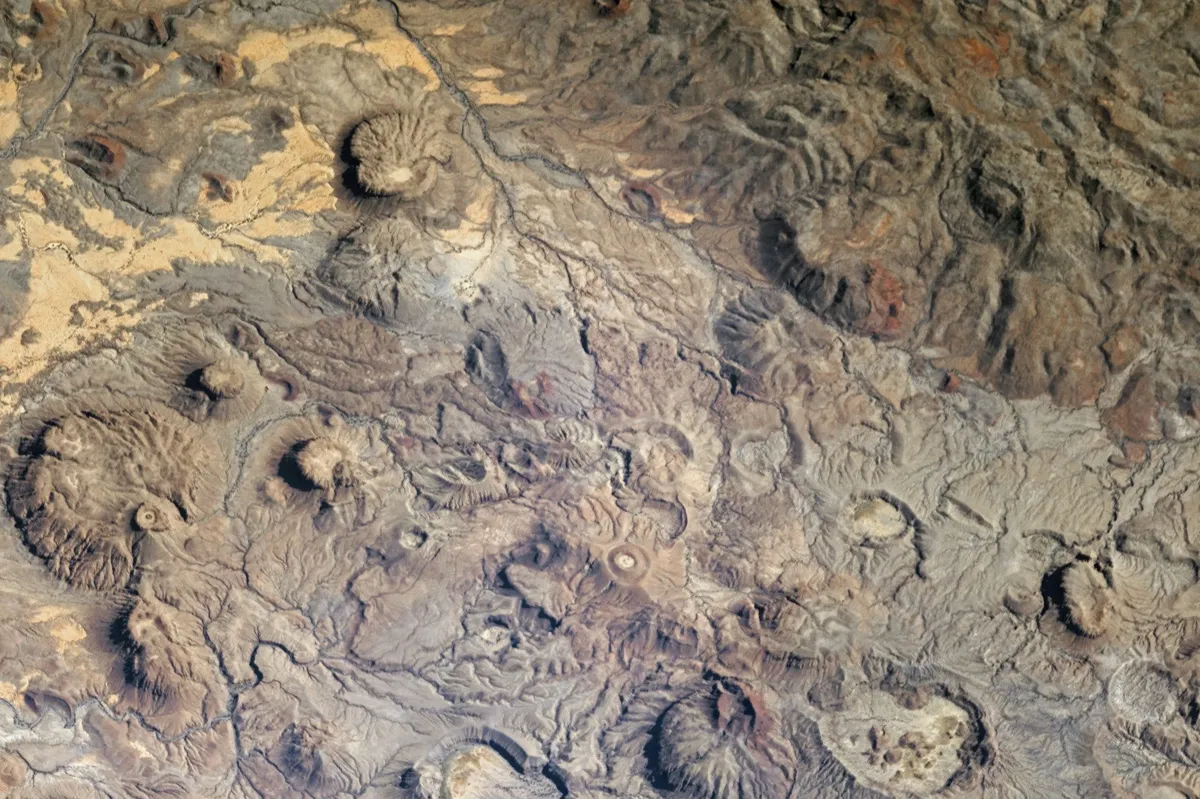
A set of bouncing baby volcanic vents is visible in a new astronaut photograph that doesn't look like it was taken over Earth.
But the image, released today (June 5) by NASA's Earth Observatory, is humanity's home planet. It's a shot of the Meidob Volcanic Field in western Sudan, where active volcanic processes have built lava domes, craters and vents. Some of those vents are less than 6 million years old, which is quite young by geologic standards.
An astronaut aboard the International Space Station snapped the shot of the volcanic field on January 1, 2017. Craters, cones and lava domes are visible in the central portion of the image. All told, the field spans 1,930 square miles (5,000 square kilometers) and is scattered with nearly 700 vents, according to the Smithsonian Institution's Global Volcanism Program.
It's an arid, rocky place marked by volcanic features: Shallow craters called maars that are made when magma hits groundwater and explodes, lava domes made when magma oozes out of the ground and piles up on the surface, and cinder cones that look like the typical grade-school rendering of a volcano.
In this astronaut image of the Meidob Volcanic Field, you can see maar craters formed from explosive eruptions, lava domes from viscous flows and scoria cones formed around a single volcanic vent.
(Image credit: NASA Earth Observatory)
Meidob originally developed between 7 million and 5 million years ago, according to a 1997 paper in the Journal of African Earth Sciences. The last confirmed eruptions at Meidob happened around 3000 B.C.
Stephanie Pappas is a contributing writer for Live Science, covering topics ranging from geoscience to archaeology to the human brain and behavior. She was previously a senior writer for Live Science but is now a freelancer based in Denver, Colorado, and regularly contributes to Scientific American and The Monitor, the monthly magazine of the American Psychological Association. Stephanie received a bachelor's degree in psychology from the University of South Carolina and a graduate certificate in science communication from the University of California, Santa Cruz.