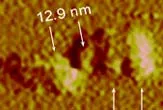
Researchers have discovered nature's miniature springs within the proteins of many living cells. These proteins could one day be used in developing incredibly small machines in the nano realm.
Nanomachines can be the size of a few molecules. One nanometer equals one billionth of a meter. Scientists envision using nanomachines to manufacture other small products for computers and other high-tech products, and to improve human health and longevity by navigating inside the body to search for problems and deliver drugs.
Like most machinery, nanomachines require parts such as motors, valves, and springs. Constructing these tiny parts is challenging. An alternative may be to use what nature has already made available.
Nature's tiny coils, which are protein components called ankyrin repeats, "resemble 'classical' springs made of a steel wire," said Piotr Marszalek, professor of mechanical engineering and materials science at the Duke Pratt School of Engineering.
In contrast to most proteins, ankyrin repeats have an unusual spiral shape that can generate force when extended or contracted.
"We can now design ankyrin proteins with a greater number of repeats to engineer bio-inspired nanosprings with several turns or even springy 'nanomattresses' to work as springs that can open gates or as shock absorbers," Marszalek said.
Sign up for the Live Science daily newsletter now
Get the world’s most fascinating discoveries delivered straight to your inbox.
Looking at the structure of other proteins, Marszalek and colleagues had an inkling that ankyrin repeats would posses some elastic properties, but nobody had stretched them far enough.
"No other protein investigated so far, with regard to their elasticity, revealed such a behavior." Marszalek told LiveScience. "When excessive forces are applied [to] the spiral's structure, it may break down and the individual repeats may unfold. However, when the external force is released, the repeats will re-fold immediately and recreate the spiral, and thus fully recover their elastic properties."
Crucial roles
Ankyrin repeats are important for cell functioning, so understanding them should help scientists better grasp how certain things in the body function.
They mediate the interaction between other proteins. For example, within the specialized hair cells of the inner ear, they participate in converting mechanical signals, such as sound, to electrical ones—a key to hearing, Marszalek explained.
The spiral shaped ankyrin repeats are found in more than 400 human proteins in different tissues. Cells most likely use them to interpret and sense forces from their surrounding.
The discovery was detailed this month in the online version of the journal Nature.
Sara Goudarzi is a Brooklyn writer and poet and covers all that piques her curiosity, from cosmology to climate change to the intersection of art and science. Sara holds an M.A. from New York University, Arthur L. Carter Journalism Institute, and an M.S. from Rutgers University. She teaches writing at NYU and is at work on a first novel in which literature is garnished with science.