













Hunting: So Easy a Cave Man Could Do It

Early humans who lived in caves more than 250,000 years ago were just as good at bringing home the bacon as their later human descendents of the Paleolithic era, though their dining habits were a little less refined, a new study suggests.
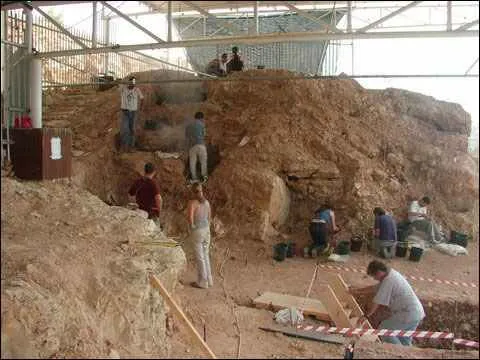
The remains of early human dinners were found in Qesem Cave in Israel, which was discovered during road construction in hilly limestone terrain, 7 miles (11 km) east of Tel Aviv about nine years ago. ("Qesem" means "surprise.")
In the cave were leftover bones from deer, aurochs, horse and other big game that made up the meals of the hunters who dwelled in the cave 400,000 to 200,000 years ago. Mary Stiner, an anthropologist at the University of Arizona, examined the cut marks left on these bones by ancient butchers to better understand how early societies hunted and divvied up the spoils of their labor.
Meat is one of the most nutrient-rich foods that humans eat, but it's much harder to bring down a buck that to pick berries.
Just how proficient the earliest hunters were hasn't been well-known, but Stiner's work indicates that they were just as good at felling their next meal as hunters who came thousands of years later.
"There's a lot of speculation as to whether people of the late Lower Paleolithic were able to hunt at all, or whether they were reduced to just scavenging," Stiner said. "Evidence from Qesem Cave says that just like later Paleolithic humans, the earlier Paleolithic humans focused on harvesting large game. They were really at the top of the food chain."
The Paleolithic is divided into the Lower, Middle and Upper stages, the dates of which can differ depending on the region. The Lower Paleolithic was from about 2.6 million years ago to about 250,000 years ago; the Middle was from 250,000 years ago to about 35,000 to 30,000 years ago; the Upper Paleolithic was from about 42,000 years ago (in southwest Asia) or 38,000 years ago (in Europe) to about 10,000 years ago.
Get the world’s most fascinating discoveries delivered straight to your inbox.
The bone cut marks did show some differences between the peoples of different stages of the Paleolithic, namely in the skill and ceremony they attached to meat cutting and sharing. Those of the Lower Paleolithic were less efficient, less organized and less specialized when it came to carving up their prey.
"This is somewhat expected, since the tools they made took considerable skill and locomotor precision to produce," Stiner said.
The randomness and higher number of the cut marks from earlier sets of bones also show that the earlier hunters attached little social ritual or formal rules to meal time, Stiner said. Lots of hands would have been reaching in to carve up a tasty morsel from the bone.
But by the Middle and Upper Paleolithic, the regular and efficient cuts on the bones suggest that "meat distribution flowed through the hands of certain butchers," Stiner said.
Stiner said her findings, detailed in the Aug. 11 issue of the journal Proceedings of the National Academy of Sciences, need to be replicated elsewhere before the results can be generalized.
"I think it will be important in the future to see if the kinds of results I have found at Qesem can be replicated in at least some other cave sites in the region and, hopefully, in other regions as well," Stiner told LiveScience. "We can always expect some variability in site contents within a period and geographic region, however, so it is not expected that every late Lower Paleolithic site would present the same butchering patterns, but some of them should."
- The Science of Being Human
- Timeline of Human Evolution
- Cave Men Loved to Sing

Andrea Thompson is an associate editor at Scientific American, where she covers sustainability, energy and the environment. Prior to that, she was a senior writer covering climate science at Climate Central and a reporter and editor at Live Science, where she primarily covered Earth science and the environment. She holds a graduate degree in science health and environmental reporting from New York University, as well as a bachelor of science and and masters of science in atmospheric chemistry from the Georgia Institute of Technology.