













'Extinct' Volcano Near Rome Rumbles to Life

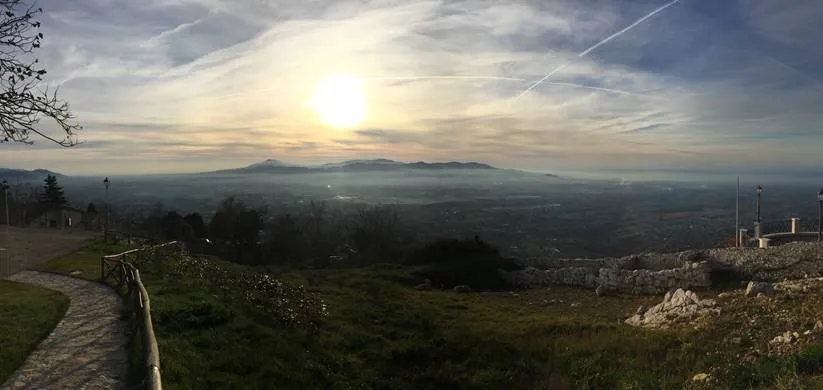
A volcano outside Rome, long thought extinct, is rumbling to life. But don't panic: The volcano isn't likely to blow its top for at least another 1,000 years.
Colli Albani is a volcanic complex of hills located 19 miles (30 kilometers) from the center of Rome. There are no historical records of eruptions from Colli Albani, so it was long thought to be extinct, according to the American Geophysical Union (AGU). Now, researchers have reported in the journal Geophysical Research Letters that Colli Albani just doesn't erupt that often. In fact, it enters an eruptive phase every 31,000 years or so.
A team of researchers, led by volcanologist Fabrizio Marra of the National Institute of Geophysics and Volcanology in Rome, used ground-based observations of rising land, earthquake swarms and steam vents alongside satellite data to track Colli Albani's recent activity. An analysis of rocks from the volcano revealed a history of past eruptions, the most recent of which occurred 36,000 years ago. [The 11 Biggest Volcanic Eruptions in History]
Now, the ground underneath the volcano is inflating, rising at a maximum of about 0.08 inches (2 millimeters) per year in areas where steam vents are emerging, Marra and his colleagues reported. During the past 200,000 years, the area has risen by about 164 feet (50 meters) in elevation, they found. This suggests that magma is entering fractures beneath the volcano, they said.
The reason for the change has to do with the subsurface geology of Colli Albani, Marra told the AGU. Until about 2,000 years ago, the surrounding land held together a fracture under the volcano, preventing magma from bubbling to the surface. More recently, however, the subsurface stresses have changed so that the rock on one side of the fracture is moving and sliding against the rock on the other side, according to the AGU.
So far, these changes have manifested in a swarm of earthquakes around Rome that lasted from 1991 to 1995. Another sign was a small fumarole, or steam vent, that appeared in a road near Rome's Fiumicino airport in 2013.
Given its 31,000-year cycle, Colli Albani is arguably overdue for an eruption, but the volcano won't unexpectedly blow its top, Marra told the AGU. It likely won't build up enough pressure for an explosive eruption for at least 1,000 years. Even then, Romans can expect plenty of warning, Marra said, as an explosive eruption would be preceded by initial stages of moderate volcanic activity.
Get the world’s most fascinating discoveries delivered straight to your inbox.
Original article on Live Science.

Stephanie Pappas is a contributing writer for Live Science, covering topics ranging from geoscience to archaeology to the human brain and behavior. She was previously a senior writer for Live Science but is now a freelancer based in Denver, Colorado, and regularly contributes to Scientific American and The Monitor, the monthly magazine of the American Psychological Association. Stephanie received a bachelor's degree in psychology from the University of South Carolina and a graduate certificate in science communication from the University of California, Santa Cruz.