















Volcano's Eruption Creates Colorful U.S. Sunsets

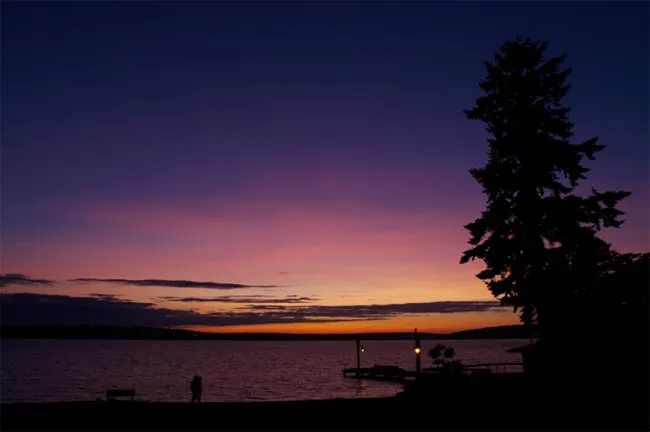
Many people in the United States and Europe are seeing gorgeous lavender sunsets lately thanks to the eruption more than two weeks ago of Russia's Sarychev Peak volcano.
The volcano blew its top June 12, generating a remarkable shock wave in the atmosphere seen in a photo taken by astronauts. It also hurled massive plumes of sulfur dioxide into the air, and that material has been circling the globe.
Deep purple hues and ripples of white characterize the spectacular views the past few evenings.
The phenomenon occurs when the ash and fine particles sprayed high into the atmosphere by the volcano scatter light. The sulfur dioxide ejected by Sarychev Peak interacts with the atmosphere to form tiny particles called sulfate aerosols.
Light scattering happens all the time. It's why the sky is blue and sunsets often red or orange. Particles in the atmosphere scatter short-wavelength blue light more effectively, to make the sky appear blue. When the sun sets, its rays have more atmosphere to travel though to reach our eyes, so more of the long-wavelength red light makes the journey.
Lately, the volcanic aerosols are combining with the normal scattering particles to create more obstacles for light to pass through, increasing the coloring effect.
"I could tell, late in the evening that there was 'something' to the clouds, the lighting as the sun was setting was off, so I found a nice view of the horizon and waited," wrote Liem Bahneman of Kirkland, Washington, who posted photos he took of the sunset on June 28 on SpaceWeather.com. "The aerosols light up well after the normal sunset has expired, so it takes some patience, but it is well worth it to experience the violet."
Get the world’s most fascinating discoveries delivered straight to your inbox.
"This evening, the volcanic aerosols were still visible over Kentucky," Rick Schrantz, of Nicholasville, Ky., wrote on SpaceWeather.com. "The delicate wispy streamers were a beautiful background for a few regular clouds."
Similarly colorful scenes were spotted across the Northern Hemisphere in August 2008, when Alaska's Kasatochi volcano erupted. One of the most dramatic volcanic eruptions in modern history — Pinatubo's 1991 explosion in the Phillipines — ejected so much material into the atmosphere that global temperatures dropped by about 0.9 degrees Fahrenheit (0.5 degrees Celsius). The last time Sarychev Peak blew was 1989.
- Images: Sunrise and Sunsets
- Volcano Quiz: Test Your Knowledge
- Gallery: Wild Volcanoes
