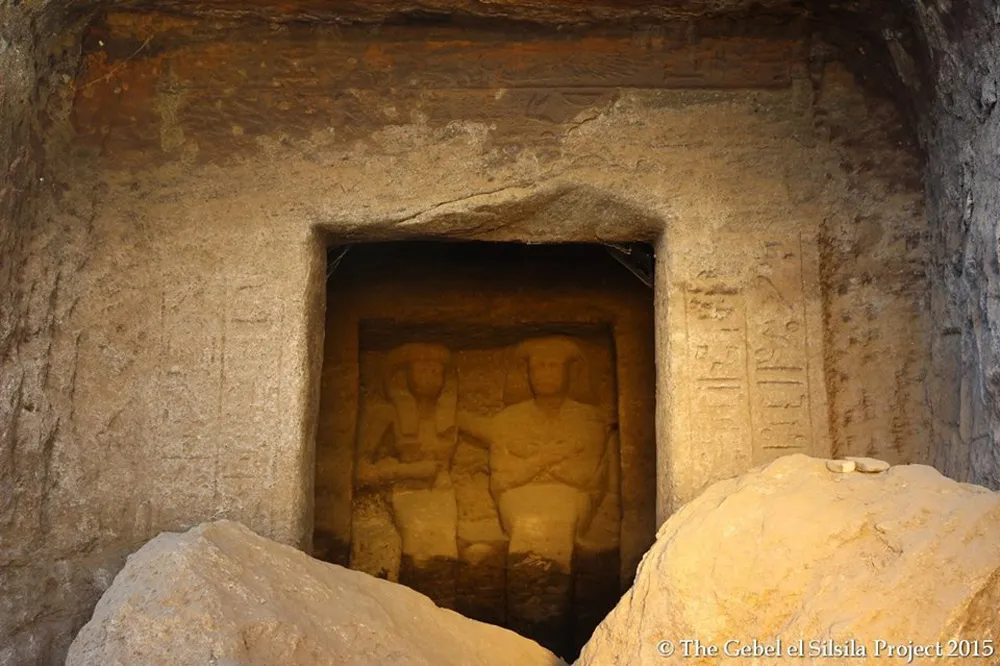
Six ancient Egyptian statues depicting a man named Neferkhewe and his family have been discovered near the Nile River. Dating back 3,500 years, the statues were found inside two cenotaphs, or "false tombs” at the Gebel el Silsila site. That site is also where many of the sandstone blocks used to build Egypt's temples were quarried. [Read full story about the Egyptian statues]
An ancient couple
A statue of a man and his wife sitting side by side graces a cenotaph at the ancient Egyptian site Gebel el Silsila. These statues date back 3,500 years to Egypt's 18th Dynasty and were buried by an earthquake and Nile flooding sometime in the last 2,000 years. (Credit: The Gebel el Silsila Survey Project, courtesy the Egyptian Ministry of State for Antiquities)
Statues of Neferkhewe, chief of the Medjay and overseer of foreign lands during the reign of Pharaoh Thutmose III and his family. These statues are in a cenotaph, or false tomb, at the Nile site Gebel el Silsila. Cenotaphs are shrines or memorials to the dead, but the bodies are interred elsewhere. (Credit: The Gebel el Silsila Survey Project, courtesy the Egyptian Ministry of State for Antiquities)
An elite family
Statues of Neferkhewe and his wife Ruiuresti and two children at Gebel el Silsila. An earthquake sloughed this shrine off the bluff in ancient times, and repeated Silt from Nile flooding covered the site until archaeologists uncovered the statues in December 2015. (Credit: The Gebel el Silsila Survey Project, courtesy the Egyptian Ministry of State for Antiquities)
Sign up for the Live Science daily newsletter now
Get the world’s most fascinating discoveries delivered straight to your inbox.
Well-preserved history
A close look at one of the new statues discovered at Gebel el Silsila. These statues are the best-preserved of any in 32 cenotaphs at the site, said excavation co-director John Ward. Large ears and round cheeks hint at the individual characteristics of the person being remembered. (Credit: The Gebel el Silsila Survey Project, courtesy the Egyptian Ministry of State for Antiquities)
A power couple
An ancient Egyptian power couple from the 18th Dynasty. Archaeologists aren't sure why certain families chose to build cenotaphs, or shrines, at Gebel el Silsila, which is also the site of an enormous sandstone quarry that provided the rock for Egypt's buildings and temples for centuries.(Credit: The Gebel el Silsila Survey Project, courtesy the Egyptian Ministry of State for Antiquities)
Ancient high society
Carvings flank the statues of an ancient Egyptian elite couple. Researchers are working to clean and translate more of the carvings found around the two new cenotaphs. (Credit: The Gebel el Silsila Survey Project, courtesy the Egyptian Ministry of State for Antiquities)
Stephanie Pappas is a contributing writer for Live Science, covering topics ranging from geoscience to archaeology to the human brain and behavior. She was previously a senior writer for Live Science but is now a freelancer based in Denver, Colorado, and regularly contributes to Scientific American and The Monitor, the monthly magazine of the American Psychological Association. Stephanie received a bachelor's degree in psychology from the University of South Carolina and a graduate certificate in science communication from the University of California, Santa Cruz.