













Why New Mothers Need Extra Attention
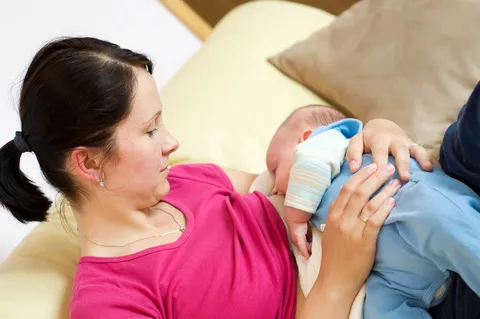
Around the globe, giving birth and caring for a baby is mostly women's work. But that work is fraught with difficulty, and women are often navigating a sea of critical choices as they try to breast-feed and bring up a child, especially under conditions of scarcity. Recent research by anthropologist Barbara Piperata of Ohio State University has shown that one of the most pressing issues for new mothers is the caloric cost of breast-feeding. Piperata has lived with the Ribeirinha people of the Amazon and analyzed how women in a culture that doesn't utilize a grocery store might cope with the high caloric demands of feeding a baby. Breast-feeding, it seems, takes an extra one-third of calories per day, and that increase is critical among the Ribeirinha, where women eat the meat and fish brought home by their husbands, and food is generally hard to come by. And this is a culture where women without babies are already working hard. A woman's day, according to Piperata, is a monotony of child care and housework. Having babies, it seems, is a chance to have a break. That break comes right after birth. Ribeirinha woman with new babies do what most new mother do — they take time off — but they do it for 40 days, a period called resguardo. Mothers stop doing their household chores, give up taking care of other children, and they quit all that work preparing food. But, surprisingly, that strategy backfires on them. Instead of conserving calories, when mothers stop doing the daily food prep work, there is less food, and they actually suffer from that lack of calories. Why then take a vacation right when they need food the most? The answer, Piperata explains, lies in the attention that a mother receives as she lies about tending the new baby. Suddenly, dads do housework and other people care for the older kids, and a mother's status goes up exponentially. Everybody says nice things about her. And it seems that this attention and social support has been what women have been after for millions for years. Looking for attention, in fact, it might be the key to the success of our species. Anthropologist Karen Rosenberg of the University of Delaware has pointed out that ever since humans began to walk upright and the female pelvis changed shape, birth has been a party, not a one-woman event. At every birth since the dawn of woman, Rosenberg suggests, there were always people to help out. They held the mother's hand as she pushed and screamed, cradled the baby as it came out, and helped the mother get the baby on her breast and start it off breast feeding. These ancient mothers may have also gotten a well-deserved maternity leave, like the Ribeirinha, so that they could focus on the new baby without distractions and gain a little respect. Rosenberg also suggests that such social help is still with us today because it is key to the success of our species. Humans are able to give birth to such needy babies at short intervals simply because we don't do it alone.
- All About Babies
- Video – A Mother's Touch
- Breastfeeding Does Not Make Breasts Sag
Meredith F. Small is an anthropologist at Cornell University. She is also the author of "Our Babies, Ourselves; How Biology and Culture Shape the Way We Parent" (link) and "The Culture of Our Discontent; Beyond the Medical Model of Mental Illness" (link).
Get the world’s most fascinating discoveries delivered straight to your inbox.