













In the Field: Burmese Motorcycle Diaries
Like mystics and soldiers of fortune, field biologists are fond of exotic, far-flung places. It's partly scientific: the study of wildlife requires wilderness. Yet sometimes there's an irrational, almost addictive edge to the attachment. Joe Slowinski, a curator of herpetology at the California Academy of Sciences, had such a bond with Myanmar—or Burma, as much of the world still calls that Southeast Asian nation, preferring tradition over a name foisted on it by a military regime. Burma is about as far from San Francisco as it's possible to be flung. In eleven trips beginning in 1997, Slowinski led expeditions throughout the country. To biologists, he is probably best known for his identification, with herpetologist Wolfgang Wüster of Bangor University in Wales, of the first new species of cobra to be described since 1922: Naja mandalayensis, the Burmese spitting cobra. Slowinski also cofounded, with the Smithsonian Institution's George R. Zug, the Myanmar Herpetological Survey, one of the country's few stable scientific institutions.
Late in the summer of 2001, Slowinski led an expedition into Burma's extreme north, in the foothills of the Himalayas near the frontier with China, to conduct the first large-scale survey of the region's life-forms. On September 12, while the world was reeling from the attacks on America, Slowinski died from the bite of a many-banded krait, Bungarus multicinctus, the deadliest land serpent in Asia. He was only thirty-eight. It was a tragic loss to science and an exemplary tale of grace under pressure. A few hours after the bite, when Slowinski could no longer breathe on his own, his colleagues began mouth-to-mouth respiration. They kept him alive that way for more than twenty-four hours, waiting for a helicopter rescue mission that came too late.
In January 2005, I began researching a biography of Slowinski with a journey of my own, tracing the route of his expedition from Putao, a small district capital in the north of Burma, to the village of Rat Baw, about thirty miles from the Chinese border, where he died. It was my fourth visit to Burma in twelve years, but the first time I ventured beyond areas ordinarily open to tourists.
I began in Yangon, the nation's capital, also known as Rangoon. The decrepit airport terminal was typical of the dilapidated infrastructure I saw everywhere, the ravages of more than four decades of dictatorial military rule. Also evident was the watchful eye of the junta. Posted on the way into the city were scarlet signs proclaiming in Burmese and English: "Oppose those relying on external elements acting as stooges holding negative views" and "Oppose foreign nationals interfering in the internal affairs of the State."
My first call in the capital was at the Forest Ministry, whose primary mission seems to be to look the other way while foreign loggers clear-cut Burma's ancient hardwood forests. On the other hand, the ministry's Nature and Wildlife Conservation Division, which sponsored most of Slowinski's field expeditions, makes a valiant effort to protect what remains of the nation's natural heritage. I met the division's director, U Khin Maung Zaw, a courtly, soft-spoken zoologist, in a dim office lined with glass-doored cabinets full of scholarly books and old maps. He and Slowinski had been friends; in fact, in 1998 Slowinski had named a new species of wolf snake after him, Lycodon zawi.
Zaw was still sorrowful about Slowinski's death. He was glad I was writing a book about his old friend, but there was a limit to what he could do. The area I wanted to visit had been a site of active resistance by guerilla groups until the mid-1990s, and the presence of foreigners there is restricted. I had only managed to obtain a ten-day pass to Putao and environs. A guide was also assigned to accompany me—a tall, serious, bespectacled man of twenty-seven named Lynn Htut Oo, who continually reminded me of the importance of giving him a big tip.
Our flight north was slightly terrifying, aboard an ancient commuter plane that looked ready for the scrap heap. When we skittered to a landing in Putao, I found myself in the middle of a broad plain encircled by distant blue mountains, the southeastern edge of the Himalayas. Concealed by the closer peaks, to my north lay Hkakabo Razi, at 19,294 feet the highest peak in Southeast Asia, which had been Slowinski's destination.
Get the world’s most fascinating discoveries delivered straight to your inbox.
While Slowinski's expedition was the first full-scale international scientific venture to the region, a few intrepid Western scientists had preceded him. As recently as 1997, Alan Rabinowitz, the director of science and exploration for the Wildlife Conservation Society, in New York City, had made a quick trip through the area, discovering a new species of deer, the diminutive leaf muntjac, which is the smallest member of the deer family. Shortly before Slowinski's expedition, Rabinowitz had helped the Forest Ministry establish a national park around Hkakabo Razi [see "The Price of Salt," by Alan Rabinowitz, September 2000].
With the aid of my government guide, I immediately set about organizing an expedition to Rat Baw. The village lies in a rugged area that is home to hill tribes that came from around Tibet hundreds of years ago. Known collectively to outsiders as the Kachin, they call themselves by the names of their tribal groups, among them the Jingpaw, Rawang, and Lisu. To my dismay, I found only one person willing to take me there. At the only decent restaurant in Putao, a town of 10,000, I met with Yosep Kokae, an experienced guide who had served on Slowinski's expedition. He said he would help me, but he couldn't find porters on such short notice.
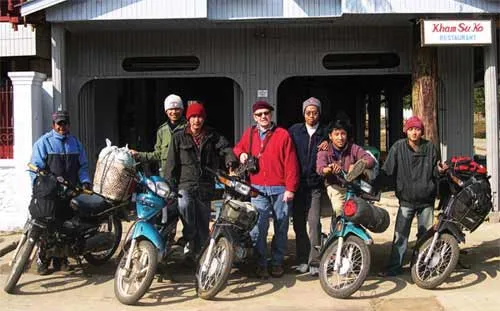
Then the restaurant's owner, a tall, dignified Kachin woman, told me that her son and his friends might be willing to take me to Rat Baw on their motorcycles. Her son, Khun Kyaw, a strapping, self-confident twenty-two-year-old, recruited two friends, making a party of six with me, my government guide, and Yosep Kokae. It wasn't ideal, roaring through the wilderness on cheap Chinese motorbikes, but I had no alternative. Just as we were about to depart, the local constabulary decided that we must have another official minder on the expedition, so we were assigned a timid twenty-year-old policeman, whom Khun Kyaw and the others treated with open contempt.
It was a cool, misty morning when we set off, seven men on six bikes, laden with bottled water and freshly killed chickens. On the outskirts of town we passed several Protestant churches, simple bamboo structures with wooden crosses surmounting their flimsy entrance gates. Burma is overwhelmingly Buddhist, but most of the people around here follow Christianity. The earliest known missionary to the Kachin was Eugenio Kincaid, a Baptist preacher from Wethersfield, Connecticut, who paddled a small boat loaded with bibles and religious tracts some 400 miles up the Irrawaddy from Mandalay in 1837.
A few miles out of town, we crossed a fine iron suspension bridge spanning a northern tributary of the Irrawaddy. Elephants were stacking freshly felled trees on the riverbank, awaiting a barge from Myitkyina, the capital of Kachin State, to collect them. It was the last evidence of logging activity I would see on the trip.
A good paved road led to the village of Machanbaw, the last outpost of relative civilization; after that, the trail became narrow and overgrown, climbing steadily to an elevation of 2,000 feet. Although it lies north of the Tropic of Cancer, the forest here has a distinctly subtropical character, with towering dipterocarps, Chinese coffin trees, flowering magnolias, fragrant screw pines, and many fruit trees, including rambutan, mangosteen, and banana, all wrapped in thick ropes of lianas and other climbers. The British botanist Frank Kingdon-Ward described the terrain in his account of a collecting expedition in 1953: "Here the forest is richer and denser—not only does frost never enter into these deep sheltered valleys, but throughout the winter they are steeped in mist till nearly midday, and so partake of the character of tropical rain forest."
Kingdon-Ward was the hardest-working and most productive of the foreign scientists who preceded Slowinski in the region. In ten epic journeys to Burma from 1914 to 1956, he collected dozens of plant species new to science, and brought back hundreds of varieties of begonias, poppies, rhododendrons, and other showy flowering plants, which became staples of English gardens. His vivid, often witty journals of those expeditions were popular reading for British Sunday gardeners.
We made our first camp at a village called Htanga. It was wretchedly poor, malaria was rampant, and the people were obviously not getting enough to eat. Yet the inhabitants were wonderfully hospitable, giving us the best house in town, a rickety bamboo structure on stilts with a thatched roof. For dinner, Yosep Kokae made "bachelor's chicken," a mild, savory curry served with tiny fried potatoes, the size of garbanzo beans, which had a delicious, nutty flavor. Later, a few children sneaked up to see us. They were fascinated by my battery-powered lantern; one little boy blew on the light bulb as if it were a flame or ember, trying to make it glow more brightly.
We awoke to a misty morning. Yosep Kokae was already busy cooking fried rice with chilies. Breakfast began with pomelo, the fruit of Citrus maxima. One of the volleyball-size fruits—the largest of the citrus fruits—fed us all. Its mild grapefruit tang was sharpened with a dash of salt. My bowl had a fried egg on top, the only one, laid overnight by the hen that lived on the back porch. One of the bikes wouldn't start, so we abandoned it there, along with our useless police escort.
After we had been an hour on the road, our surroundings took on a wilder aspect, so I told the guys to break for a few hours. I went ahead on foot and was soon surrounded by dense forest. I saw a hornbill swoop overhead, a reliable harbinger of wilderness; farther along I heard a pair of gibbons serenading each other. The most thriving forms of wildlife I observed, however, were the leeches. The morning mist gave them a congenial environment in low-hanging foliage. Kingdon-Ward wrote after an expedition to Putao District in 1937, "It was rather horrible to see the hordes of famished leeches advancing immediately one entered the jungle. It is almost indecent how they smell their victim and sway their way towards him, the foliage shivering to their regular movements."
By midday the weather had cleared, and the landscape displayed an exquisite, rugged beauty—high rock cliffs with waterfalls plunging a hundred feet or more, soaring trees, ferns with fronds five to ten feet long, stands of many varieties of bamboo, and treelike rhododendrons. I passed some boys catching tiny fish in a creek with conical, thorn-lined traps. Where a tree had fallen across the trail, I sat to wait for my escort. In a shady recess by a small creek I found a black orchid—a rare flower, but not as beautiful as its name.
At dusk, just as a light rain began to fall, we reached Rat Baw, tucked into a valley between two high ridges that vanished into swirling clouds. Home to forty-eight families, the village has a rustic, Tolkienesque charm: bamboo fences crisscross the gentle hillside, ruling off neat vegetable patches; the low roofs of the houses, thatched with fan-palm leaves, blend imperceptibly with the surrounding secondary forest. A dirt path curves back toward the river, leading to the schoolhouse, a solid frame building with a tin roof. It was here Joe Slowinski died.
We pitched our tents in the main classroom. After dinner the schoolmaster, Joseph Tawng Wa, invited me to his house behind the school, just as he had Slowinski in 2001. His house was almost in ruins, with gaping holes in the floor and roof. Wild spearmint grew all around, covering the mild funk of cow dung. A grave, placid man with two gold incisors, Wa wore a Norwegian ski sweater against the damp cold. He had lost three of his five children to malaria. He opened a bottle of homemade rum and we talked about our lives. He told me he loved America, and showed me a laminated portrait of Bill Clinton he carried in his wallet.
Recalling the death of Slowinski, Wa said, "We were so sad, sir. The lady teachers all wept. The men teachers were also very sad." He was upset that Slowinski had refused to take mashaw-tsi, the local herbal cure for snakebite. He claimed that no one in Rat Baw ever died of snakebites, thanks to the plant's miraculous curative power. Kingdon-Ward was the first to identify the herbal remedy as a species of the genus Euonymus. At that time a Kachin elder controlled the market for the precious herb. "This cheerful old rogue," wrote Kingdon-Ward, "claimed a monopoly not only in purveying mashaw-tsi—at a price—to the public, but even in the occurrence of the plant, which he maintained grew only in the jungle near his village." (Later in Putao, I bought a sprig in the market for a few cents.)
In the morning, Wa told me, "You are very fortunate to find me here." After six years as schoolmaster in Rat Baw, he had been offered a new job, and was leaving for good just four days later.
My rush to get to Rat Baw and back before my permit expired was soon revealed to be pointless. In Putao I learned that my flight to Yangon had been cancelled indefinitely. So I was stranded there with a trio of British birdwatchers, staying in an unheated guesthouse next door to a karaoke club that catered to very drunk loggers. The birders told me that they had sighted the Burmese bushlark, hooded treepie, white-browed nuthatch, white-throated babbler, and several species of bulbul. They held out little hope for the pink-headed duck, Rhodonessa caryophyllacea, a legendary waterfowl with a head as pink as bubble gum. It is almost certainly extinct; the last reported sighting was in 1966.
A week later, an airlift was organized for us, serendipitously scheduled for the morning after Putao's annual festival. This country fair consisted mainly of dart-throwing gambling games, booths selling beer and fried snacks, and karaoke. The chief attraction was a performance by an inept rock band, Claptonian noodling laid over a thumping pop rhythm of bass and drums. Yosep Kokae was there with his wife; Khun Kyaw and his compadres were flirting with the girls, boasting about their adventure. Perhaps 500 people milled about watching the show. Outside Burma it might have been accounted a pretty poor festival, but after my trip to Rat Baw it seemed like a jubilant saturnalia.
A writer of both fiction and nonfiction, Jamie James grew up in Texas and lived in New York City for many years before settling in Indonesia nine years ago. His book about Joe Slowinski, The Snake Charmer: A Life and Death in Pursuit of Knowledge, is being published by Hyperion this month. Previous books he has authored include The Music of the Spheres: Music, Science, and the Natural Order of the Universe (Springer, 1993).